Université de La Réunion, Unité de recherche Etudes Pharmaco-Immunologie (EPI), CHU La Réunion site Félix Guyon, Allée des Topazes, CS11021, 97400, Saint Denis de La, Réunion, France.
Laboratoire d'immunologie clinique et expérimentale de la zone de l'océan indien (LICE-OI, CHU La Réunion site Félix Guyon, Allée des Topazes, CS11021, 97400, Saint Denis de La, Réunion, France.
Sci Rep. 2021 Mar 18;11(1):6369. doi: 10.1038/s41598-021-85840-z.
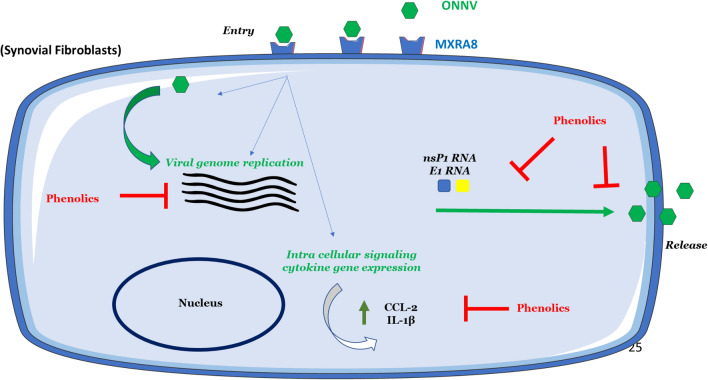
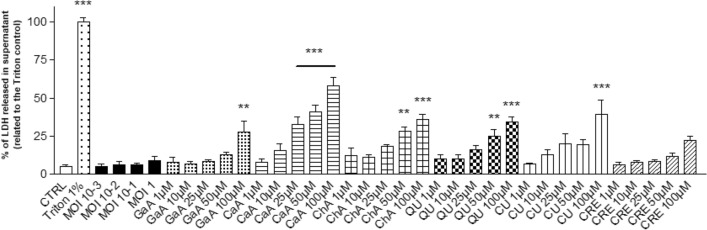
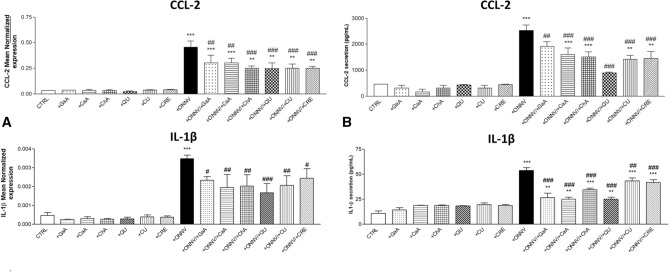
O'nyong-nyong virus is an alphavirus closely related to chikungunya virus, causing arthralgia, rash and fever. Alphaviruses mainly target synovial fibroblasts and persists in the joints of patients, possibly leading to chronic arthritis. To date, no specific antiviral treatment is available for ONNV infection and induced-inflammation. Primary human synovial fibroblasts cells were used to assess infection by ONNV and the resulting cytokine responses. Phenolics (gallic acid, caffeic acid and chlorogenic acid, curcumin and quercetin) and a curcuminoids-rich extract from turmeric were tested for their antiviral and anti-inflammatory capacities. We showed that infection occurred in HSF cells and increased gene expression and protein secretion of two major proinflammatory CCL-2 and IL-1β markers. In ONNV-infected HSF cells (MOI 1), we found that non-cytotoxic concentrations of phenolics (10 µM) reduced the level of viral RNA (E1, E2, nsP1, nsP2) and downregulated CCL-2 and IL-1β expression and secretion. These results highlighted the high value of the flavonol quercetin to reduce viral RNA levels and inflammatory status induced by ONNV in HSF cells.
奥尼永永病毒是一种与基孔肯雅病毒密切相关的甲病毒,可引起关节痛、皮疹和发热。甲病毒主要靶向滑膜成纤维细胞,并在患者的关节中持续存在,可能导致慢性关节炎。迄今为止,尚无针对 ONNV 感染和诱导炎症的特异性抗病毒治疗方法。我们使用原代人滑膜成纤维细胞来评估 ONNV 的感染及其引起的细胞因子反应。我们测试了酚类物质(没食子酸、咖啡酸和绿原酸、姜黄素和槲皮素)以及来自姜黄的富含姜黄素的提取物的抗病毒和抗炎能力。我们发现感染发生在 HSF 细胞中,并增加了两种主要促炎 CCL-2 和 IL-1β标志物的基因表达和蛋白分泌。在感染 ONNV 的 HSF 细胞(MOI 1)中,我们发现非细胞毒性浓度的酚类物质(10 μM)降低了病毒 RNA(E1、E2、nsP1、nsP2)的水平,并下调了 CCL-2 和 IL-1β的表达和分泌。这些结果突出了类黄酮槲皮素在降低 HSF 细胞中由 ONNV 诱导的病毒 RNA 水平和炎症状态方面的高价值。