Mouritzen Michelle V, Petkovic Marija, Qvist Katrine, Poulsen Steen S, Alarico Susana, Leal Ermelindo C, Dalgaard Louise T, Empadinhas Nuno, Carvalho Eugenia, Jenssen Håvard
Department of Science and Environment, Roskilde University, Roskilde, Denmark.
Center for Neuroscience and Cell Biology, University of Coimbra, Coimbra, Portugal.
Mol Ther Methods Clin Dev. 2021 Feb 15;20:726-739. doi: 10.1016/j.omtm.2021.02.008. eCollection 2021 Mar 12.
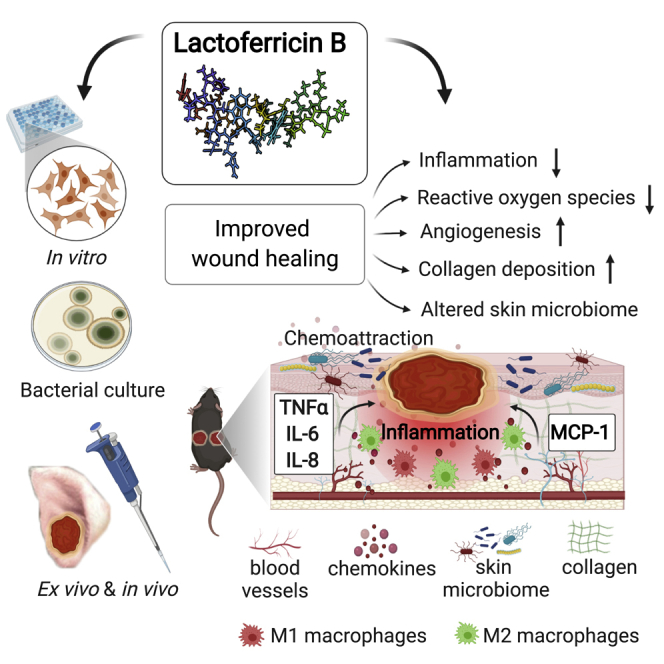
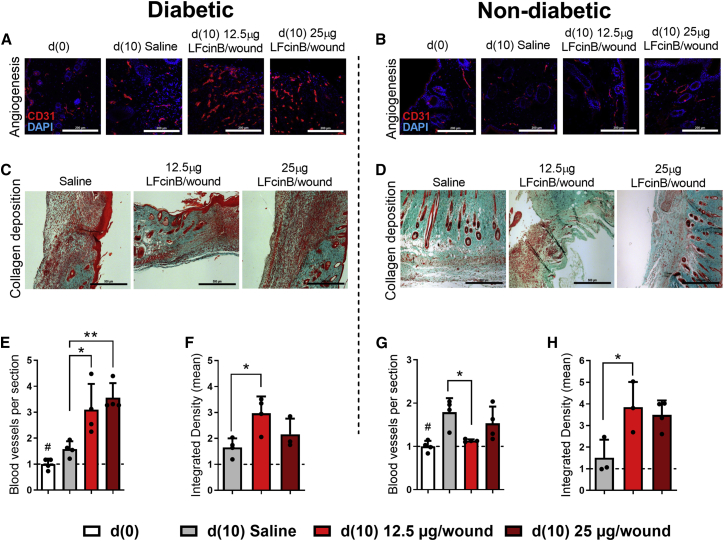
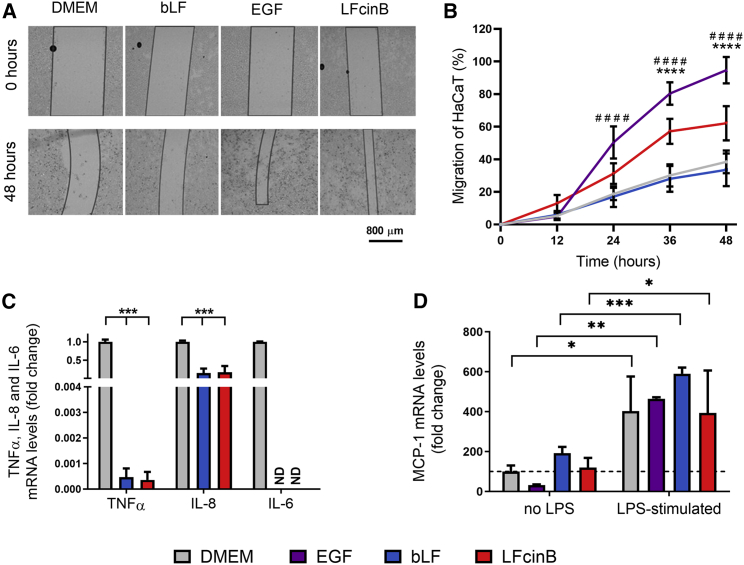
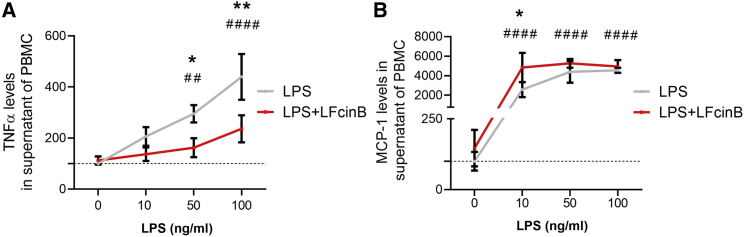
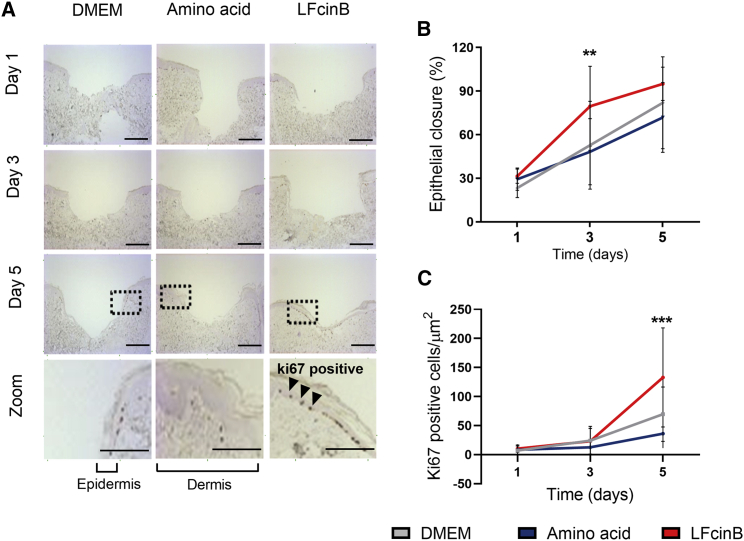
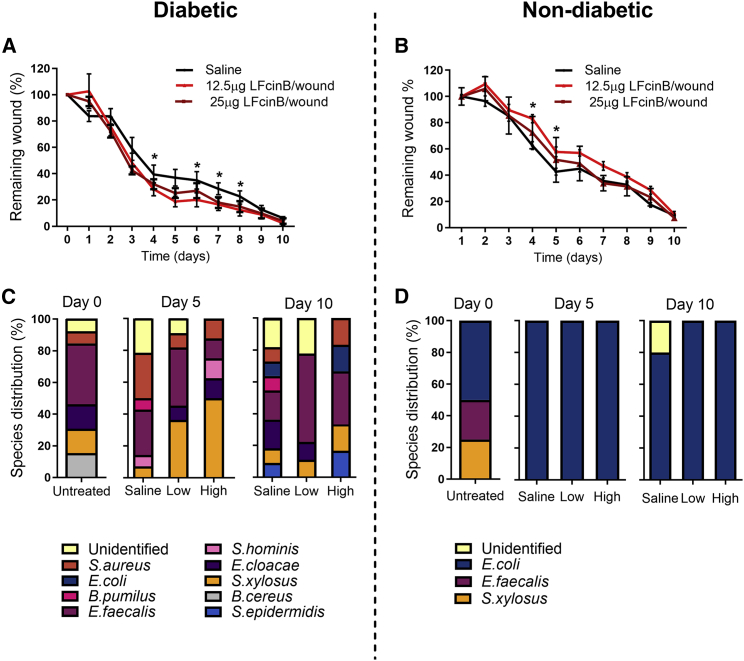
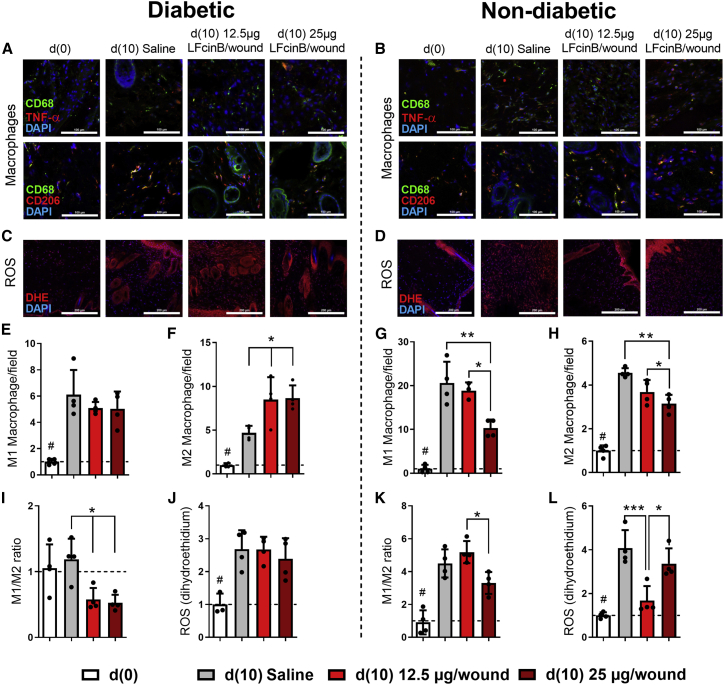
Bovine lactoferricin (LFcinB) has antimicrobial and immunomodulatory properties; however, the effects on diabetic wound healing remain poorly understood. The wound healing potential of LFcinB was investigated with , , and models. Cell migration and proliferation were tested on keratinocytes and on porcine ears. A type 1 diabetic mouse model was also used to evaluate wound healing kinetics, bacterial diversity patterns, and the effect of LFcinB on oxidative stress, macrophage phenotype, angiogenesis, and collagen deposition. LFcinB increased keratinocyte migration (p < 0.05) and (p < 0.001) and improved wound healing in diabetic mice (p < 0.05), though not in normoglycemic control mice. In diabetic mouse wounds, LFcinB treatment led to the eradication of a decrease in , and an increase in the prevalence. LFcinB increased angiogenesis in diabetic mice (p < 0.01), but this was decreased in control mice (p < 0.05). LFcinB improved collagen deposition in both diabetic and control mice (p < 0.05). Both oxidative stress and the M1-to-M2 macrophage ratios were decreased in LFcinB-treated wounds of diabetic animals (p < 0.001 and p < 0.05, respectively) compared with saline, suggesting a downregulation of inflammation in diabetic wounds. In conclusion, LFcinB treatment demonstrated noticeable positive effects on diabetic wound healing.
牛乳铁蛋白肽(LFcinB)具有抗菌和免疫调节特性;然而,其对糖尿病伤口愈合的影响仍知之甚少。本研究使用[具体模型1]、[具体模型2]和[具体模型3]模型研究了LFcinB的伤口愈合潜力。在角质形成细胞和猪耳上测试了细胞迁移和增殖情况。还使用1型糖尿病小鼠模型评估伤口愈合动力学、细菌多样性模式以及LFcinB对氧化应激、巨噬细胞表型、血管生成和胶原蛋白沉积的影响。LFcinB可增加角质形成细胞迁移(p<0.05)和[具体指标2](p<0.001),并改善糖尿病小鼠的伤口愈合(p<0.05),但对血糖正常的对照小鼠无此作用。在糖尿病小鼠伤口中,LFcinB治疗导致[细菌种类1]的根除、[具体细菌指标2]的减少以及[具体细菌种类3]患病率的增加。LFcinB可增加糖尿病小鼠的血管生成(p<0.01),但在对照小鼠中则降低(p<0.05)。LFcinB可改善糖尿病和对照小鼠的胶原蛋白沉积(p<0.05)。与生理盐水相比,在糖尿病动物经LFcinB治疗的伤口中,氧化应激和M1与M2巨噬细胞比例均降低(分别为p<0.001和p<0.05),这表明糖尿病伤口中的炎症得到了下调。总之,LFcinB治疗对糖尿病伤口愈合显示出显著的积极作用。