Key Laboratory for Cell and Gene Engineering of Zhejiang Province, Institute of Genetics and Regenerative Biology, College of Life Sciences, Zhejiang University, Zhejiang, 310058, Hangzhou, China.
BMC Plant Biol. 2021 Mar 19;21(1):145. doi: 10.1186/s12870-021-02922-w.
Barley is known to be recalcitrant to tissue culture, which hinders genetic transformation and its biotechnological application. To date, the ideal explant for transformation remains limited to immature embryos; the mechanism underlying embryonic callus formation is elusive.
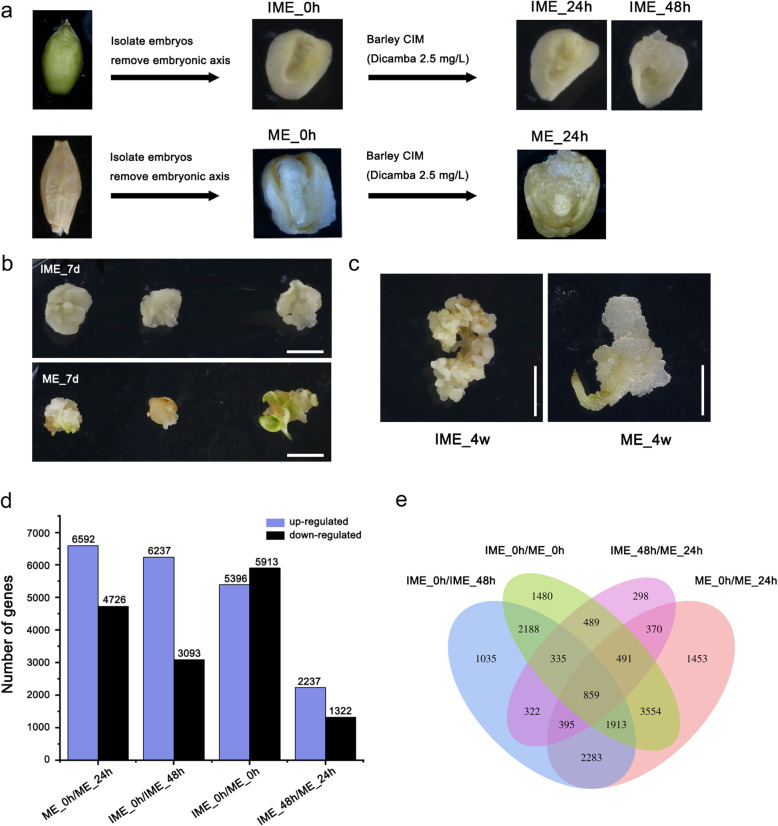
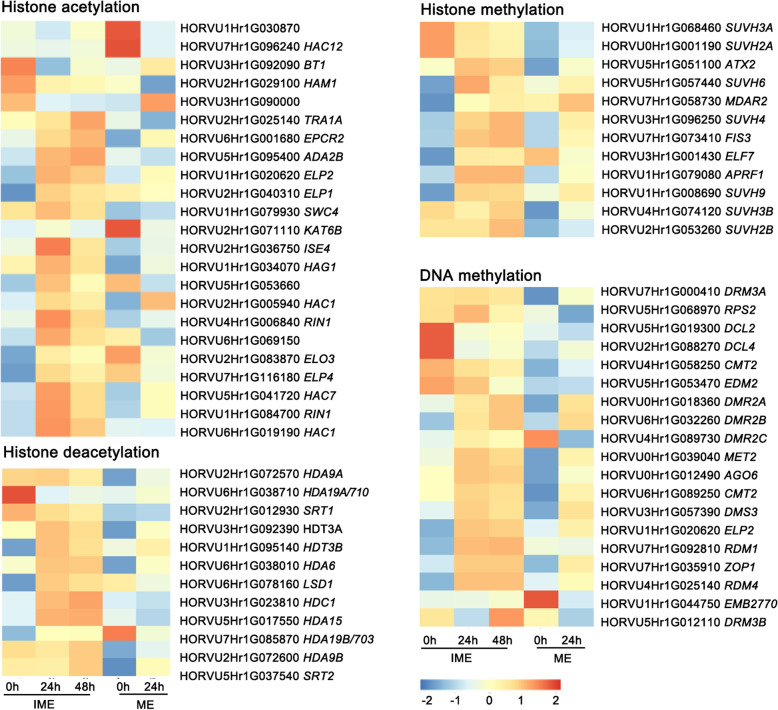
This study aimed to uncover the different transcription regulation pathways between calli formed from immature (IME) and mature (ME) embryos through transcriptome sequencing. We showed that incubation of embryos in an auxin-rich medium caused dramatic changes in gene expression profiles within 48 h. Overall, 9330 and 11,318 differentially expressed genes (DEGs) were found in the IME and ME systems, respectively. 3880 DEGs were found to be specific to IME_0h/IME_48h, and protein phosphorylation, regulation of transcription, and oxidative-reduction processes were the most common gene ontology categories of this group. Twenty-three IAA, fourteen ARF, eight SAUR, three YUC, and four PIN genes were found to be differentially expressed during callus formation. The effect of callus-inducing medium (CIM) on IAA genes was broader in the IME system than in the ME system, indicating that auxin response participates in regulating cell reprogramming during callus formation. BBM, LEC1, and PLT2 exhibited a significant increase in expression levels in the IME system but were not activated in the ME system. WUS showed a more substantial growth trend in the IME system than in the ME system, suggesting that these embryonic, shoot, and root meristem genes play crucial roles in determining the acquisition of competency. Moreover, epigenetic regulators, including SUVH3A, SUVH2A, and HDA19B/703, exhibited differential expression patterns between the two induction systems, indicating that epigenetic reprogramming might contribute to gene expression activation/suppression in this process. Furthermore, we examined the effect of ectopic expression of HvBBM and HvWUS on Agrobacterium-mediated barley transformation. The transformation efficiency in the group expressing the PLTPpro:HvBBM + Axig1pro:HvWUS construct was increased by three times that in the control (empty vector) because of enhanced plant regeneration capacity.
We identified some regulatory factors that might contribute to the differential responses of the two explants to callus induction and provide a promising strategy to improve transformation efficiency in barley.
众所周知,大麦对组织培养具有抗性,这阻碍了其遗传转化及其生物技术应用。迄今为止,转化的理想外植体仍然仅限于未成熟胚胎;胚胎愈伤组织形成的机制尚不清楚。
本研究旨在通过转录组测序揭示未成熟(IME)和成熟(ME)胚胎形成的愈伤组织之间不同的转录调控途径。我们表明,在富含生长素的培养基中孵育胚胎会在 48 小时内引起基因表达谱的剧烈变化。总体而言,在 IME 和 ME 系统中分别发现了 9330 和 11318 个差异表达基因(DEG)。发现 3880 个 DEG 仅在 IME_0h/IME_48h 中特异表达,蛋白质磷酸化、转录调控和氧化还原过程是该组最常见的基因本体类别。在愈伤组织形成过程中发现 23 个 IAA、14 个 ARF、8 个 SAUR、3 个 YUC 和 4 个 PIN 基因差异表达。与 ME 系统相比,在 IME 系统中,诱导愈伤组织形成的培养基(CIM)对 IAA 基因的影响更广泛,表明生长素反应参与调节愈伤组织形成过程中的细胞重编程。在 IME 系统中,BBM、LEC1 和 PLT2 的表达水平显著增加,但在 ME 系统中未被激活。在 IME 系统中,WUS 表现出比 ME 系统更显著的生长趋势,表明这些胚胎、芽和根分生组织基因在决定获得能力方面起着关键作用。此外,包括 SUVH3A、SUVH2A 和 HDA19B/703 在内的表观遗传调控因子在两个诱导系统之间表现出不同的表达模式,表明表观遗传重编程可能有助于该过程中基因表达的激活/抑制。此外,我们检查了异位表达 HvBBM 和 HvWUS 对大麦农杆菌介导转化的影响。在表达 PLTPpro:HvBBM + Axig1pro:HvWUS 构建体的组中,由于植物再生能力增强,转化效率比对照(空载体)提高了三倍。
我们鉴定了一些可能有助于两个外植体对愈伤组织诱导产生不同反应的调节因子,并为提高大麦转化效率提供了一种有前景的策略。