Diabetes Research Centre, University of Leicester, Leicester General Hospital, Leicester LE5 4PW, UK.
National Institute for Health Research (NIHR) Leicester Biomedical Research Centre (BRC), Leicester General Hospital, Leicester LE5 4PW, UK.
Eur J Public Health. 2021 Jul 13;31(3):630-634. doi: 10.1093/eurpub/ckab041.
People from South Asian and black minority ethnic groups are disproportionately affected by the COVID-19 pandemic. It is unknown whether deprivation mediates this excess ethnic risk.
We used UK Biobank with linked COVID-19 outcomes occurring between 16th March 2020 and 24th August 2020. A four-way decomposition mediation analysis was used to model the extent to which the excess risk of testing positive, severe disease and mortality for COVID-19 in South Asian and black individuals, relative to white individuals, would be eliminated if levels of high material deprivation were reduced within the population.
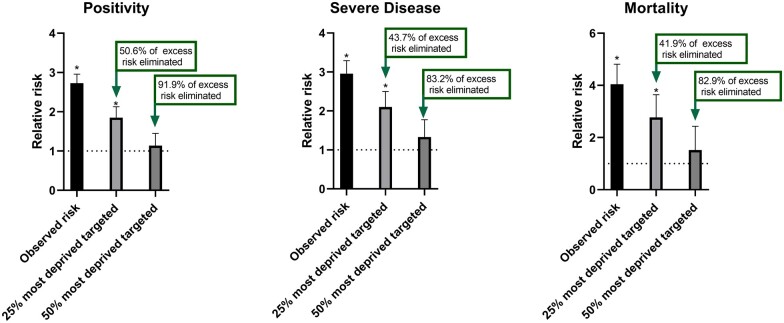
We included 15 044 (53.0% women) South Asian and black and 392 786 (55.2% women) white individuals. There were 151 (1.0%) positive tests, 91 (0.6%) severe cases and 31 (0.2%) deaths due to COVID-19 in South Asian and black individuals compared with 1471 (0.4%), 895 (0.2%) and 313 (0.1%), respectively, in white individuals. Compared with white individuals, the relative risk of testing positive for COVID-19, developing severe disease and COVID-19 mortality in South Asian and black individuals were 2.73 (95% CI: 2.26, 3.19), 2.96 (2.31, 3.61) and 4.04 (2.54, 5.55), respectively. A hypothetical intervention moving the 25% most deprived in the population out of deprivation was modelled to eliminate between 40 and 50% of the excess risk of all COVID-19 outcomes in South Asian and black populations, whereas moving the 50% most deprived out of deprivation would eliminate over 80% of the excess risk of COVID-19 outcomes.
The excess risk of COVID-19 outcomes in South Asian and black communities could be substantially reduced with population level policies targeting material deprivation.
南亚和少数族裔人群(黑人群体)受到 COVID-19 大流行的不成比例影响。尚不清楚贫困是否会加剧这种族间的风险。
我们使用英国生物库(UK Biobank),其中包含 2020 年 3 月 16 日至 2020 年 8 月 24 日期间发生的与 COVID-19 相关的结果。采用四项分解中介分析,对南亚裔和黑人群体相对于白人个体,其 COVID-19 检测阳性、严重疾病和死亡率的超额风险,如果降低人群中的高度物质贫困水平,其风险消除的程度进行建模。
共纳入了 15044 名(53.0%为女性)南亚裔和黑人群体以及 392786 名(55.2%为女性)白人群体。南亚裔和黑人群体中,COVID-19 阳性检测、严重病例和 COVID-19 死亡的人数分别为 151 例(1.0%)、91 例(0.6%)和 31 例(0.2%),而白人群体中,这些数字分别为 1471 例(0.4%)、895 例(0.2%)和 313 例(0.1%)。与白人个体相比,南亚裔和黑人群体 COVID-19 检测阳性、发生严重疾病和 COVID-19 死亡率的相对风险分别为 2.73(95%CI:2.26,3.19)、2.96(2.31,3.61)和 4.04(2.54,5.55)。假设干预措施将人群中最贫困的 25%的人移出贫困,那么南亚裔和黑人群体所有 COVID-19 结局的超额风险可减少 40%至 50%,而将最贫困的 50%的人移出贫困,可消除 COVID-19 结局的超额风险的 80%以上。
通过针对物质贫困的人群政策,南亚裔和黑人群体 COVID-19 结局的超额风险可大幅降低。