Zhang Da, Lin Ziguo, Wu Ming, Cai Zhixiong, Zheng Youshi, He Lei, Li Zhenli, Zhou Jie, Sun Liqin, Chen Geng, Zeng Yongyi, Li Juan, Liu Jingfeng, Yang Huanghao, Liu Xiaolong
The United Innovation of Mengchao Hepatobiliary Technology Key Laboratory of Fujian Province Mengchao Hepatobiliary Hospital of Fujian Medical University Fuzhou 350025 P. R. China.
The Key Lab of Analysis and Detection Technology for Food Safety of the MOE, Fujian Provincial Key Laboratory of Analysis and Detection Technology for Food Safety, College of Chemistry Fuzhou University Fuzhou 350002 P. R. China.
Adv Sci (Weinh). 2021 Jan 29;8(6):2003504. doi: 10.1002/advs.202003504. eCollection 2021 Mar.
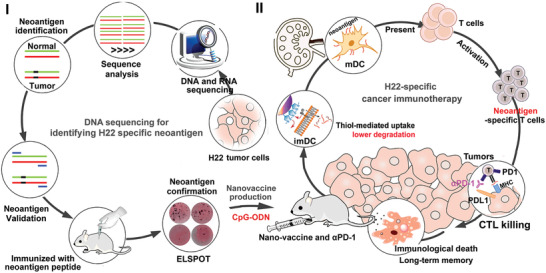
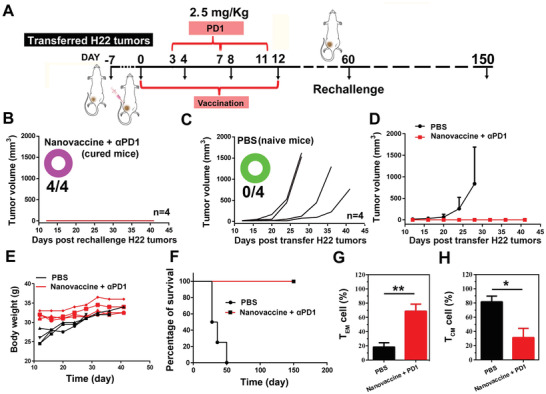
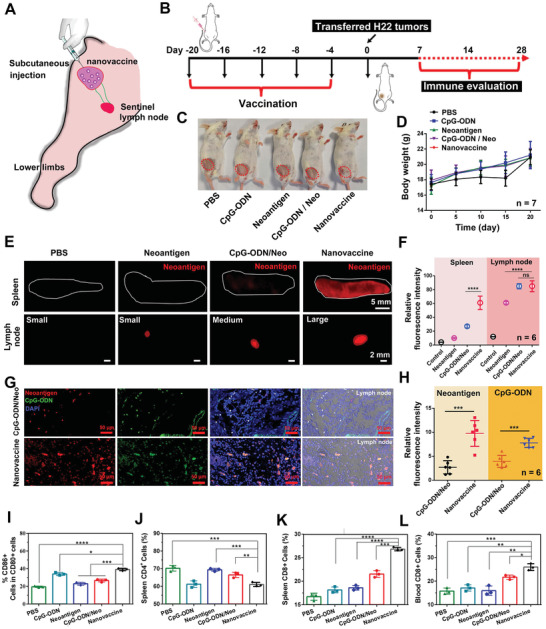
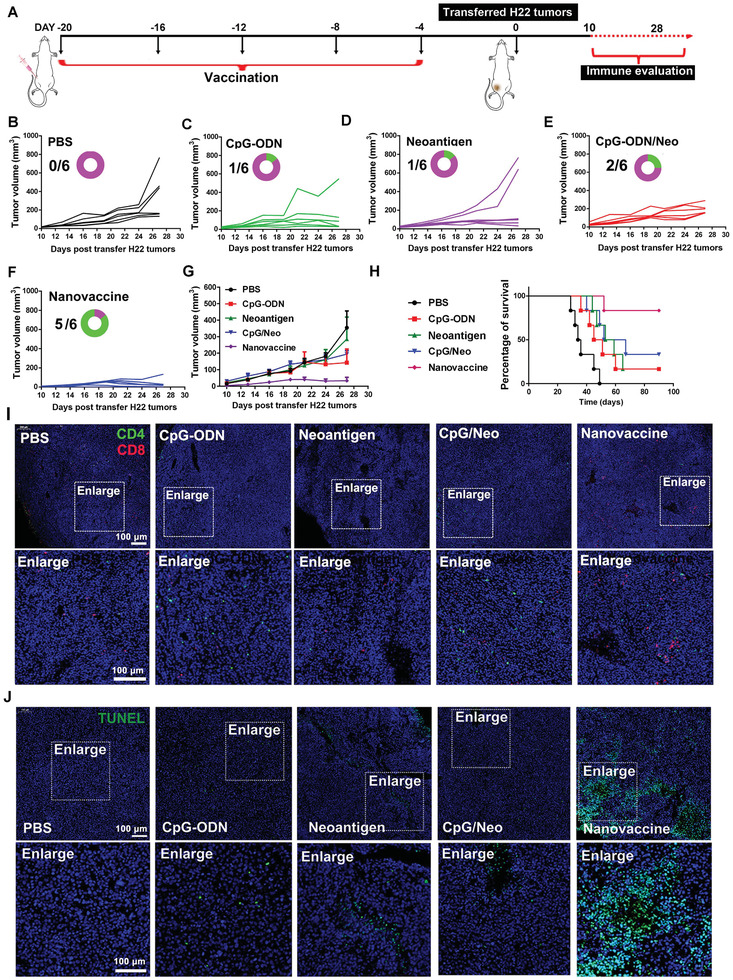
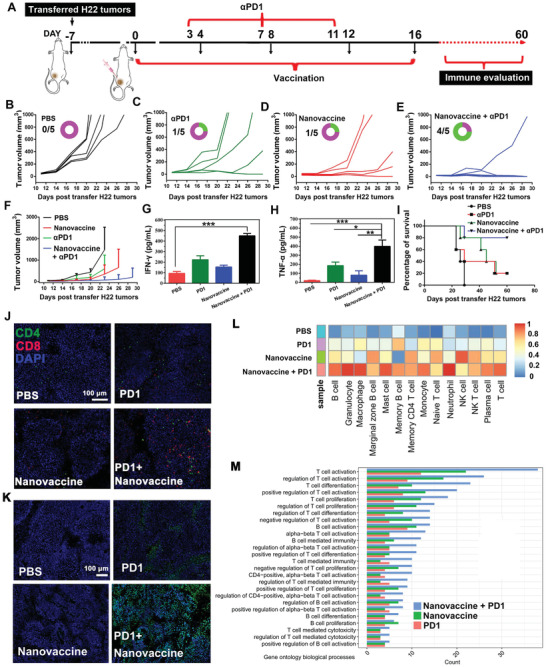
Although tumor-specific neoantigen-based cancer vaccines hold tremendous potential, it still faces low cross-presentation associated with severe degradation via endocytosis pathway. Herein, a thiolated nano-vaccine allowing direct cytosolic delivery of neoantigen and Toll like receptor 9 agonist CpG-ODN is developed. This approach is capable of bypassing the endo-/lysosome degradation, increasing uptake and local concentration of neoantigen and CpG-ODN to activate antigen-presenting cells, significantly strengthening the anti-cancer T-cell immunity. In vivo immunization with thiolated nano-vaccine enhanced the lymph organ homing and promoted the antigen presentation on dendritic cells, effectively inhibited tumor growth, and significantly prolonged the survival of H22-bearing mice. Strikingly, further combination of the thiolated nano-vaccine with anti-programmed cell death protein-1 antibody (PD-1) could efficiently reverse immunosuppression and enhance response rate of tumors, which led to enhanced tumor elimination, complete prevention of tumor re-challenge, and long-term survival above 150 d. Collectively, a versatile methodology to design cancer vaccines for strengthening anti-cancer T-cell immunity in solid tumors is presented, which could be further remarkably enhanced by combining with immune checkpoint inhibitors.
尽管基于肿瘤特异性新抗原的癌症疫苗具有巨大潜力,但它仍面临与通过内吞途径严重降解相关的低交叉呈递问题。在此,开发了一种硫醇化纳米疫苗,可直接将新抗原和Toll样受体9激动剂CpG-ODN递送至细胞质。这种方法能够绕过内体/溶酶体降解,增加新抗原和CpG-ODN的摄取和局部浓度以激活抗原呈递细胞,显著增强抗癌T细胞免疫。用硫醇化纳米疫苗进行体内免疫可增强淋巴器官归巢并促进树突状细胞上的抗原呈递,有效抑制肿瘤生长,并显著延长荷H22小鼠的生存期。引人注目的是,硫醇化纳米疫苗与抗程序性细胞死亡蛋白1抗体(PD-1)的进一步联合可有效逆转免疫抑制并提高肿瘤反应率,从而增强肿瘤清除能力,完全预防肿瘤再次攻击,并实现超过150天的长期生存。总的来说,本文提出了一种设计癌症疫苗以增强实体瘤中抗癌T细胞免疫的通用方法,通过与免疫检查点抑制剂联合可进一步显著增强其效果。