Amsterdam University Medical Centers, University of Amsterdam, Department of Public and Occupational Health, Amsterdam Public Health Research Institute, Amsterdam, Netherlands.
Department of Dermatology and Allergology, Amsterdam University Medical Centers, Amsterdam, Netherlands.
Front Public Health. 2021 Mar 4;9:602933. doi: 10.3389/fpubh.2021.602933. eCollection 2021.
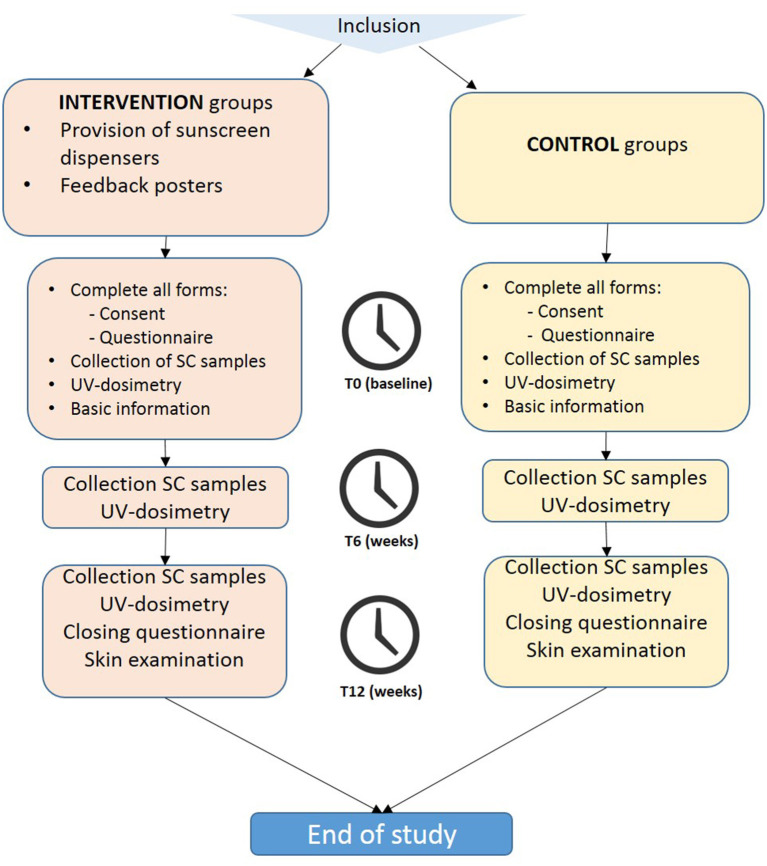
Non-melanoma skin cancer (NMSC) incidence is increasing, and occupational solar exposure contributes greatly to the overall lifetime ultraviolet radiation (UVR) dose. This is reflected in an excess risk of NMSC showing up to three-fold increase in outdoor workers. Risk of NMSC can be reduced if appropriate measures to reduce UVR-exposure are taken. Regular use of sunscreens showed reduced risk of NMSC. However, sun-safety behavior in outdoor workers is poor. The objective of this study is to investigate the effectiveness of an intervention aiming at increasing sunscreen use by construction workers. This non-randomized controlled intervention study is comprised of two intervention and two control groups recruited at four different construction sites in the Netherlands. The study population comprises ~200 construction workers, aged 18 years or older, followed during 12 weeks. The intervention consists of providing dispensers with sunscreens (SPF 50+) at construction sites and regular feedback on the application achieved by continuous electronic monitoring. All groups will receive basic information on UV-exposure and skin protection. Stratum corneum (SC) samples will be collected for measurement of biomarkers to assess internal UV-dose. External UV-dose will be assessed by personal UV-sensors worn by the workers during work-shifts in both groups. To detect presence of actinic keratosis (AK) or NMSC, a skin check of body parts exposed to the sun will be performed at the end of the study. The effect of the intervention will be assessed from data on self-reported sunscreen use by means of questionnaires collected on baseline and after 12 weeks of intervention (primary outcome). Levels of SC biomarkers of internal UV-dose, external UV-dose, number of sunburn episodes, and prevalence of NMSC including AK will be assessed as secondary outcomes. The electronically monitored sunscreen consumption will be assessed as process outcome. This study is intended to provide evidence of the effectiveness of a technology-driven intervention to increase sunscreen use in outdoor construction workers. Furthermore, it will increase insight in the UV-protective behavior, external and internal UV-exposure, and the prevalence of NMSC, including AK, in construction workers. The Netherlands Trial Register (NTR): NL8462 Registered on March 19, 2020.
非黑色素瘤皮肤癌(NMSC)的发病率正在上升,职业性太阳照射对人体终生紫外线辐射(UVR)剂量的影响很大。这反映在户外工作者中 NMSC 的风险增加了两倍。如果采取适当的措施减少 UVR 暴露,NMSC 的风险可以降低。经常使用防晒霜可降低 NMSC 的风险。然而,户外工作者的防晒行为很差。本研究的目的是调查一项旨在增加建筑工人使用防晒霜的干预措施的效果。这项非随机对照干预研究包括在荷兰四个不同建筑工地招募的两个干预组和两个对照组。研究人群包括约 200 名年龄在 18 岁或以上的建筑工人,在 12 周内进行随访。干预措施包括在建筑工地提供防晒霜(SPF50+)分配器,并通过连续电子监测对应用情况进行定期反馈,以了解防晒霜的使用情况。所有组都将获得有关紫外线暴露和皮肤保护的基本信息。将采集角质层(SC)样本,以测量生物标志物来评估内部 UVR 剂量。通过在两组工人工作时佩戴的个人紫外线传感器评估外部 UVR 剂量。为了检测光化性角化病(AK)或 NMSC 的存在,将在研究结束时对暴露于阳光的身体部位进行皮肤检查。通过在基线和干预 12 周后收集的问卷评估自我报告的防晒霜使用情况来评估干预效果(主要结果)。将评估内部 UVR 剂量、外部 UVR 剂量、晒伤次数的 SC 生物标志物水平以及包括 AK 在内的 NMSC 的患病率作为次要结果。将评估电子监控的防晒霜消耗情况作为过程结果。本研究旨在提供证据证明一种技术驱动的干预措施可有效增加户外建筑工人使用防晒霜。此外,它将增加对户外建筑工人的紫外线防护行为、外部和内部紫外线暴露以及 NMSC(包括 AK)的患病率的了解。荷兰试验注册库(NTR):NL8462 于 2020 年 3 月 19 日注册。