Wang Yi, Chen Yinhao, Zhu Bingye, Ma Limin, Xing Qianwei
Department of Urology, Affiliated Hospital of Nantong University, Nantong, China.
Front Mol Biosci. 2021 Mar 4;8:567730. doi: 10.3389/fmolb.2021.567730. eCollection 2021.
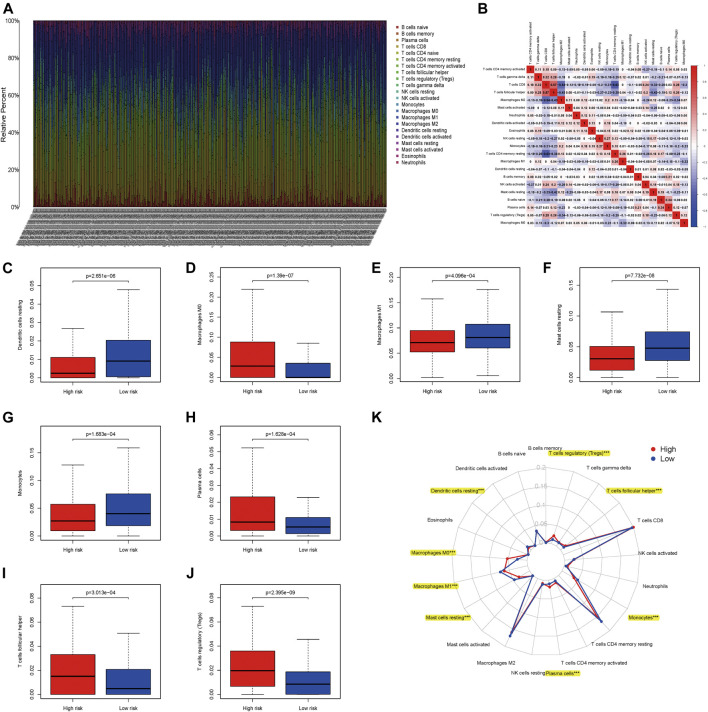
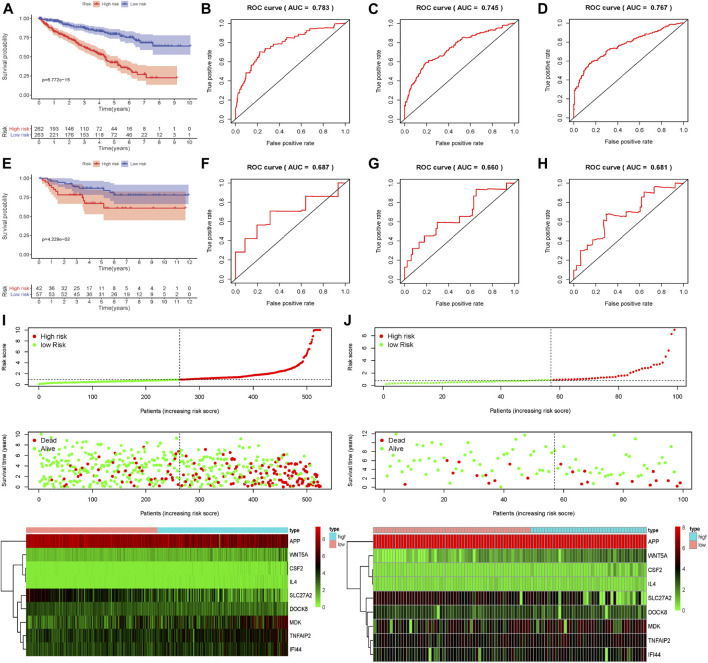
This study was designed to establish a sensitive prognostic model based on apoptosis-related genes to predict overall survival (OS) in patients with clear cell renal cell carcinoma (ccRCC). Obtaining the expression of apoptosis-related genes and associated clinical parameters from online datasets (The Cancer Genome Atlas, TCGA), their biological function analyses were performed through differently expressed genes. By means of LASSO, unadjusted and adjusted Cox regression analyses, this predictive signature was constructed and validated by internal and external databases (both TCGA and ArrayExpress). A total of nine apoptosis-related genes (SLC27A2, TNFAIP2, IFI44, CSF2, IL4, MDK, DOCK8, WNT5A, APP) were ultimately screened as associated hub genes and utilized to construct a prognosis model. Then our constructed riskScore model significantly passed the validation in both the internal and external datasets of OS (all < 0.05) and verified their expressions by qRT-PCR. Moreover, we conducted the Receiver Operating Characteristic (ROC), finding the area under the ROC curves (AUCs) were all above 0.70 which indicated that riskScore was a stable independent prognostic factor ( < 0.05). Furthermore, prognostic nomograms were established to figure out the relationship between 1-, 3- and 5-year OS and individual parameters for ccRCC patients. Additionally, survival analyses indicated that our riskScore worked well in predicting OS in subgroups of age, gender, grade, stage, T, M, N0, White (all < 0.05), except for African, Asian and N1 ( > 0.05). We also explored its association with immune infiltration and applied cMap database to seek out highly correlated small molecule drugs. Our study successfully constructed a prognostic model containing nine hub apoptosis-related genes for ccRCC, helping clinicians predict patients' OS and making the prognostic assessment more standardized. Future prospective studies are required to validate our findings.
本研究旨在建立一种基于凋亡相关基因的敏感预后模型,以预测透明细胞肾细胞癌(ccRCC)患者的总生存期(OS)。从在线数据集(癌症基因组图谱,TCGA)获取凋亡相关基因的表达及相关临床参数,通过差异表达基因进行其生物学功能分析。借助LASSO、未校正和校正的Cox回归分析,构建了该预测特征,并通过内部和外部数据库(TCGA和ArrayExpress)进行验证。最终筛选出9个凋亡相关基因(SLC27A2、TNFAIP2、IFI44、CSF2、IL4、MDK、DOCK8、WNT5A、APP)作为相关枢纽基因,并用于构建预后模型。然后,我们构建的风险评分模型在OS的内部和外部数据集中均显著通过验证(均P<0.05),并通过qRT-PCR验证了它们的表达。此外,我们进行了受试者工作特征(ROC)分析,发现ROC曲线下面积(AUC)均高于0.70,这表明风险评分是一个稳定的独立预后因素(P<0.05)。此外,还建立了预后列线图,以明确ccRCC患者1年、3年和5年OS与个体参数之间的关系。此外,生存分析表明,我们的风险评分在预测年龄、性别、分级、分期、T、M、N0、白人亚组的OS方面效果良好(均P<0.05),但在非洲人、亚洲人和N1亚组中效果不佳(P>0.05)。我们还探讨了其与免疫浸润的关联,并应用cMap数据库寻找高度相关的小分子药物。我们的研究成功构建了一个包含9个枢纽凋亡相关基因的ccRCC预后模型,有助于临床医生预测患者的OS,并使预后评估更加标准化。未来需要进行前瞻性研究来验证我们的发现。