Van Vertloo Laura R, Carnevale Joyce M, Parsons Rebecca L, Rosburg Meghann, Millman Suzanne T
Department of Veterinary Clinical Sciences, Iowa State University, Ames, IA, United States.
Department of Veterinary Diagnostic and Production Animal Medicine, Iowa State University, Ames, IA, United States.
Front Vet Sci. 2021 Mar 5;8:640751. doi: 10.3389/fvets.2021.640751. eCollection 2021.
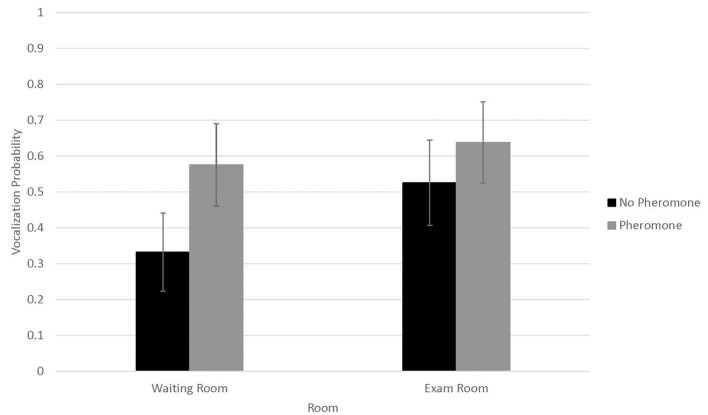
Obtaining accurate blood pressure measurements in cats is challenging due to the stressful nature of clinic visits. The objective of this study was to evaluate the effects of veterinary clinic waiting experiences and a feline pheromone spray on blood pressure in the cat. We hypothesized that reduced stress associated with bypassing the waiting room and use of synthetic feline facial pheromone (FFP) spray would result in lower blood pressure. A 2 × 2 factorial design involved two rooms and two FFP treatments. Thirty-nine healthy adult cats were recruited and were systematically assigned to four treatment combinations administered over four visits in 2016 and 2017. Cats were kept in the hospital waiting room or were taken directly to the exam room, with or without FFP treatment. All cats were then acclimated to the exam room for an additional 10 min, where vocalizations were recorded manually, before blood pressure measurements were collected using Doppler ultrasonography. Data were analyzed using generalized linear mixed models, with room × FFP interaction, visit, sex, and trial year in the model. There was no significant effect of waiting room by FFP interaction on blood pressure ( = 0.95). Mean blood pressure was significantly higher at visit 1 than visits 2 and 4 ( < 0.01), but higher at visit 3 than visit 2 ( = 0.02). Mean blood pressure was higher in males ( = 0.01), and males were more likely to be categorized as borderline hypertensive/hypertensive or severely hypertensive ( = 0.01). Number of vocalizations was significantly associated with waiting room by FFP interactions ( < 0.01), with fewer vocalizations associated with bypassing the waiting room and when FFP was provided. In conclusion, although we found some behavioral evidence supporting stress reduction when feline patients bypass the waiting room and are provided with FFP, these interventions did not result in lower blood pressure in a clinical setting.
由于临床就诊时的应激特性,在猫身上获得准确的血压测量值具有挑战性。本研究的目的是评估兽医诊所等待经历和猫用信息素喷雾对猫血压的影响。我们假设,绕过候诊室以及使用合成猫面部信息素(FFP)喷雾所带来的应激减轻会导致血压降低。一个2×2析因设计涉及两个房间和两种FFP处理。招募了39只健康成年猫,并在2016年和2017年分四次就诊将它们系统地分配到四种处理组合中。猫被安置在医院候诊室或直接被带到检查室,接受或不接受FFP处理。然后让所有猫在检查室再适应10分钟,在此期间人工记录发声情况,之后使用多普勒超声收集血压测量值。使用广义线性混合模型对数据进行分析,模型中纳入房间×FFP交互作用、就诊次数、性别和试验年份。FFP交互作用对候诊室的血压没有显著影响(P = 0.95)。第1次就诊时的平均血压显著高于第2次和第4次就诊(P < 0.01),但第3次就诊时高于第2次就诊(P = 0.02)。雄性猫的平均血压更高(P = 0.01),并且雄性猫更有可能被归类为临界高血压/高血压或重度高血压(P = 0.01)。发声次数与候诊室×FFP交互作用显著相关(P < 0.01),绕过候诊室以及提供FFP时发声次数较少。总之,尽管我们发现了一些行为学证据支持猫科患者绕过候诊室并接受FFP时应激减轻,但在临床环境中这些干预措施并未导致血压降低。