Li Jennifer, Palmer Gracie, Shankar Suraj, Villwock Mark R, Chiu Alexander G, Sykes Kevin J, Villwock Jennifer A
Department of Otolaryngology, University of Kansas Medical Center, Kansas City, Kansas, USA.
OTO Open. 2020 Oct 13;4(4):2473974X20962464. doi: 10.1177/2473974X20962464. eCollection 2020 Oct-Dec.
To further demonstrate the validity of Affordable Rapid Olfaction Measurement Array (AROMA), an essential oil-based smell test, and compare it to the Sniffin' Sticks 12 Test (SST12).
Prospective cross-sectional study.
Academic medical center.
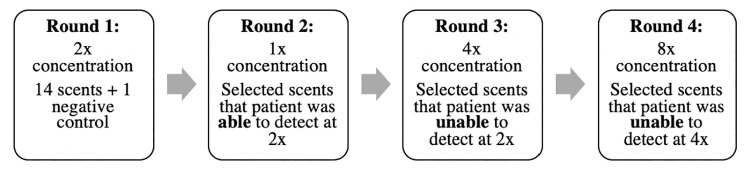
Fifty healthy individuals without sinonasal disease were recruited to the study. AROMA has been previously validated against the University of Pennsylvania Smell Identification Test. The current study tests 2 additional higher concentrations to increase the ability to detect olfactory reserve. Healthy participants completed AROMA, SST12, Sino-Nasal Outcome Test (SNOT-22), and Questionnaire of Olfactory Disorders (QoD). Spearman correlations were used to evaluate AROMA, SST, SNOT-22, and QoD.
AROMA demonstrated strong test-retest reliability ( = 0.757, < .01). AROMA showed a moderate correlation to SST12 (ρ = 0.412, < .01). Age and SNOT-22 were significantly correlated ( < .05) with AROMA (ρ = -0.547, -0.331, respectively), and age was weakly correlated with SST (ρ = -0.377, < .01). Median percent correct scores were as follows: SST12 identification, 92%; AROMA detection, 90%; and AROMA identification, 81%. Median correct odor identification of AROMA concentrations at 1×, 2×, 4×, and 8× were 64%, 75%, 92%, and 92%, respectively.
AROMA has a moderate correlation with SST12. AROMA is more strongly correlated than SST12 to age and SNOT-22. AROMA's stronger correlation with subjective olfactory status, low cost, and adaptability may help remove barriers to routine olfactory testing in the clinic.
进一步证明基于精油的嗅觉测试——经济适用快速嗅觉测量阵列(AROMA)的有效性,并将其与嗅觉棒12项测试(SST12)进行比较。
前瞻性横断面研究。
学术医疗中心。
招募50名无鼻鼻窦疾病的健康个体参与研究。AROMA先前已针对宾夕法尼亚大学嗅觉识别测试进行了验证。本研究测试了另外两种更高浓度,以提高检测嗅觉储备的能力。健康参与者完成了AROMA、SST12、鼻鼻窦结局测试(SNOT - 22)和嗅觉障碍问卷(QoD)。采用Spearman相关性分析来评估AROMA、SST、SNOT - 22和QoD。
AROMA显示出较强的重测信度( = 0.757, <.01)。AROMA与SST12呈中度相关(ρ = 0.412, <.01)。年龄和SNOT - 22与AROMA显著相关( <.05)(ρ分别为 - 0.547和 - 0.331),年龄与SST呈弱相关(ρ = - 0.377, <.01)。正确得分百分比中位数如下:SST12识别为92%;AROMA检测为90%;AROMA识别为81%。AROMA浓度为1×、2×、4×和8×时的正确气味识别中位数分别为64%、75%、92%和92%。
AROMA与SST12呈中度相关。AROMA与年龄和SNOT - 22的相关性比SST12更强。AROMA与主观嗅觉状态更强的相关性、低成本及适应性可能有助于消除临床常规嗅觉测试的障碍。