Max Planck Institute for Dynamics of Complex Technical Systems, Sandtorstraße 1, 39106, Magdeburg, Germany.
Institute for Chemical, Environmental and Bioscience Engineering, Research Area Biochemical Engineering, Technische Universität Wien, Gumpendorfer Straße 1a, 1060, Vienna, Austria.
Microb Cell Fact. 2021 Mar 9;20(1):63. doi: 10.1186/s12934-021-01554-x.
The alcohol 2,3-butanediol (2,3-BDO) is an important chemical and an Escherichia coli producer strain was recently engineered for bio-based production of 2,3-BDO. However, further improvements are required for realistic applications.
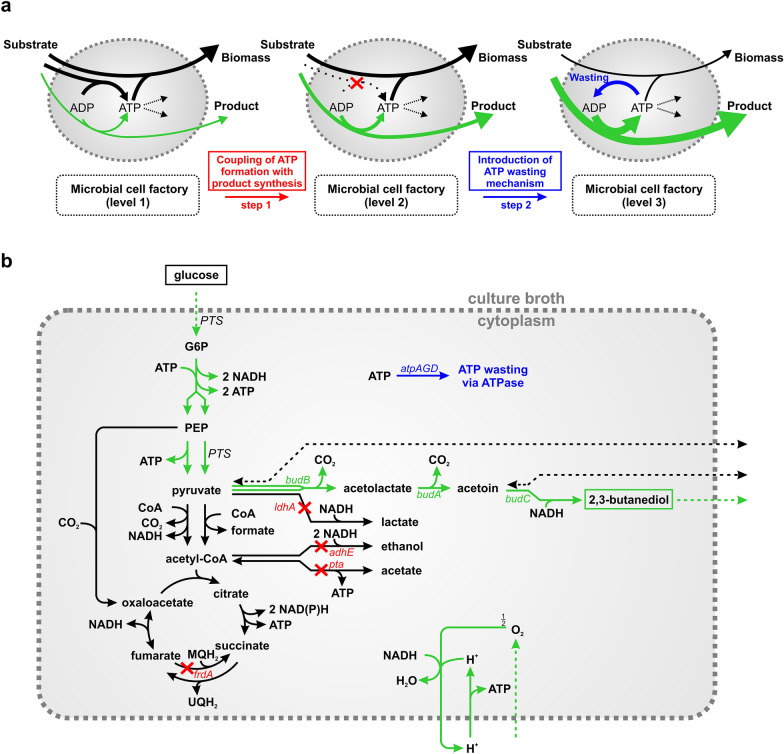
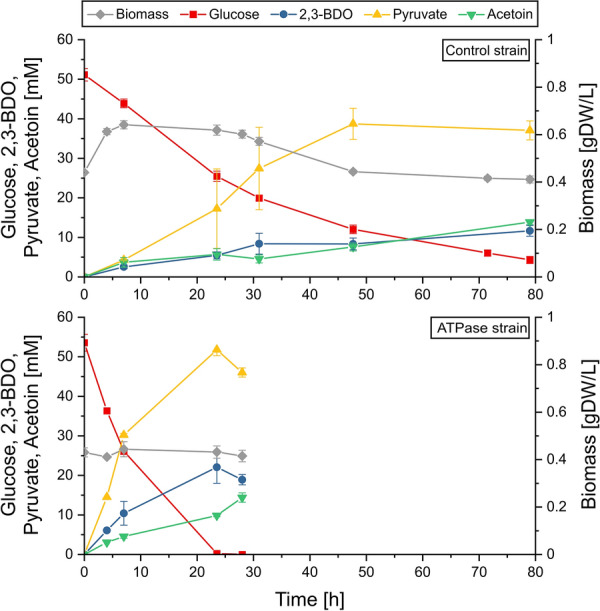
Here we report that enforced ATP wasting, implemented by overexpressing the genes of the ATP-hydrolyzing F-part of the ATPase, leads to significant increases of yield and especially of productivity of 2,3-BDO synthesis in an E. coli producer strain under various cultivation conditions. We studied aerobic and microaerobic conditions as well as growth-coupled and growth-decoupled production scenarios. In all these cases, the specific substrate uptake and 2,3-BDO synthesis rate (up to sixfold and tenfold higher, respectively) were markedly improved in the ATPase strain compared to a control strain. However, aerobic conditions generally enable higher productivities only with reduced 2,3-BDO yields while high product yields under microaerobic conditions are accompanied with low productivities. Based on these findings we finally designed and validated a three-stage process for optimal conversion of glucose to 2,3-BDO, which enables a high productivity in combination with relatively high yield. The ATPase strain showed again superior performance and finished the process twice as fast as the control strain and with higher 2,3-BDO yield.
Our results demonstrate the high potential of enforced ATP wasting as a generic metabolic engineering strategy and we expect more applications to come in the future.
酒精 2,3-丁二醇(2,3-BDO)是一种重要的化学物质,最近已经对大肠杆菌进行了工程改造,以用于生物基生产 2,3-BDO。然而,为了实现实际应用,还需要进一步改进。
在这里,我们报告说,通过过表达 ATP 水解 F 部分的基因来强制消耗 ATP,可导致在各种培养条件下,大肠杆菌生产菌株中 2,3-BDO 合成的产率和特别是生产率有显著提高。我们研究了需氧和微需氧条件以及生长偶联和生长解偶联的生产方案。在所有这些情况下,与对照菌株相比,ATP 酶菌株的特定底物摄取和 2,3-BDO 合成速率(分别提高了六倍和十倍)明显提高。然而,在需氧条件下,通常只能通过降低 2,3-BDO 产率来获得更高的生产率,而在微需氧条件下获得高产率则伴随着低生产率。基于这些发现,我们最终设计并验证了一种三阶段工艺,用于葡萄糖到 2,3-BDO 的最佳转化,该工艺可在结合相对较高产率的情况下实现高生产率。ATP 酶菌株再次表现出优异的性能,完成该过程的速度比对照菌株快两倍,并且 2,3-BDO 的产率更高。
我们的结果表明,强制消耗 ATP 可作为一种通用的代谢工程策略具有很高的潜力,我们预计未来会有更多的应用。