Salje Henrik, Wesolowski Amy, Brown Tyler S, Kiang Mathew V, Berry Irina Maljkovic, Lefrancq Noemie, Fernandez Stefan, Jarman Richard G, Ruchusatsawat Kriangsak, Iamsirithaworn Sopon, Vandepitte Warunee P, Suntarattiwong Piyarat, Read Jonathan M, Klungthong Chonticha, Thaisomboonsuk Butsaya, Engø-Monsen Kenth, Buckee Caroline, Cauchemez Simon, Cummings Derek A T
Department of Genetics, University of Cambridge, Cambridge, UK.
Mathematical Modelling of Infectious Diseases Unit, Institut Pasteur, CNRS, UMR, 2000, Paris, France.
Nat Commun. 2021 Mar 22;12(1):1810. doi: 10.1038/s41467-021-21888-9.
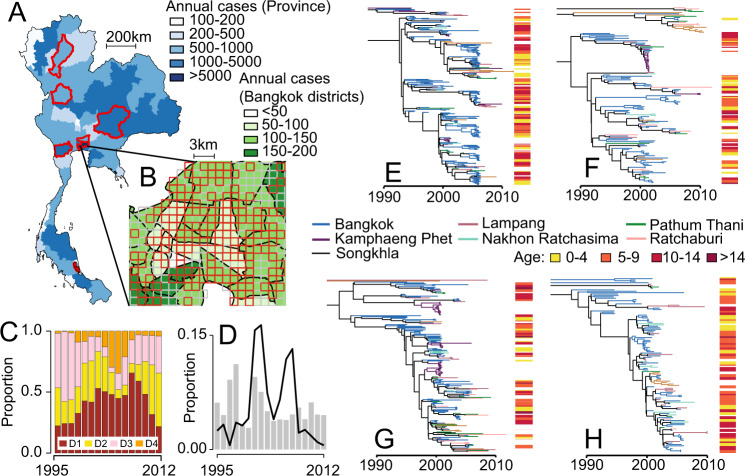
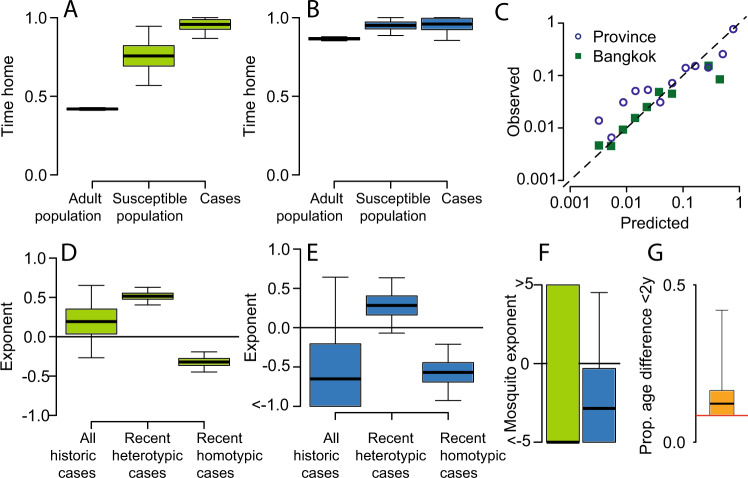
For most pathogens, transmission is driven by interactions between the behaviours of infectious individuals, the behaviours of the wider population, the local environment, and immunity. Phylogeographic approaches are currently unable to disentangle the relative effects of these competing factors. We develop a spatiotemporally structured phylogenetic framework that addresses these limitations by considering individual transmission events, reconstructed across spatial scales. We apply it to geocoded dengue virus sequences from Thailand (N = 726 over 18 years). We find infected individuals spend 96% of their time in their home community compared to 76% for the susceptible population (mainly children) and 42% for adults. Dynamic pockets of local immunity make transmission more likely in places with high heterotypic immunity and less likely where high homotypic immunity exists. Age-dependent mixing of individuals and vector distributions are not important in determining spread. This approach provides previously unknown insights into one of the most complex disease systems known and will be applicable to other pathogens.
对于大多数病原体而言,传播是由感染个体的行为、更广泛人群的行为、当地环境以及免疫力之间的相互作用驱动的。系统发育地理学方法目前无法厘清这些相互竞争因素的相对影响。我们开发了一个时空结构化的系统发育框架,通过考虑跨空间尺度重建的个体传播事件来解决这些局限性。我们将其应用于来自泰国的地理编码登革热病毒序列(18年间共726个序列)。我们发现,与易感人群(主要是儿童)的76%和成年人的42%相比,感染个体96%的时间都待在其所在社区。局部免疫的动态区域使得在异型免疫力高的地方传播更有可能发生,而在同型免疫力高的地方则不太可能发生。个体的年龄依赖性混合以及病媒分布在决定传播方面并不重要。这种方法为已知最复杂的疾病系统之一提供了前所未有的见解,并且将适用于其他病原体。