Lampinen Björn, Lätt Jimmy, Wasselius Johan, van Westen Danielle, Nilsson Markus
Clinical Sciences Lund, Medical Radiation Physics, Lund University, Lund, Sweden.
Center for Medical Imaging and Physiology, Skåne University Hospital Lund, Lund, Sweden.
Magn Reson Med. 2021 Aug;86(2):754-764. doi: 10.1002/mrm.28743. Epub 2021 Mar 23.
Reperfusion therapy enables effective treatment of ischemic stroke presenting within 4-6 hours. However, tissue progression from ischemia to infarction is variable, and some patients benefit from treatment up until 24 hours. Improved imaging techniques are needed to identify these patients. Here, it was hypothesized that time dependence in diffusion MRI may predict tissue outcome in ischemic stroke.
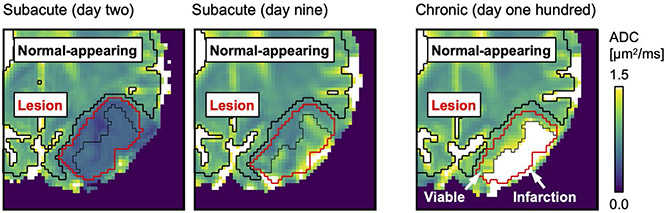
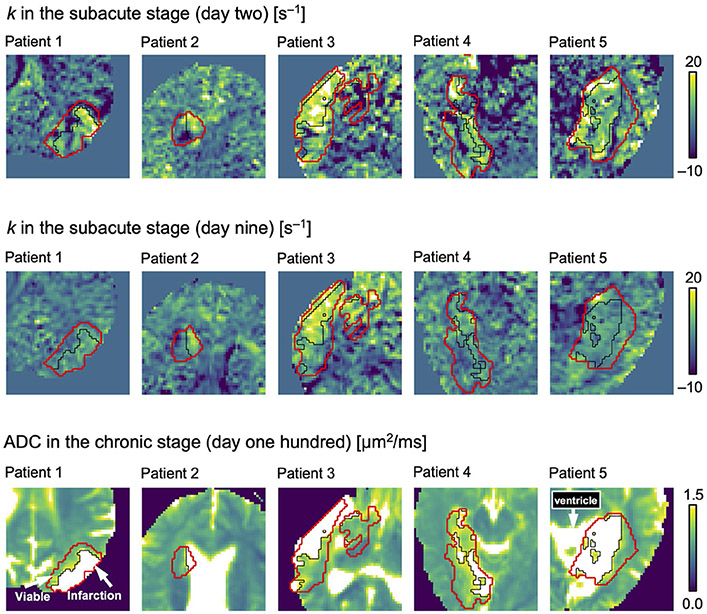
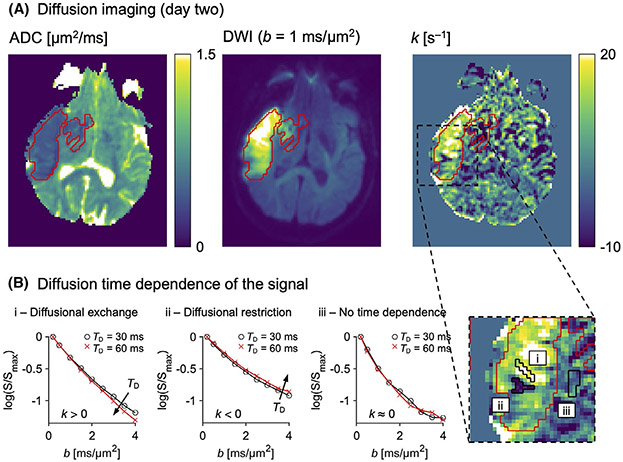
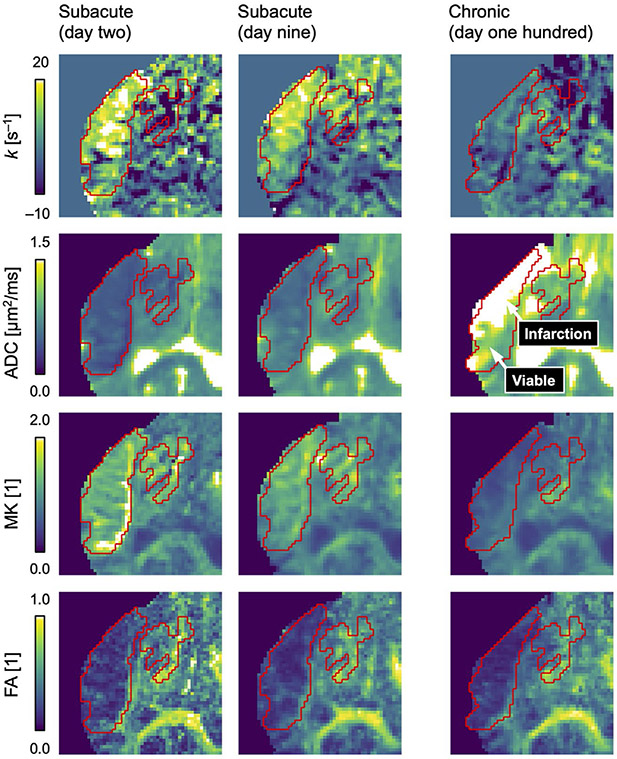
Diffusion MRI data were acquired with multiple diffusion times in five non-reperfused patients at 2, 9, and 100 days after stroke onset. Maps of "rate of kurtosis change" (k), mean kurtosis, ADC, and fractional anisotropy were derived. The ADC maps defined lesions, normal-appearing tissue, and the lesion tissue that would either be infarcted or remain viable by day 100. Diffusion parameters were compared (1) between lesions and normal-appearing tissue, and (2) between lesion tissue that would be infarcted or remain viable.
Positive values of k were observed within stroke lesions on day 2 (P = .001) and on day 9 (P = .023), indicating diffusional exchange. On day 100, high ADC values indicated infarction of 50 ± 20% of the lesion volumes. Tissue infarction was predicted by high k values both on day 2 (P = .026) and on day 9 (P = .046), by low mean kurtosis values on day 2 (P = .043), and by low fractional anisotropy values on day 9 (P = .029), but not by low ADC values.
Diffusion time dependence predicted tissue outcome in ischemic stroke more accurately than the ADC, and may be useful for predicting reperfusion benefit.
再灌注疗法能够有效治疗发病4 - 6小时内的缺血性卒中。然而,组织从缺血发展到梗死的进程存在差异,部分患者在发病24小时内接受治疗仍可获益。因此需要改进成像技术来识别这些患者。在此,我们假设扩散加权磁共振成像(MRI)中的时间依赖性可以预测缺血性卒中的组织转归。
对5例未接受再灌注治疗的患者在卒中发作后第2天、第9天和第100天进行了多个扩散时间点的扩散加权MRI数据采集。得出了“峰度变化率”(k)、平均峰度、表观扩散系数(ADC)和分数各向异性图。ADC图界定了梗死灶、外观正常的组织以及到第100天时会梗死或仍存活的梗死灶组织。比较了扩散参数:(1)梗死灶与外观正常组织之间;(2)会梗死或仍存活的梗死灶组织之间。
在第2天(P = 0.001)和第9天(P = 0.023)的卒中病灶内观察到k值为正,提示存在扩散交换。在第100天,高ADC值提示梗死灶体积的50±20%发生了梗死。第2天(P = 0.026)和第9天(P = 0.046)的高k值、第2天的低平均峰度值(P = 0.043)以及第9天的低分数各向异性值(P = 0.029)可预测组织梗死,而低ADC值则不能。
扩散时间依赖性比ADC能更准确地预测缺血性卒中的组织转归,可能有助于预测再灌注治疗的获益情况。