Dushoff Jonathan, Park Sang Woo
Department of Biology, McMaster University, Hamilton, Ontario, Canada.
Department of Mathematics and Statistics, McMaster University, Hamilton, Ontario, Canada.
Proc Biol Sci. 2021 Mar 31;288(1947):20201556. doi: 10.1098/rspb.2020.1556. Epub 2021 Mar 24.
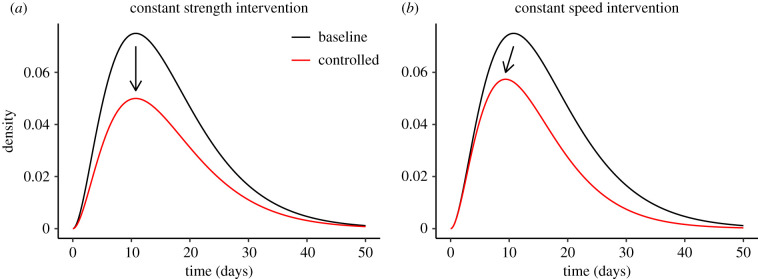
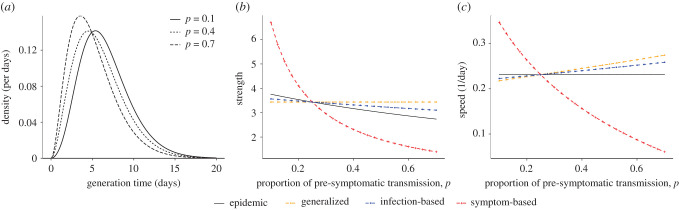
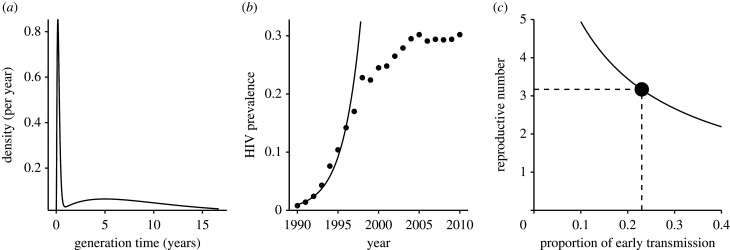
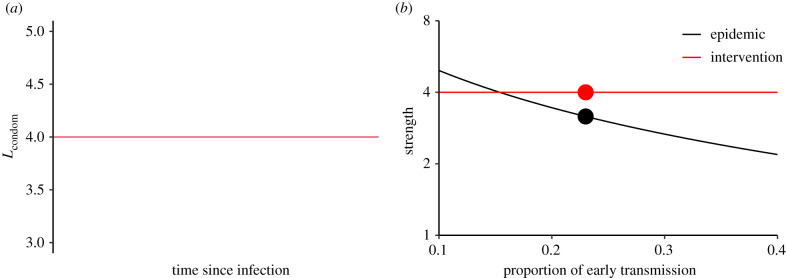
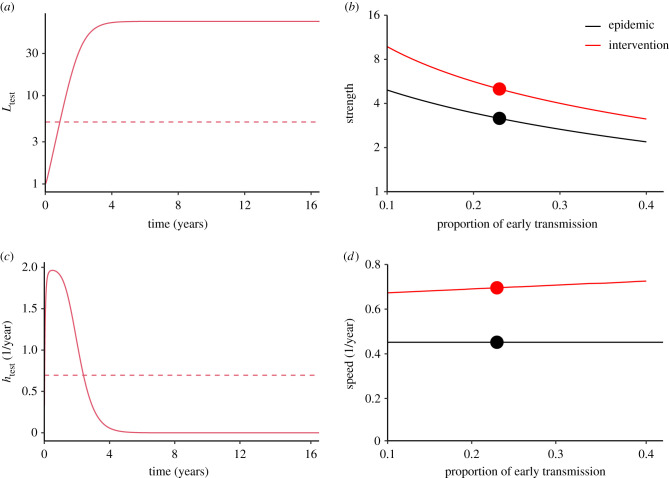
An epidemic can be characterized by its strength (i.e., the reproductive number [Formula: see text]) and speed (i.e., the exponential growth rate ). Disease modellers have historically placed much more emphasis on strength, in part because the effectiveness of an intervention strategy is typically evaluated on this scale. Here, we develop a mathematical framework for the classic, strength-based paradigm and show that there is a dual speed-based paradigm which can provide complementary insights. In particular, we note that = 0 is a threshold for disease spread, just like [Formula: see text] [ 1], and show that we can measure the strength and speed of an intervention on the same scale as the strength and speed of an epidemic, respectively. We argue that, while the strength-based paradigm provides the clearest insight into certain questions, the speed-based paradigm provides the clearest view in other cases. As an example, we show that evaluating the prospects of 'test-and-treat' interventions against the human immunodeficiency virus (HIV) can be done more clearly on the speed than strength scale, given uncertainty in the proportion of HIV spread that happens early in the course of infection. We also discuss evaluating the effects of the importance of pre-symptomatic transmission of the SARS-CoV-2 virus. We suggest that disease modellers should avoid over-emphasizing the reproductive number at the expense of the exponential growth rate, but instead look at these as complementary measures.
一种流行病可以通过其强度(即繁殖数[公式:见正文])和速度(即指数增长率)来表征。历史上,疾病建模者更侧重于强度,部分原因是干预策略的有效性通常在此尺度上进行评估。在此,我们为经典的基于强度的范式建立了一个数学框架,并表明存在一种基于速度的对偶范式,它可以提供互补的见解。特别是,我们注意到 = 0 是疾病传播的一个阈值,就像[公式:见正文][1]一样,并表明我们可以分别在与流行病的强度和速度相同的尺度上衡量干预的强度和速度。我们认为,虽然基于强度的范式能对某些问题提供最清晰的见解,但基于速度的范式在其他情况下能提供最清晰的视角。例如,我们表明,鉴于在感染过程早期发生的艾滋病毒传播比例存在不确定性,在速度而非强度尺度上评估针对人类免疫缺陷病毒(HIV)的“检测与治疗”干预的前景会更清晰。我们还讨论了评估严重急性呼吸综合征冠状病毒2(SARS-CoV-2)病毒症状前传播重要性的影响。我们建议疾病建模者应避免过度强调繁殖数而忽视指数增长率,而应将它们视为互补的度量。