Education and Research Center for Clinical Pharmacy, Kyoto Pharmaceutical University, 5-Nakauchi-cho, Misasagi, Yamashina-ku, Kyoto, 607-8414, Japan.
Department of Pharmacy, Tachibana Medical Corporation Higashisumiyoshi-Morimoto Hospital, Osaka, Japan.
BMC Cancer. 2021 Mar 23;21(1):304. doi: 10.1186/s12885-021-08049-3.
The clinical use of patient-reported outcomes as compared to inflammatory biomarkers for predicting cancer survival remains a challenge in palliative care settings. We evaluated the role of the European Organization for Research and Treatment of Cancer Quality of Life Questionnaire Core 15 Palliative scores (EORTC QLQ-C15-PAL) and the inflammatory biomarkers C-reactive protein (CRP), albumin (Alb), and neutrophil-lymphocyte ratio (NLR) for survival prediction in patients with advanced cancer.
This was an observational study in terminally ill patients with cancer hospitalized in a palliative care unit between June 2018 and December 2019. Patients' data collected at the time of hospitalization were analyzed. Cox regression was performed to examine significant factors influencing survival. A receiver operating characteristic (ROC) analysis was performed to estimate cut-off values for predicting survival within 3 weeks, and a log-rank test was performed to compare survival curves between groups divided by the cut-off values.
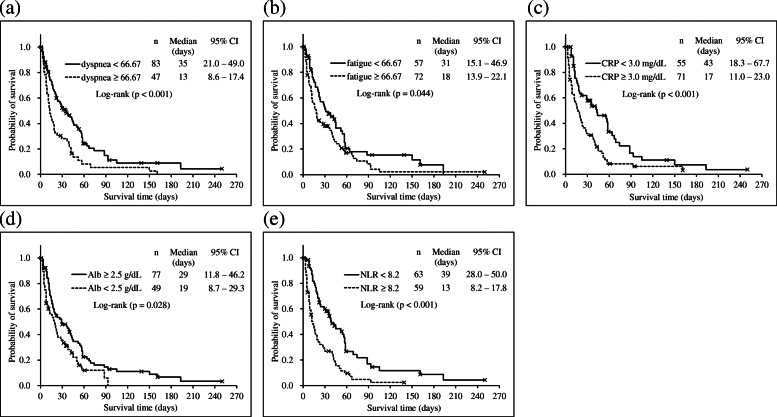
Totally, 130 patients participated in the study. Cox regression suggested that the QLQ-C15-PAL dyspnea and fatigue scores and levels of CRP, Alb, and NLR were significantly associated with survival time, and cut-off values were 66.67, 66.67, 3.0 mg/dL, 2.5 g/dL, and 8.2, respectively. The areas under ROC curves of these variables were 0.6-0.7. There were statistically significant differences in the survival curves between groups categorized using each of these cut-off values (p < .05 for all cases).
Our findings suggest that the assessment of not only objective indicators for the systemic inflammatory response but also patient-reported outcomes using EORTC QLQ-C15-PAL is beneficial for the prediction of short-term survival in terminally ill patients with cancer.
与炎症生物标志物相比,患者报告的结局在预测癌症生存方面在姑息治疗环境中的临床应用仍然是一个挑战。我们评估了欧洲癌症研究与治疗组织生活质量问卷核心 15 项姑息治疗评分(EORTC QLQ-C15-PAL)和炎症生物标志物 C 反应蛋白(CRP)、白蛋白(Alb)和中性粒细胞-淋巴细胞比值(NLR)在晚期癌症患者生存预测中的作用。
这是一项观察性研究,纳入了 2018 年 6 月至 2019 年 12 月期间在姑息治疗病房住院的晚期癌症终末期患者。分析了患者住院时收集的数据。使用 Cox 回归分析检查影响生存的显著因素。进行受试者工作特征(ROC)分析以估计预测 3 周内生存的截断值,并使用对数秩检验比较按截断值划分的组之间的生存曲线。
共有 130 名患者参与了这项研究。Cox 回归表明,QLQ-C15-PAL 呼吸困难和疲劳评分以及 CRP、Alb 和 NLR 水平与生存时间显著相关,截断值分别为 66.67、66.67、3.0mg/dL、2.5g/dL 和 8.2。这些变量的 ROC 曲线下面积为 0.6-0.7。使用这些截断值对每个组进行分类时,生存曲线存在统计学差异(所有情况 p <.05)。
我们的研究结果表明,评估不仅包括系统炎症反应的客观指标,还包括使用 EORTC QLQ-C15-PAL 评估患者报告的结局,这有助于预测晚期癌症患者的短期生存。