Department of Radiology, Stanford University, Stanford, CA, USA.
Department of Informatics, Technical University of Munich, Garching, Germany.
Sci Rep. 2021 Mar 23;11(1):6703. doi: 10.1038/s41598-021-86174-6.
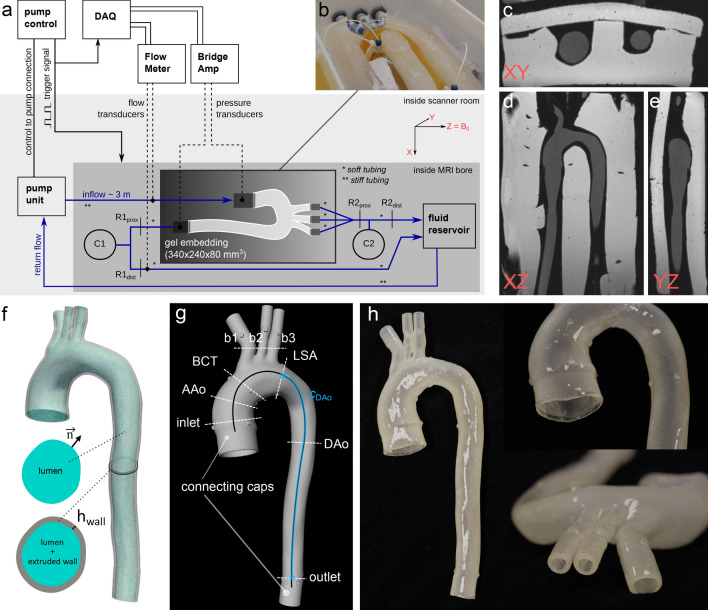
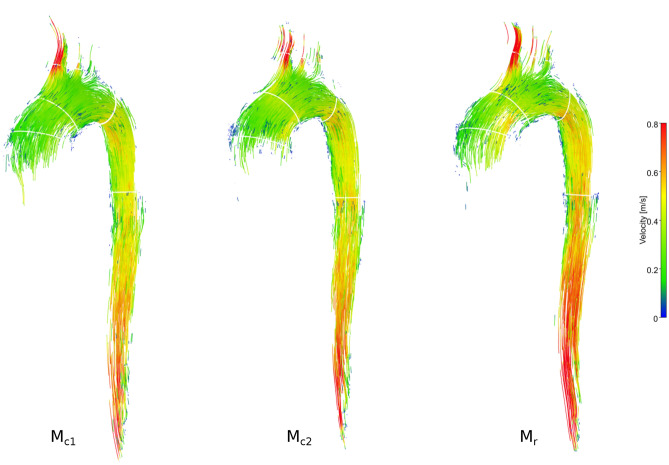
Aortic wall stiffening is a predictive marker for morbidity in hypertensive patients. Arterial pulse wave velocity (PWV) correlates with the level of stiffness and can be derived using non-invasive 4D-flow magnetic resonance imaging (MRI). The objectives of this study were twofold: to develop subject-specific thoracic aorta models embedded into an MRI-compatible flow circuit operating under controlled physiological conditions; and to evaluate how a range of aortic wall stiffness impacts 4D-flow-based quantification of hemodynamics, particularly PWV. Three aorta models were 3D-printed using a novel photopolymer material at two compliant and one nearly rigid stiffnesses and characterized via tensile testing. Luminal pressure and 4D-flow MRI data were acquired for each model and cross-sectional net flow, peak velocities, and PWV were measured. In addition, the confounding effect of temporal resolution on all metrics was evaluated. Stiffer models resulted in increased systolic pressures (112, 116, and 133 mmHg), variations in velocity patterns, and increased peak velocities, peak flow rate, and PWV (5.8-7.3 m/s). Lower temporal resolution (20 ms down to 62.5 ms per image frame) impacted estimates of peak velocity and PWV (7.31 down to 4.77 m/s). Using compliant aorta models is essential to produce realistic flow dynamics and conditions that recapitulated in vivo hemodynamics.
主动脉壁僵硬是高血压患者发病的预测指标。脉搏波速度(PWV)与僵硬程度相关,可以通过非侵入性的 4D 流磁共振成像(MRI)来测量。本研究的目的有两个:一是开发嵌入在 MRI 兼容的流动回路中的特定于个体的胸主动脉模型,该回路在受控的生理条件下运行;二是评估一系列主动脉壁僵硬度如何影响基于 4D 流的血流动力学定量分析,特别是 PWV。三个主动脉模型使用新型光聚合材料通过 3D 打印而成,其顺应性为两种,刚性为一种,并通过拉伸测试进行了表征。对每个模型都进行了内腔压力和 4D 流 MRI 数据采集,并测量了横截面净流量、峰值速度和 PWV。此外,还评估了时间分辨率对所有指标的干扰效应。较硬的模型会导致收缩压升高(112、116 和 133mmHg)、速度模式的变化以及峰值速度、峰值流量和 PWV 增加(5.8-7.3m/s)。较低的时间分辨率(从 20 毫秒降至 62.5 毫秒,每帧图像)会影响峰值速度和 PWV 的估计值(从 7.31 降至 4.77m/s)。使用顺应性主动脉模型对于产生真实的流动动力学和再现体内血液动力学的条件至关重要。