Department of Respiratory Medicine, Taizhou Municipal Hospital, Taizhou, Zhejiang 318000, P.R. China.
Department of Invasive Technology, The First Affiliated Hospital of Wenzhou Medical University, Wenzhou, Zhejiang 325000, P.R. China.
Mol Med Rep. 2021 May;23(5). doi: 10.3892/mmr.2021.12024. Epub 2021 Mar 24.
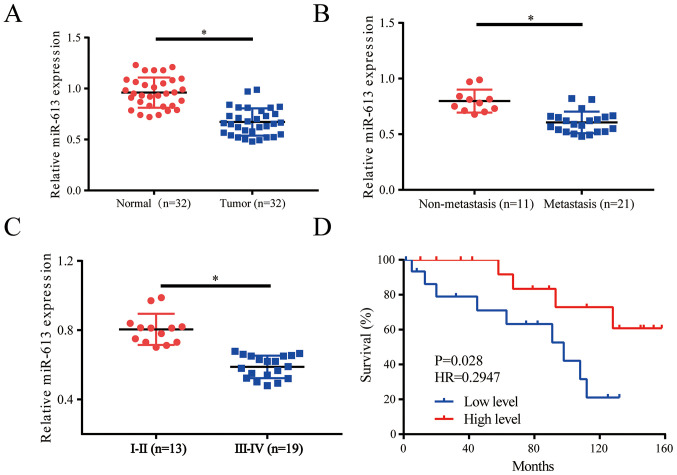
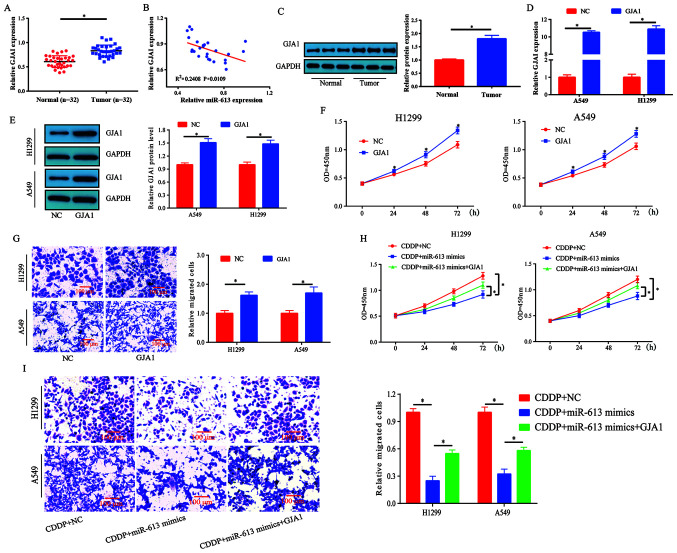
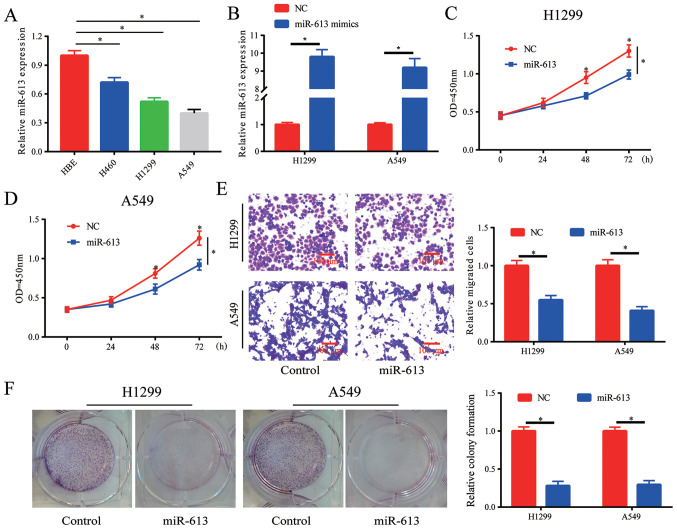
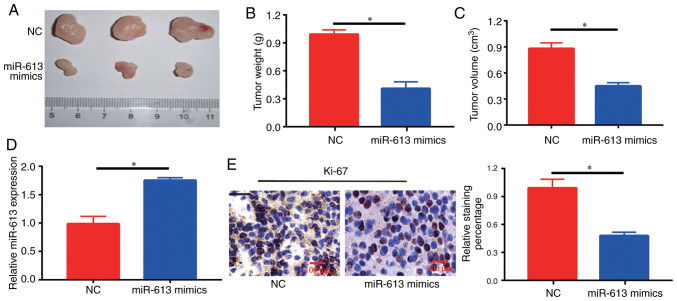
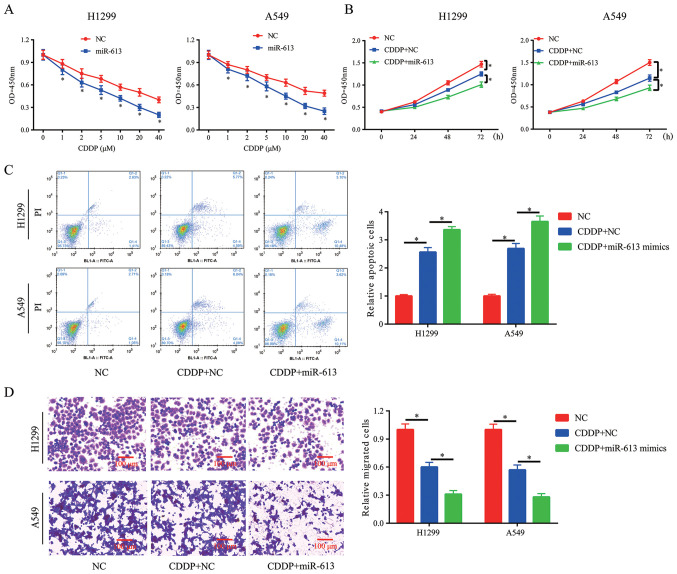
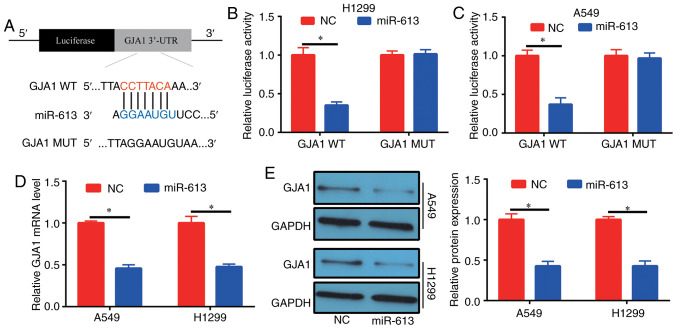
It has been reported that microRNAs (miRs) contribute to several biological functions and are associated with drug resistance in various types of cancer. However, to the best of our knowledge, whether miR‑613 can affect cisplatin (CDDP) sensitivity in non‑small cell lung cancer (NSCLC) remains unknown. Reverse transcription‑quantitative PCR was performed to detect the expression levels of miR‑613 and gap junction α‑1 protein (GJA1) in patients with NSCLC. Cell Counting Kit‑8, colony formation and Transwell assays were employed to exam the effects of miR‑613 and GJA1 on cell functions. Cell apoptosis was analyzed using flow cytometry. An experiment was conducted to determine the influence of miR‑613 on tumor formation. In the present study, miR‑613 was revealed to be significantly downregulated in lung cancer tissues compared with in adjacent normal tissues, and low miR‑613 expression indicated a poor prognosis. Furthermore, cell proliferation, colony formation and migration of lung cancer cells were inhibited by overexpression of miR‑613. experiments also demonstrated that miR‑613 could inhibit tumor growth. Moreover, miR‑613 could enhance the negative effects of CDDP on cell proliferation, apoptosis and migration. GJA1 was revealed to be a target gene of miR‑613 and was upregulated in human lung cancer tissues. Rescue experiments demonstrated that miR‑613 increased the chemosensitivity of lung cancer cells by targeting GJA1. Collectively, the results suggested a tumor suppressor role of miR‑613 in NSCLC and indicated that miR‑613 could strengthen CDDP sensitivity in NSCLC cells by targeting GJA1, which may provide a novel therapeutic target for NSCLC.
据报道,microRNAs(miRs)参与多种生物学功能,并与各种类型癌症的耐药性有关。然而,据我们所知,miR-613 是否能影响非小细胞肺癌(NSCLC)中的顺铂(CDDP)敏感性尚不清楚。采用逆转录定量 PCR 检测 NSCLC 患者中 miR-613 和间隙连接蛋白α-1 蛋白(GJA1)的表达水平。采用细胞计数试剂盒-8、集落形成和 Transwell 检测分析 miR-613 和 GJA1 对细胞功能的影响。采用流式细胞术分析细胞凋亡。进行实验以确定 miR-613 对肿瘤形成的影响。在本研究中,与相邻正常组织相比,肺癌组织中 miR-613 的表达明显下调,低表达 miR-613 表明预后不良。此外,miR-613 的过表达抑制了肺癌细胞的增殖、集落形成和迁移。实验还表明,miR-613 可抑制肿瘤生长。此外,miR-613 可增强 CDDP 对细胞增殖、凋亡和迁移的负性影响。GJA1 被证实是 miR-613 的靶基因,在人类肺癌组织中上调。挽救实验表明,miR-613 通过靶向 GJA1 增加了肺癌细胞的化疗敏感性。综上所述,miR-613 在 NSCLC 中发挥抑癌作用,并表明 miR-613 可通过靶向 GJA1 增强 NSCLC 细胞对 CDDP 的敏感性,这可能为 NSCLC 提供新的治疗靶点。