Institute for Research on Sociology and Economic Inequalities. Department of Social Sciences, University of Luxembourg, Belval Campus, L-4366, Esch-sur-Alzette, Luxembourg.
Centre Maurice Halbwachs, CNRS-ENS-PSL, 48 Boulevard Jourdan, 75014, Paris, France.
BMC Public Health. 2021 Mar 24;21(1):588. doi: 10.1186/s12889-021-10564-8.
Mobility of workers living in one country and working in a different country has increased in the European Union. Exposed to commuting factors, cross-border workers (CBWs) constitute a potential high-risk population. But the relationships between health and commuting abroad are under-documented. Our aims were to: (1) measure the prevalence of the perceived health status and the physical health outcomes (activity limitation, chronic diseases, disability and no leisure activities), (2) analyse their associations with commuting status as well as (3) with income and health index among CBWs.
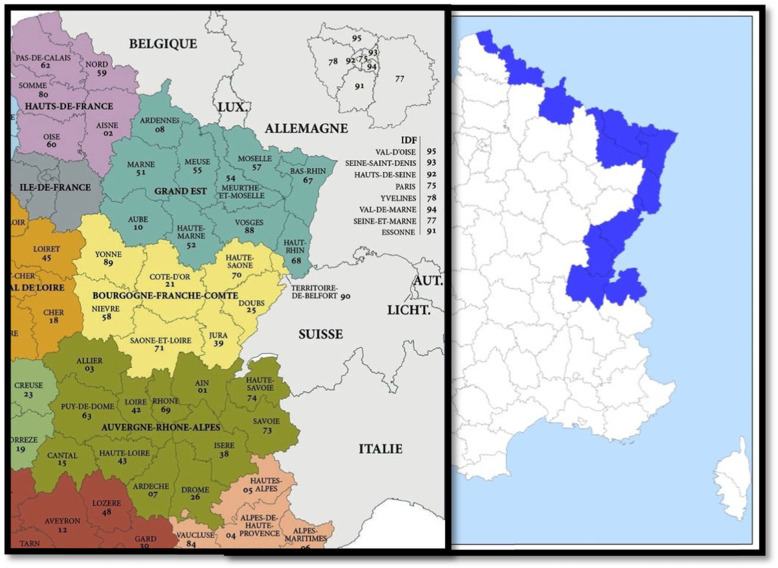
Based on the 'Enquête Emploi', the French cross-sectional survey segment of the European Labour Force Survey (EU LFS), the population was composed of 2,546,802 workers. Inclusion criteria for the samples were aged between 20 and 60 years and living in the French cross-border departments of Germany, Belgium, Switzerland and Luxembourg. The Health Index is an additional measure obtained with five health variables. A logistic model was used to estimate the odds ratios of each group of CBWs, taking non-cross border workers (NCBWs) as the reference group, controlling by demographic background and labour status variables.
A sample of 22,828 observations (2456 CBWs vs. 20,372 NCBWs) was retained. The CBW status is negatively associated with chronic diseases and disability. A marginal improvement of the health index is correlated with a wage premium for both NCBWs and CBWs. Commuters to Luxembourg have the best health outcomes, whereas commuters to Germany the worst.
CBWs are healthier and have more income. Interpretations suggest (1) a healthy cross-border phenomenon steming from a social selection and a positive association between income and the health index is confirmed; (2) the existence of major health disparities among CBWs; and (3) the rejection of the spillover phenomenon assumption for CBWs. The newly founded European Labour Authority (ELA) should take into account health policies as a promising way to support the cross-border mobility within the European Union.
居住在一国、在另一国工作的工人的流动性在欧盟国家增加。跨境工人(CBW)接触通勤因素,构成了一个潜在的高风险人群。但健康与跨境通勤之间的关系尚未得到充分记录。我们的目的是:(1)衡量感知健康状况和身体健康结果(活动受限、慢性病、残疾和无休闲活动)的流行率,(2)分析其与通勤状况的关系,以及(3)分析其与跨境工人的收入和健康指数的关系。
基于法国的横断面调查片段“Enquête Emploi”,即欧洲劳动力调查(EU LFS),该人群由 2546802 名工人组成。样本的纳入标准为年龄在 20 至 60 岁之间,居住在法国与德国、比利时、瑞士和卢森堡接壤的部门。健康指数是通过五个健康变量获得的额外衡量标准。使用逻辑模型来估计每个跨境工人群体的优势比,将非跨境工人(NCBW)作为参考组,控制人口统计学背景和劳动力状况变量。
保留了 22828 次观察的样本(2456 名 CBW 与 20372 名 NCBW)。CBW 身份与慢性病和残疾呈负相关。健康指数的边际改善与 NCBW 和 CBW 的工资溢价相关。前往卢森堡的通勤者健康状况最好,而前往德国的通勤者健康状况最差。
CBW 更健康,收入更高。解释表明(1)存在一种健康的跨境现象,源于社会选择,并且收入与健康指数之间存在正相关;(2)跨境工人之间存在重大健康差距;(3)拒绝假设 CBW 存在溢出效应。新成立的欧洲劳工局(ELA)应将健康政策纳入考虑范围,作为支持欧盟内部跨境流动的一种有前途的方式。