MMWR Morb Mortal Wkly Rep. 2021 Mar 26;70(12):409-414. doi: 10.15585/mmwr.mm7012a1.
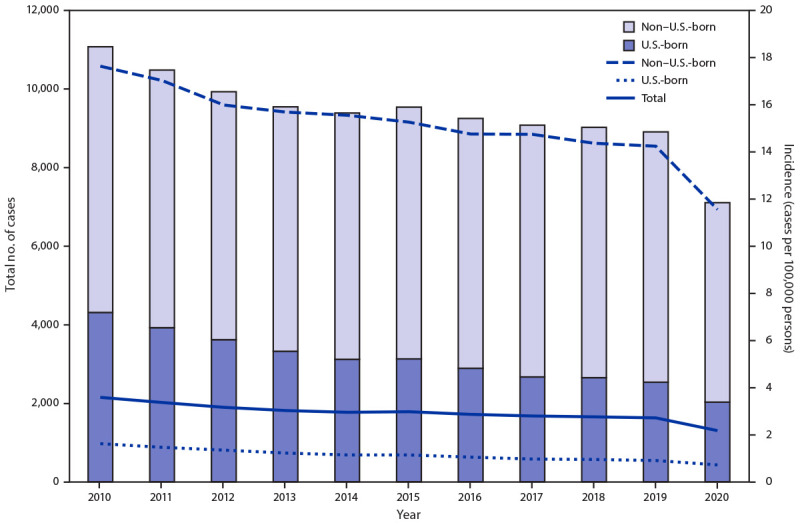
Tuberculosis (TB) disease incidence has decreased steadily since 1993 (1), a result of decades of work by local TB programs to detect, treat, and prevent TB disease and transmission. During 2020, a total of 7,163 TB cases were provisionally reported to CDC's National Tuberculosis Surveillance System (NTSS) by the 50 U.S. states and the District of Columbia (DC), a relative reduction of 20%, compared with the number of cases reported during 2019.* TB incidence per 100,000 persons was 2.2 during 2020, compared with 2.7 during 2019. Since 2010, TB incidence has decreased by an average of 2%-3% annually (1). Pandemic mitigation efforts and reduced travel might have contributed to the reported decrease. The magnitude and breadth of the decrease suggest potentially missed or delayed TB diagnoses. Health care providers should consider TB disease when evaluating patients with signs and symptoms consistent with TB (e.g., cough of >2 weeks in duration, unintentional weight loss, and hemoptysis), especially when diagnostic tests are negative for SARS-CoV-2, the virus that causes COVID-19. In addition, members of the public should be encouraged to follow up with their health care providers for any respiratory illness that persists or returns after initial treatment. The steep, unexpected decline in TB cases raises concerns of missed cases, and further work is in progress to better understand factors associated with the decline.
自 1993 年以来,结核病(TB)发病率稳步下降(1),这是地方结核病规划在发现、治疗和预防结核病以及传播方面几十年工作的结果。2020 年,美国 50 个州和哥伦比亚特区(DC)向疾病预防控制中心国家结核病监测系统(NTSS)临时报告了共计 7163 例结核病病例,与 2019 年报告的病例数相比减少了 20%。*2020 年每 10 万人结核病发病率为 2.2,而 2019 年为 2.7。自 2010 年以来,结核病发病率每年平均下降 2%-3%(1)。大流行缓解工作和旅行减少可能促成了报告的下降。下降的幅度和广度表明可能存在结核病诊断的漏诊或延迟。当评估有结核病症状和体征(例如,持续咳嗽>2 周、意外体重减轻和咯血)的患者时,医疗保健提供者应考虑结核病,特别是在针对导致 COVID-19 的 SARS-CoV-2 病毒的检测呈阴性时。此外,应鼓励公众在呼吸道疾病初始治疗后持续存在或复发时,向医疗保健提供者进行随访。结核病病例的急剧、意外下降引起了对漏诊病例的关注,正在进一步努力更好地了解与下降相关的因素。