Hu Wei, Wang Chao, Tan Hao, Duan Hengli, Li Guinan, Li Na, Ji Qianqian, Lu Ying, Wang Yao, Sun Zhihu, Hu Fengchun, Yan Wensheng
National Synchrotron Radiation Laboratory, University of Science and Technology of China, Hefei, P. R. China.
Nat Commun. 2021 Mar 25;12(1):1854. doi: 10.1038/s41467-021-22122-2.
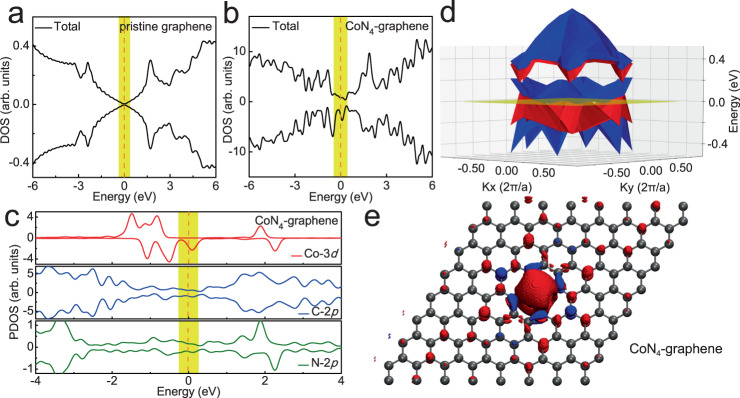
Graphene is extremely promising for next-generation spintronics applications; however, realizing graphene-based room-temperature magnets remains a great challenge. Here, we demonstrate that robust room-temperature ferromagnetism with T up to ∼400 K and saturation magnetization of 0.11 emu g (300 K) can be achieved in graphene by embedding isolated Co atoms with the aid of coordinated N atoms. Extensive structural characterizations show that square-planar Co-N moieties were formed in the graphene lattices, where atomically dispersed Co atoms provide local magnetic moments. Detailed electronic structure calculations reveal that the hybridization between the d electrons of Co atoms and delocalized p electrons of N/C atoms enhances the conduction-electron mediated long-range magnetic coupling. This work provides an effective means to induce room-temperature ferromagnetism in graphene and may open possibilities for developing graphene-based spintronics devices.
石墨烯在下一代自旋电子学应用中极具前景;然而,实现基于石墨烯的室温磁体仍然是一个巨大的挑战。在此,我们证明,借助配位的氮原子嵌入孤立的钴原子,可在石墨烯中实现高达约400 K的居里温度和0.11 emu g(300 K)的饱和磁化强度的强室温铁磁性。广泛的结构表征表明,在石墨烯晶格中形成了平面正方形的Co-N部分,其中原子级分散的钴原子提供了局部磁矩。详细的电子结构计算表明,钴原子的d电子与氮/碳原子的离域p电子之间的杂化增强了传导电子介导的长程磁耦合。这项工作提供了一种在石墨烯中诱导室温铁磁性的有效方法,并可能为开发基于石墨烯的自旋电子学器件开辟可能性。