Center for Animal Welfare, Department of Animal Science, University of California, Davis, 95616, USA.
Animal Behavior Graduate Group, University of California, Davis, 95616, USA.
Sci Rep. 2021 Mar 25;11(1):6888. doi: 10.1038/s41598-021-86313-z.
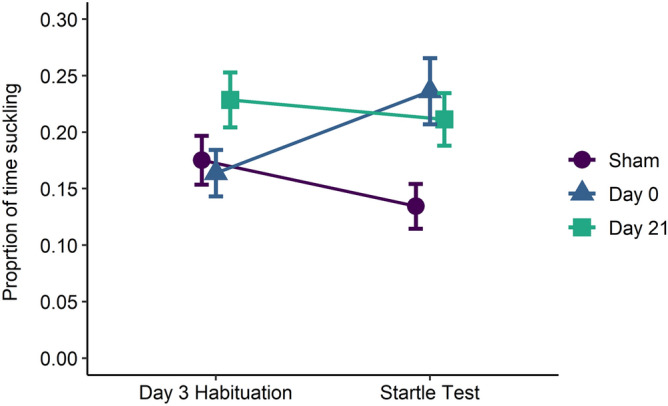
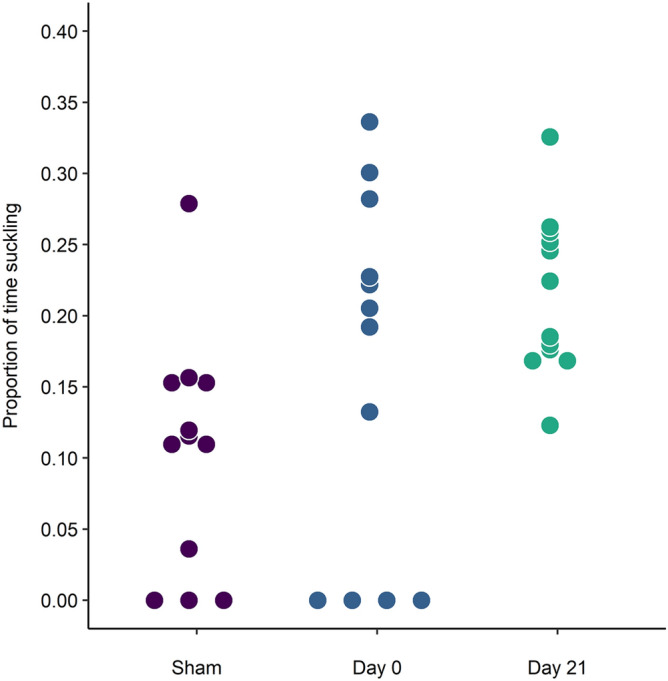
Injury can produce long-lasting motivational changes that may alter decisions made under risk. Our objective was to determine whether a routine painful husbandry procedure, hot-iron disbudding, affects how calves trade off risk avoidance against a competing motivation (i.e., feeding), and whether this response depends on time since injury. We used a startle test to evaluate this trade-off in calves disbudded 0 or 21 days previously and non-injured control calves. For 3 days, calves were individually habituated to the testing arena in which they received a 0.5 L milk meal via a rubber teat. On the 4 day, upon approaching the milk reward, the calf was startled by a sudden noise. We assessed the duration and magnitude of the calf's startle response, their latency to return to the milk bottle, and duration spent suckling after startling. No treatment differences were observed in the duration and magnitude of the startle response or in the probability of returning to the bottle after startling. However, among those who did return, disbudded calves spent longer suckling, indicating they accepted more risk in order to feed compared to controls. In addition, calves with 21-day-old injuries tended to return to the bottle faster compared to newly disbudded calves and controls. We suggest that hot-iron disbudding increases calves' motivation to suckle, as they were more likely to prioritize this behaviour over risk avoidance compared to control calves. This effect was most evident 21 days after disbudding, indicating that injury can produce long-term changes in motivational state.
伤害会产生持久的动机变化,可能会改变风险下的决策。我们的目的是确定常规的疼痛性饲养程序——热铁去角是否会影响小牛在回避风险和竞争动机(即进食)之间的权衡,以及这种反应是否取决于受伤后的时间。我们使用惊跳测试来评估 0 天或 21 天前去角和未受伤对照小牛的这种权衡。在 3 天的时间里,小牛单独适应测试竞技场,在那里通过橡胶奶嘴接受 0.5 升牛奶餐。在第 4 天,当接近牛奶奖励时,小牛会被突然的噪音惊吓。我们评估了小牛惊跳反应的持续时间和幅度、它们返回奶瓶的潜伏期以及惊跳后吸吮的持续时间。在惊跳反应的持续时间和幅度或惊跳后返回奶瓶的概率方面,没有观察到处理差异。然而,在那些返回的小牛中,去角的小牛吸吮时间更长,这表明它们为了进食而接受了更多的风险,与对照小牛相比。此外,与新去角的小牛和对照小牛相比,21 天大的受伤小牛返回奶瓶的速度更快。我们认为,热铁去角增加了小牛吸吮的动机,因为它们更有可能将这种行为置于风险回避之上,而不是与对照小牛相比。这种影响在去角后 21 天最为明显,表明伤害会导致动机状态的长期变化。