Center for Outcomes Research and Evaluation, Maine Medical Center Research Institute, Portland, ME, United States.
Division of General Internal Medicine, University of Iowa Carver College of Medicine, Iowa City, IA, United States.
J Med Internet Res. 2021 Apr 22;23(4):e27832. doi: 10.2196/27832.
Communicating scientific uncertainty about public health threats such as COVID-19 is an ethically desirable task endorsed by expert guidelines on crisis communication. However, the communication of scientific uncertainty is challenging because of its potential to promote ambiguity aversion-a well-described syndrome of negative psychological responses consisting of heightened risk perceptions, emotional distress, and decision avoidance. Communication strategies that can inform the public about scientific uncertainty while mitigating ambiguity aversion are a critical unmet need.
This study aimed to evaluate whether an "uncertainty-normalizing" communication strategy-aimed at reinforcing the expected nature of scientific uncertainty about the COVID-19 pandemic-can reduce ambiguity aversion, and to compare its effectiveness to conventional public communication strategies aimed at promoting hope and prosocial values.
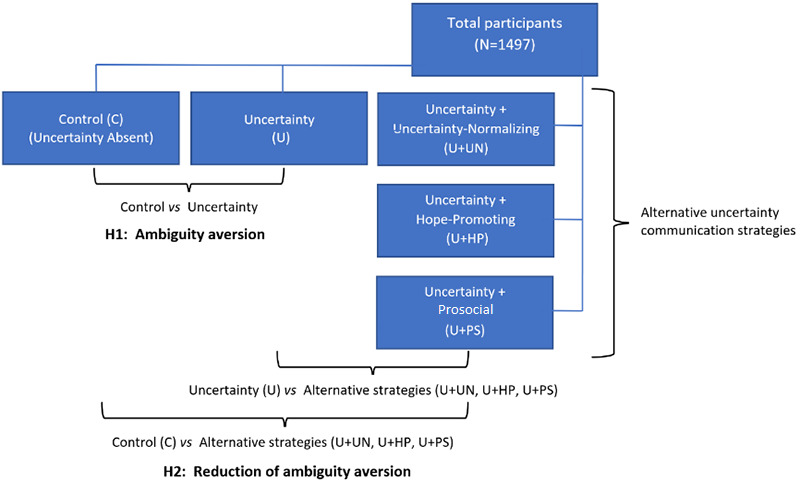
In an online factorial experiment conducted from May to June 2020, a national sample of 1497 US adults read one of five versions of an informational message describing the nature, transmission, prevention, and treatment of COVID-19; the versions varied in level of expressed scientific uncertainty and supplemental focus (ie, uncertainty-normalizing, hope-promoting, and prosocial). Participants then completed measures of cognitive, emotional, and behavioral manifestations of ambiguity aversion (ie, perceived likelihood of getting COVID-19, COVID-19 worry, and intentions for COVID-19 risk-reducing behaviors and vaccination). Analyses assessed (1) the extent to which communicating uncertainty produced ambiguity-averse psychological responses; (2) the comparative effectiveness of uncertainty-normalizing, hope-promoting, and prosocial communication strategies in reducing ambiguity-averse responses; and (3) potential moderators of the effects of alternative uncertainty communication strategies.
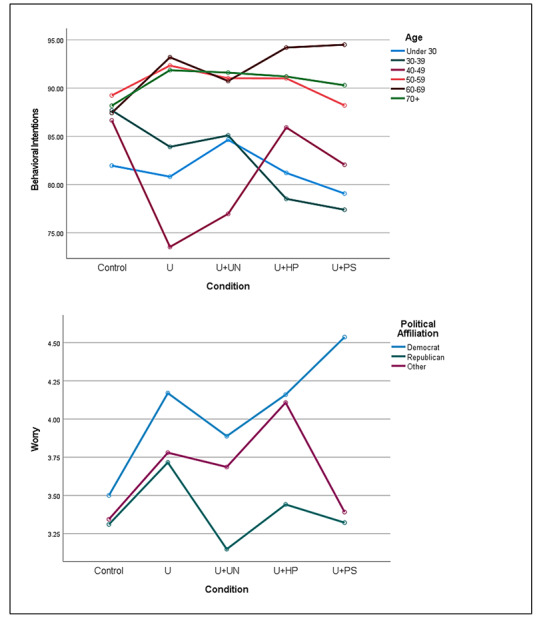
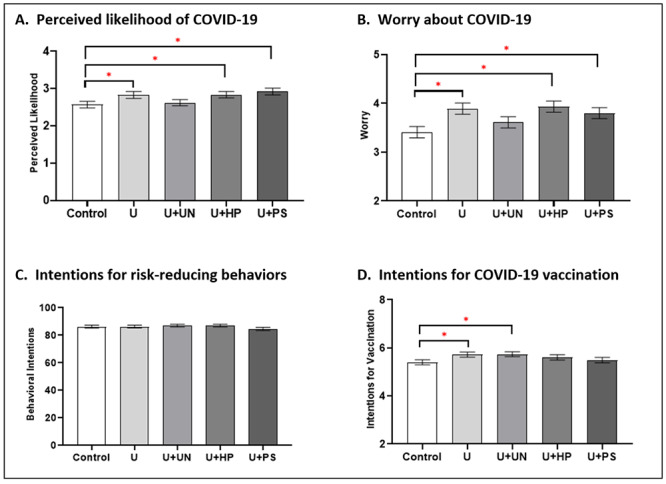
The communication of scientific uncertainty about the COVID-19 pandemic increased perceived likelihood of getting COVID-19 and worry about COVID-19, consistent with ambiguity aversion. However, it did not affect intentions for risk-reducing behaviors or vaccination. The uncertainty-normalizing strategy reduced these aversive effects of communicating scientific uncertainty, resulting in levels of both perceived likelihood of getting COVID-19 and worry about COVID-19 that did not differ from the control message that did not communicate uncertainty. In contrast, the hope-promoting and prosocial strategies did not decrease ambiguity-averse responses to scientific uncertainty. Age and political affiliation, respectively, moderated the effects of uncertainty communication strategies on intentions for COVID-19 risk-reducing behaviors and worry about COVID-19.
Communicating scientific uncertainty about the COVID-19 pandemic produces ambiguity-averse cognitive and emotional, but not behavioral, responses among the general public, and an uncertainty-normalizing communication strategy reduces these responses. Normalizing uncertainty may be an effective strategy for mitigating ambiguity aversion in crisis communication efforts. More research is needed to test uncertainty-normalizing communication strategies and to elucidate the factors that moderate their effectiveness.
传播有关 COVID-19 等公共卫生威胁的科学不确定性是符合伦理道德的,这一任务得到了危机传播专家指南的认可。然而,传播科学不确定性具有挑战性,因为它可能会引发模糊厌恶——一种描述性的综合征,包括风险感知增强、情绪困扰和决策回避等负面心理反应。能够在减轻模糊厌恶的同时向公众传达科学不确定性的沟通策略是一个关键的未满足需求。
本研究旨在评估一种“不确定性正常化”的沟通策略——旨在强化公众对 COVID-19 大流行的科学不确定性的预期性质——是否可以减轻模糊厌恶,并将其与旨在促进希望和亲社会价值观的传统公共沟通策略进行比较。
在 2020 年 5 月至 6 月期间进行的一项在线析因实验中,来自美国的 1497 名成年人参与了一项在线实验,他们阅读了五种版本的信息性信息之一,描述了 COVID-19 的性质、传播、预防和治疗;这些版本在表达科学不确定性和补充重点(即不确定性正常化、希望促进和亲社会)方面存在差异。参与者随后完成了模糊厌恶的认知、情绪和行为表现的测量(即感染 COVID-19 的可能性、COVID-19 担忧以及 COVID-19 风险降低行为和疫苗接种的意图)。分析评估了(1)传达不确定性产生模糊厌恶心理反应的程度;(2)不确定性正常化、希望促进和亲社会沟通策略在减轻模糊厌恶反应方面的相对有效性;(3)替代不确定性沟通策略效果的潜在调节因素。
关于 COVID-19 的科学不确定性的沟通增加了对感染 COVID-19 和对 COVID-19 担忧的可能性感知,这与模糊厌恶一致。然而,它并没有影响风险降低行为或疫苗接种的意愿。不确定性正常化策略减轻了传达科学不确定性的这种厌恶作用,导致对感染 COVID-19 的可能性和对 COVID-19 的担忧的感知与不传达不确定性的对照信息没有差异。相比之下,希望促进和亲社会的策略并没有降低对科学不确定性的模糊厌恶反应。年龄和政治派别分别调节了不确定性沟通策略对 COVID-19 风险降低行为和对 COVID-19 担忧的意图的影响。
在普通公众中,传播有关 COVID-19 的科学不确定性会产生模糊厌恶的认知和情绪反应,但不会产生行为反应,而不确定性正常化沟通策略则会减轻这些反应。在危机沟通工作中,正常化不确定性可能是减轻模糊厌恶的有效策略。需要进一步研究来测试不确定性正常化沟通策略,并阐明调节其有效性的因素。