Scharnetzki Elizabeth, Waterston Leo, Scherer Aaron M, Thorpe Alistair, Fagerlin Angela, Han Paul K J
Center for Interdisciplinary Population and Health Research, MaineHealth Institute for Research, Portland, ME, United States.
Department of Internal Medicine, University of Iowa, Iowa City, IA, United States.
JMIR Form Res. 2023 Aug 1;7:e41959. doi: 10.2196/41959.
The COVID-19 pandemic has engendered widespread fear and skepticism about recommended risk-reducing behaviors including vaccination. Health agencies are faced with the need to communicate to the public in ways that both provide reassurance and promote risk-reducing behaviors. Communication strategies that promote prosocial (PS) values and hope are being widely used; however, the existing research on the persuasiveness of these strategies has offered mixed evidence. There is also very little research examining the comparative effectiveness of PS and hope-promoting (HP) strategies.
The aim of this study is to evaluate the comparative effectiveness of PS and HP messages in reassuring the public and motivating COVID-19 risk-reducing behaviors.
A web-based factorial experiment was conducted in which a diverse sample of the US public was randomized to read messages which adapted existing COVID-19 information from a public website produced by a state government public health department to include alternative framing language: PS, HP, or no additional framing (control). Participants then completed surveys measuring COVID-19 worry and intentions for COVID-19 risk-reducing behaviors and vaccination.
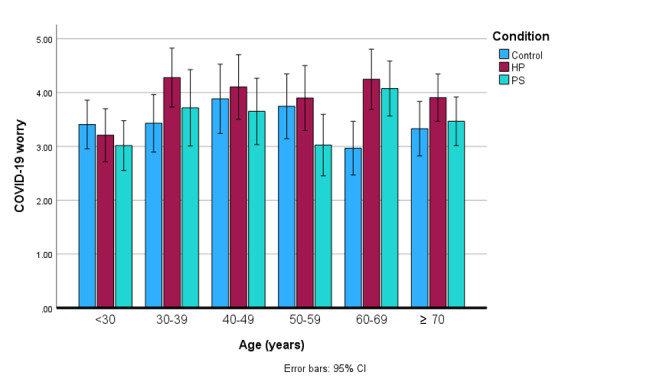
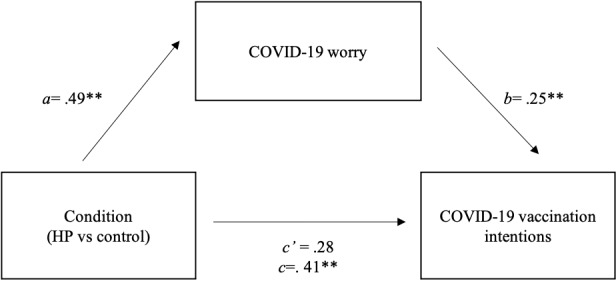
COVID-19 worry was unexpectedly higher in the HP than in the control and PS conditions. Intentions for COVID-19 risk-reducing behaviors did not differ between groups; however, intentions for COVID-19 vaccination were higher in the HP than in the control condition, and this effect was mediated by COVID-19 worry.
It appears that HP communication strategies may be more effective than PS strategies in motivating risk-reducing behaviors in some contexts but with the paradoxical cost of promoting worry.
新冠疫情引发了公众对包括疫苗接种在内的推荐降低风险行为的广泛恐惧和怀疑。卫生机构面临着以既能提供安心感又能促进降低风险行为的方式与公众沟通的需求。促进亲社会(PS)价值观和希望的沟通策略被广泛使用;然而,关于这些策略说服力的现有研究提供了参差不齐的证据。也很少有研究考察PS策略和促进希望(HP)策略的相对有效性。
本研究的目的是评估PS信息和HP信息在让公众安心并激励采取降低新冠风险行为方面的相对有效性。
进行了一项基于网络的析因实验,将美国公众的多样化样本随机分组,让他们阅读信息,这些信息改编自一个州政府公共卫生部门制作的公共网站上现有的新冠信息,包括不同的框架语言:PS、HP或无额外框架(对照组)。参与者随后完成了测量对新冠的担忧以及采取降低新冠风险行为和接种疫苗意图的调查。
令人意外的是,HP组中对新冠的担忧高于对照组和PS组。不同组之间采取降低新冠风险行为的意图没有差异;然而,HP组中接种新冠疫苗的意图高于对照组,并且这种效应是由对新冠的担忧介导的。
在某些情况下,HP沟通策略在激励降低风险行为方面可能比PS策略更有效,但却存在引发担忧这种自相矛盾的代价。