Department of Microbiology, Douglass Hanly Moir Pathology, New South Wales, Australia.
Department of Endocrinology, Sir Charles Gairdner Hospital, Western Australia, Australia.
J Clin Virol. 2021 May;138:104797. doi: 10.1016/j.jcv.2021.104797. Epub 2021 Mar 17.
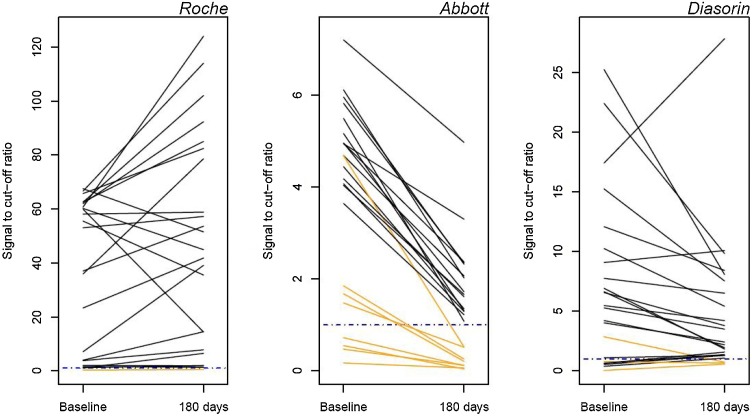
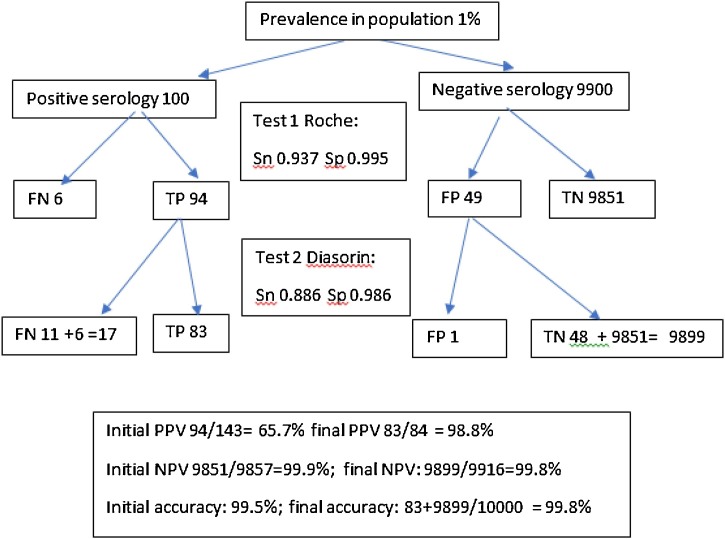
A total of 1080 individual patient samples (158 positive serology samples from confirmed, predominantly mildly symptomatic COVID-19 patients and 922 serology negative including 496 collected pre-COVID) from four states in Australia were analysed on four commercial SARS-CoV-2 serological assays targeting antibodies to different antigens (Roche Elecsys and Abbott Architect: nucleocapsid; Diasorin Liaison and Euroimmun: spike). A subset was compared to immunofluorescent antibody (IFA) and micro-neutralisation. Sensitivity and specificity of the Roche (n = 1033), Abbott (n = 806), Diasorin (n = 1034) and Euroimmun (n = 175) were 93.7 %/99.5 %, 90.2 %/99.4 %, 88.6 %/98.6 % and 91.3 %/98.8 %, respectively. ROC analysis with specificity held at 99 % increased the sensitivity for the Roche and Abbott assays from 93.7% to 98.7% (cut-off 0.21) and 90.2 % to 94.0 % (cut-off 0.91), respectively. Overall seropositivity of samples increased from a maximum of 23 % for samples 0-7 days-post-onset of symptoms (dpos), to 61 % from samples 8-14dpos and 93 % from those >14dpos. IFA and microneutralisation values correlated best with assays targeting antibodies to spike protein with values >80 AU/mL on the Diasorin assay associated with neutralising antibody. Detectable antibody was present in 22/23 (96 %), 20/23 (87 %), 15/23 (65 %) and 9/22 (41 %) patients with samples >180dpos on the Roche, Diasorin, Abbott and microneutralisation assays respectively. Given the low prevalence in this community, two-step algorithms on initial positive results saw an increase in the positive predictive value (PPV) of positive samples (39 %-65 % to ≥98 %) for all combinations. Similarly accuracy increased from a range of 98.5 %-99.4 % to ≥99.8 % assuming a 1 % seroprevalence. Negative predictive value (NPV) was high (≥99.8 %) regardless of which assay was used initially.
从澳大利亚四个州的 1080 名个体患者样本(158 份来自确诊的、主要为轻症 COVID-19 患者的阳性血清学样本和 922 份阴性血清学样本,包括 496 份采集于 COVID-19 之前)中,使用四种针对不同抗原的商业 SARS-CoV-2 血清学检测方法(罗氏 Elecsys 和雅培 Architect:核衣壳;DiaSorin Liaison 和 Euroimmun:刺突)对其进行了分析。一部分样本与免疫荧光抗体(IFA)和微量中和试验进行了比较。罗氏(n=1033)、雅培(n=806)、DiaSorin(n=1034)和 Euroimmun(n=175)的灵敏度和特异性分别为 93.7%/99.5%、90.2%/99.4%、88.6%/98.6%和 91.3%/98.8%。在特异性保持在 99%的情况下,ROC 分析将罗氏和雅培检测方法的灵敏度从 93.7%分别提高到 98.7%(临界值 0.21)和 90.2%至 94.0%(临界值 0.91)。随着症状发作后(dpos)0-7 天内样本的血清阳性率最高达到 23%,到 8-14dpos 时上升至 61%,到>14dpos 时上升至 93%,样本的总体血清阳性率增加。IFA 和微量中和试验与针对刺突蛋白抗体的检测方法相关性最好,Diasorin 检测方法上>80 AU/mL 的值与中和抗体相关。在 Roche、DiaSorin、Abbott 和微量中和试验上,有 23/23(96%)、20/23(87%)、15/23(65%)和 9/22(41%)的患者样本>180dpos 时可检测到抗体。鉴于该社区的低患病率,对初始阳性结果采用两步算法,所有组合的阳性样本的阳性预测值(PPV)(39%-65%至≥98%)都有所增加。同样,在假设血清流行率为 1%的情况下,检测的准确性从 98.5%-99.4%提高到了≥99.8%。无论最初使用哪种检测方法,阴性预测值(NPV)都很高(≥99.8%)。