Department of Haematology, Royal North Shore Hospital, Sydney, NSW, Australia.
Kolling Institute, Royal North Shore Hospital, Sydney, NSW, Australia.
Blood. 2022 Dec 22;140(25):2709-2721. doi: 10.1182/blood.2022017814.
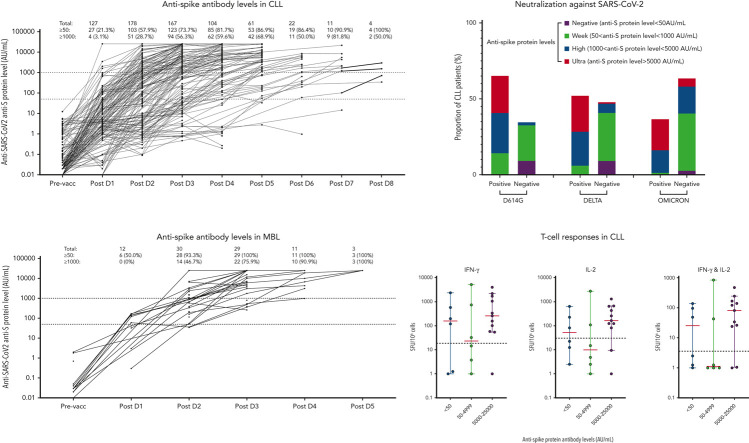
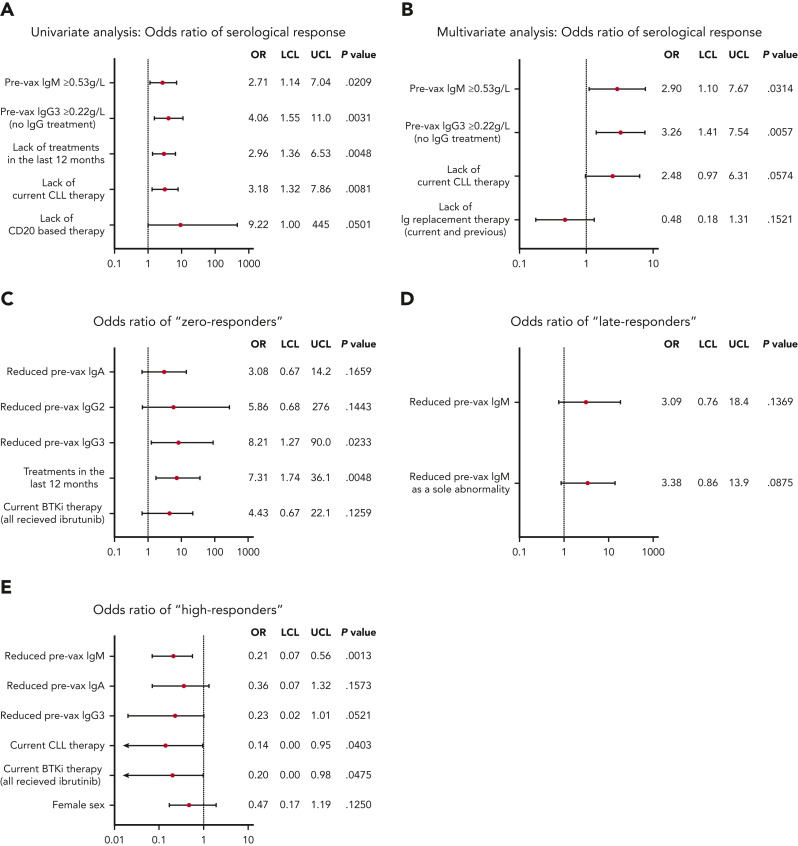
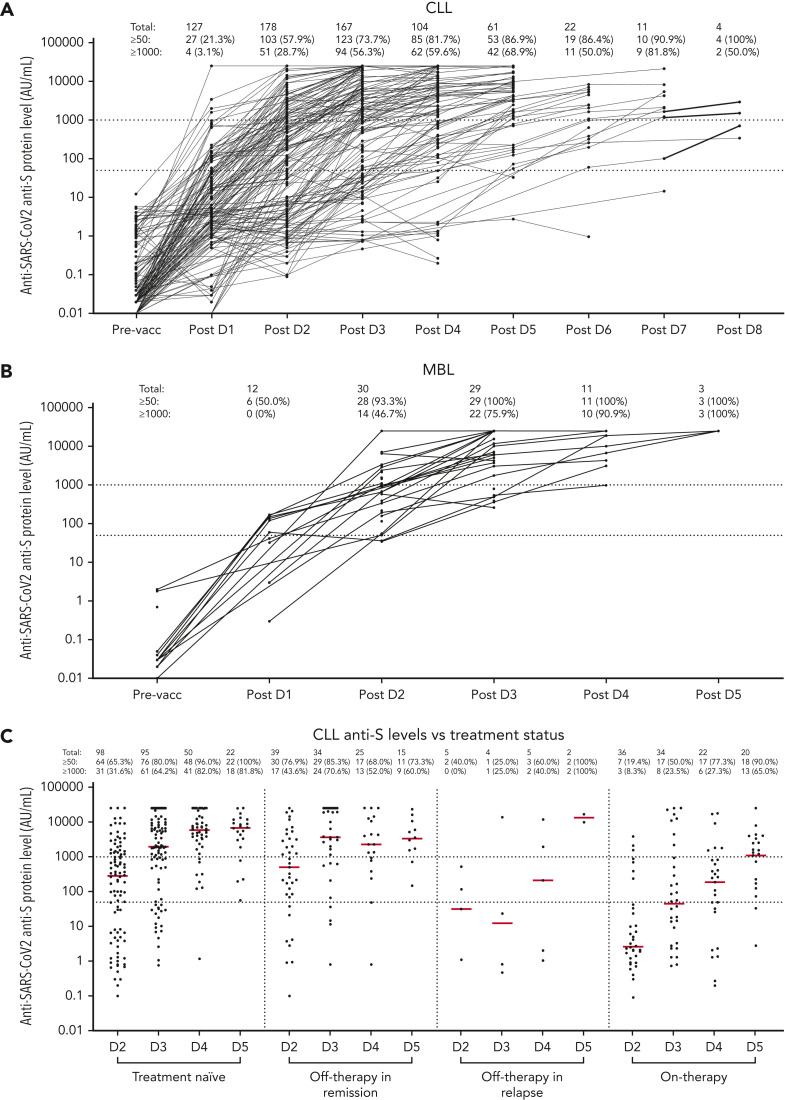
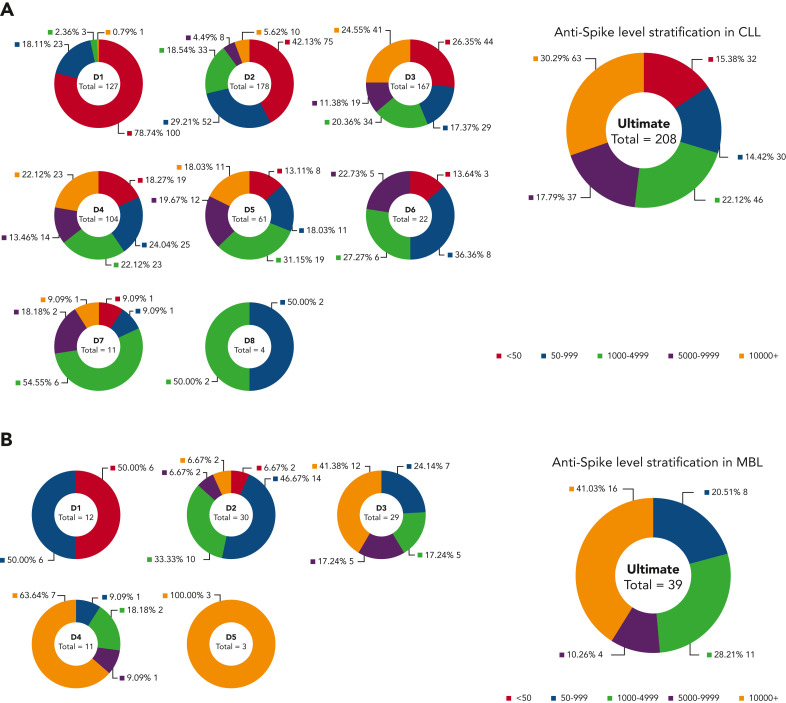
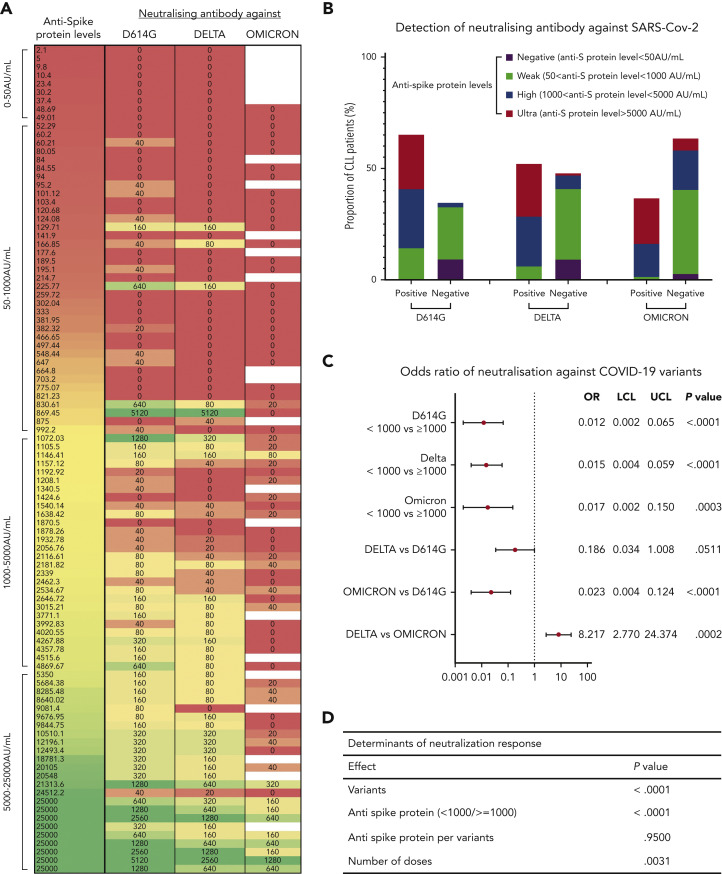
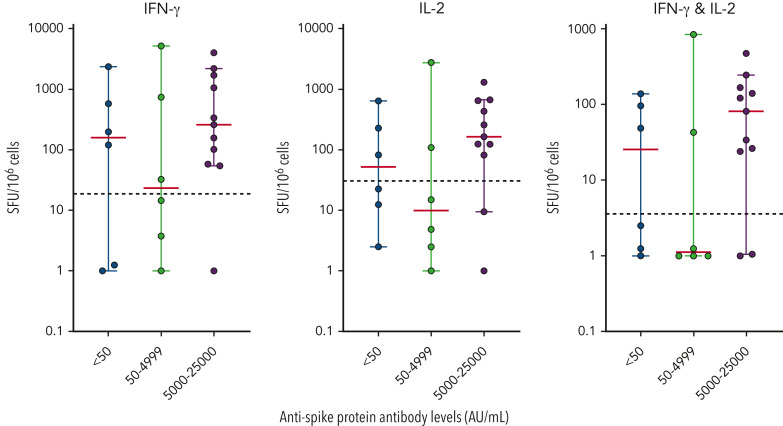
Patients with chronic lymphocytic leukemia (CLL) or monoclonal B-lymphocytosis (MBL) have impaired response to COVID-19 vaccination. A total of 258 patients (215 with CLL and 43 with MBL) had antispike antibody levels evaluable for statistical analysis. The overall seroconversion rate in patients with CLL was 94.2% (antispike antibodies ≥50 AU/mL) and 100% in patients with MBL after multiple vaccine doses. After 3 doses (post-D3) in 167 patients with CLL, 73.7% were seropositive, 17.4% had antispike antibody levels between 50 and 999 AU/mL, and 56.3% had antispike antibody levels ≥1000 AU/mL, with a median rise from 144.6 to 1800.7 AU/mL. Of patients who were seronegative post-D2, 39.7% seroconverted post-D3. For those who then remained seronegative after their previous dose, seroconversion occurred in 40.6% post-D4, 46.2% post-D5, 16.7% post-D6, and 0% after D7 or D8. After seroconversion, most had a progressive increase in antispike antibody levels. Neutralization was associated with higher antispike antibody levels, more vaccine doses, and earlier severe acute respiratory syndrome coronavirus 2 (SARS-CoV-2) variants; neutralizing antibody against early clade D614G was detected in 65.3%, against Delta in 52.0%, and against Omicron in 36.5%. SARS-CoV-2-specific T-cell production of interferon γ and interleukin 2 occurred in 73.9% and 60.9%, respectively, of 23 patients tested. After multiple vaccine doses, by multivariate analysis, immunoglobulin M ≥0.53 g/L, immunoglobulin subclass G3 ≥0.22 g/L and absence of current CLL therapy were independent predictors of positive serological responses. Multiple sequential COVID-19 vaccination significantly increased seroconversion and antispike antibody levels in patients with CLL or MBL.
患有慢性淋巴细胞白血病 (CLL) 或单克隆 B 淋巴细胞增多症 (MBL) 的患者对 COVID-19 疫苗的反应受损。共有 258 名患者(215 名 CLL 患者和 43 名 MBL 患者)的抗尖峰抗体水平可进行统计分析。CLL 患者的总体血清转化率为 94.2%(抗尖峰抗体≥50 AU/mL),MBL 患者的血清转化率为 100%,经过多次疫苗接种。在 167 名 CLL 患者中接受 3 剂(D3 后)后,73.7%呈血清阳性,17.4%的抗尖峰抗体水平在 50 至 999 AU/mL 之间,56.3%的抗尖峰抗体水平≥1000 AU/mL,中位数从 144.6 上升至 1800.7 AU/mL。D2 后血清阴性的患者中有 39.7%在 D3 后发生血清转化。对于那些在前一剂后仍保持血清阴性的患者,在 D4 后有 40.6%发生血清转化,D5 后有 46.2%,D6 后有 16.7%,D7 或 D8 后无血清转化。血清转化后,大多数患者的抗尖峰抗体水平呈进行性增加。中和与更高的抗尖峰抗体水平、更多的疫苗剂量和更早的严重急性呼吸综合征冠状病毒 2 (SARS-CoV-2) 变体有关;检测到针对早期 clade D614G 的中和抗体占 65.3%,针对 Delta 的占 52.0%,针对 Omicron 的占 36.5%。在 23 名接受检测的患者中,分别有 73.9%和 60.9%产生了 SARS-CoV-2 特异性干扰素 γ 和白细胞介素 2 的 T 细胞。通过多变量分析,免疫球蛋白 M≥0.53 g/L、免疫球蛋白亚类 G3≥0.22 g/L 和无当前 CLL 治疗是血清学反应阳性的独立预测因素。多次序贯 COVID-19 疫苗接种显著增加了 CLL 或 MBL 患者的血清转化率和抗尖峰抗体水平。