Department of Paediatrics, The Children's Clinical Hospital Józef Polikarp Brudziński, Warsaw, Poland
Department of Paediatrics, The Medical University of Warsaw, Warsaw, Poland.
BMJ Open Diabetes Res Care. 2021 Mar;9(1). doi: 10.1136/bmjdrc-2020-001523.
The gut microbiota may be relevant in the development of type 1 diabetes (T1D). We examined the effects of GG and Bb12 on beta-cell function in children with newly diagnosed T1D.
Children aged 8-17 years with newly (within 60 days) diagnosed T1D were enrolled in a double-blind, randomised controlled trial in which they received GG and Bb12 at a dose of 10 colony-forming units or placebo, orally, once daily, for 6 months. The follow-up was for 12 months. The primary outcome measure was the area under the curve (AUC) of the C-peptide level during 2-hour responses to a mixed meal.
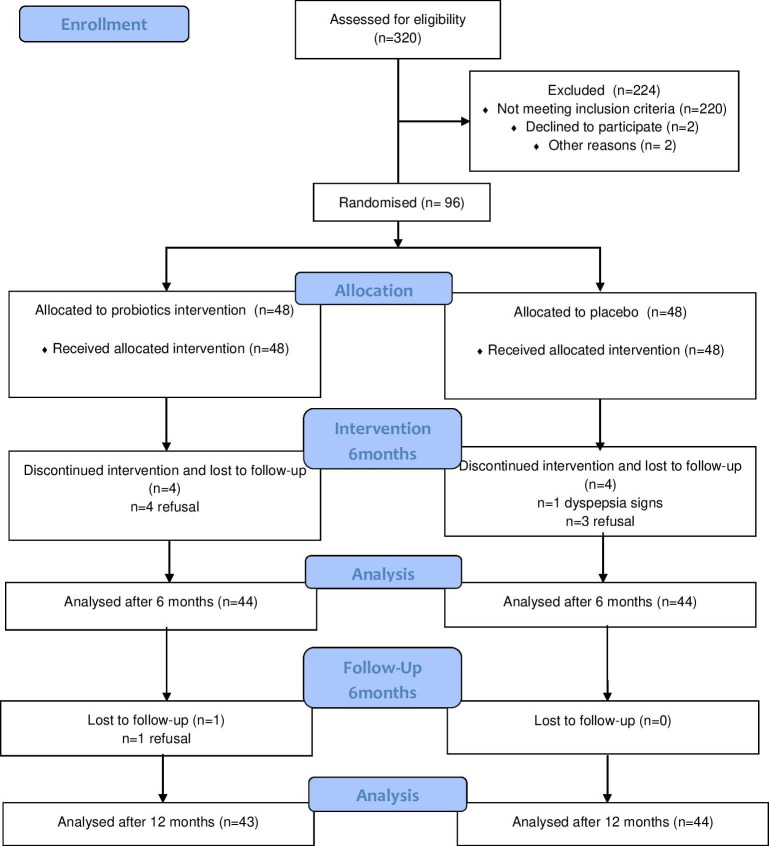
Ninety-six children were randomised (probiotics, n=48; placebo n=48; median age 12.3 years). Eighty-eight (92%) completed the 6-month intervention, and 87 (91%) completed the follow-up at 12 months. There was no significant difference between the study groups for the AUC of the C-peptide level. For the secondary outcomes at 6 months, there were no differences between the study groups. At 12 months, with one exception, there also were no significant differences between the groups. Compared with the placebo group, there was a significantly increased number of subjects with thyroid autoimmunity in the probiotic group. However, at baseline, there was also a higher frequency of thyroid autoimmunity in the probiotic group. There were no cases of severe hypoglycemia or ketoacidosis in any of the groups. No adverse events related to the study products were reported.
GG and Bb12, as administered in this study, had no significant effect in maintaining the residual pancreatic beta-cell function in children with newly diagnosed T1D. It remains unclear which probiotics, if any, alone or in combination, are potentially the most useful for management of T1D.
NCT03032354.
肠道微生物群可能与 1 型糖尿病(T1D)的发展有关。我们研究了 GG 和 Bb12 对新诊断为 T1D 的儿童β细胞功能的影响。
年龄在 8-17 岁之间的新诊断(60 天内)T1D 儿童参加了一项双盲、随机对照试验,他们每天口服 10 个菌落形成单位的 GG 和 Bb12 或安慰剂,持续 6 个月。随访时间为 12 个月。主要观察指标是混合餐 2 小时反应时 C 肽水平的曲线下面积(AUC)。
96 名儿童被随机分配(益生菌组,n=48;安慰剂组,n=48;中位年龄 12.3 岁)。88 名(92%)儿童完成了 6 个月的干预,87 名(91%)儿童完成了 12 个月的随访。研究组间 C 肽水平 AUC 无显著差异。次要终点 6 个月时,两组间无差异。12 个月时,除一个例外,组间也无显著差异。与安慰剂组相比,益生菌组中甲状腺自身免疫的受试者数量明显增加。然而,在基线时,益生菌组中也有更高频率的甲状腺自身免疫。各组均无严重低血糖或酮症酸中毒病例。未报告与研究产品相关的不良事件。
在本研究中给予 GG 和 Bb12 对新诊断为 T1D 的儿童残余胰岛β细胞功能无显著影响。尚不清楚单独或联合使用哪些益生菌(如果有的话)对 T1D 的治疗最有用。
NCT03032354。