Department of Biochemistry and Molecular Pharmacology, University of Massachusetts Medical School, Worcester, MA, United States.
Nat Commun. 2021 Mar 26;12(1):1898. doi: 10.1038/s41467-021-22282-1.
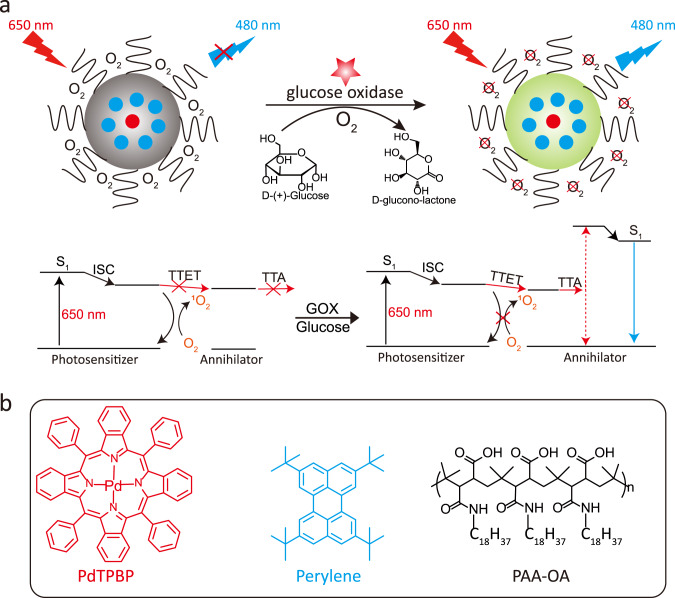
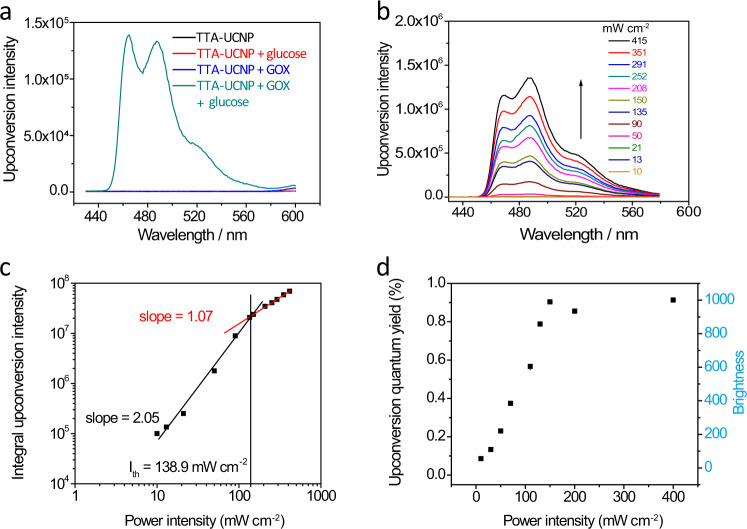
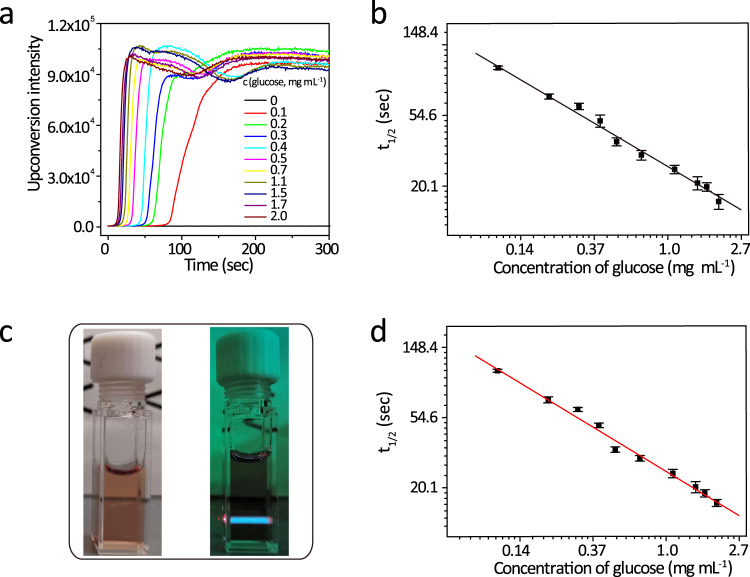
Triplet-triplet annihilation upconversion nanoparticles have attracted considerable interest due to their promises in organic chemistry, solar energy harvesting and several biological applications. However, triplet-triplet annihilation upconversion in aqueous solutions is challenging due to sensitivity to oxygen, hindering its biological applications under ambient atmosphere. Herein, we report a simple enzymatic strategy to overcome oxygen-induced triplet-triplet annihilation upconversion quenching. This strategy stems from a glucose oxidase catalyzed glucose oxidation reaction, which enables rapid oxygen depletion to turn on upconversion in the aqueous solution. Furthermore, self-standing upconversion biological sensors of such nanoparticles are developed to detect glucose and measure the activity of enzymes related to glucose metabolism in a highly specific, sensitive and background-free manner. This study not only overcomes the key roadblock for applications of triplet-triplet annihilation upconversion nanoparticles in aqueous solutions, it also establishes the proof-of-concept to develop triplet-triplet annihilation upconversion nanoparticles as background free self-standing biological sensors.
三重态-三重态湮灭上转换纳米粒子因其在有机化学、太阳能收集和多种生物应用方面的潜力而引起了相当大的关注。然而,由于三重态-三重态湮灭上转换对氧气敏感,在环境大气下会阻碍其生物应用,因此在水溶液中实现三重态-三重态湮灭上转换具有挑战性。在此,我们报告了一种简单的酶促策略来克服氧诱导的三重态-三重态湮灭上转换猝灭。该策略源于葡萄糖氧化酶催化的葡萄糖氧化反应,可快速耗尽氧气以开启水溶液中的上转换。此外,还开发了这种纳米粒子的自支撑上转换生物传感器,以高度特异性、灵敏和无背景的方式检测葡萄糖,并测量与葡萄糖代谢相关的酶的活性。这项研究不仅克服了三重态-三重态湮灭上转换纳米粒子在水溶液中应用的关键障碍,还为开发无背景自支撑生物传感器的三重态-三重态湮灭上转换纳米粒子奠定了概念验证。