Department of Kinesiology and Nutrition, University of Illinois at Chicago, 1919 West Taylor Street, Room 532, Chicago, IL, 60612, USA.
Curr Atheroscler Rep. 2021 Mar 26;23(5):22. doi: 10.1007/s11883-021-00922-7.
Time-restricted eating (TRE) is a form of intermittent fasting that involves confining the eating window to 4-10 h and fasting for the remaining hours of the day. The purpose of this review is to summarize the current literature pertaining to the effects of TRE on body weight and cardiovascular disease risk factors.
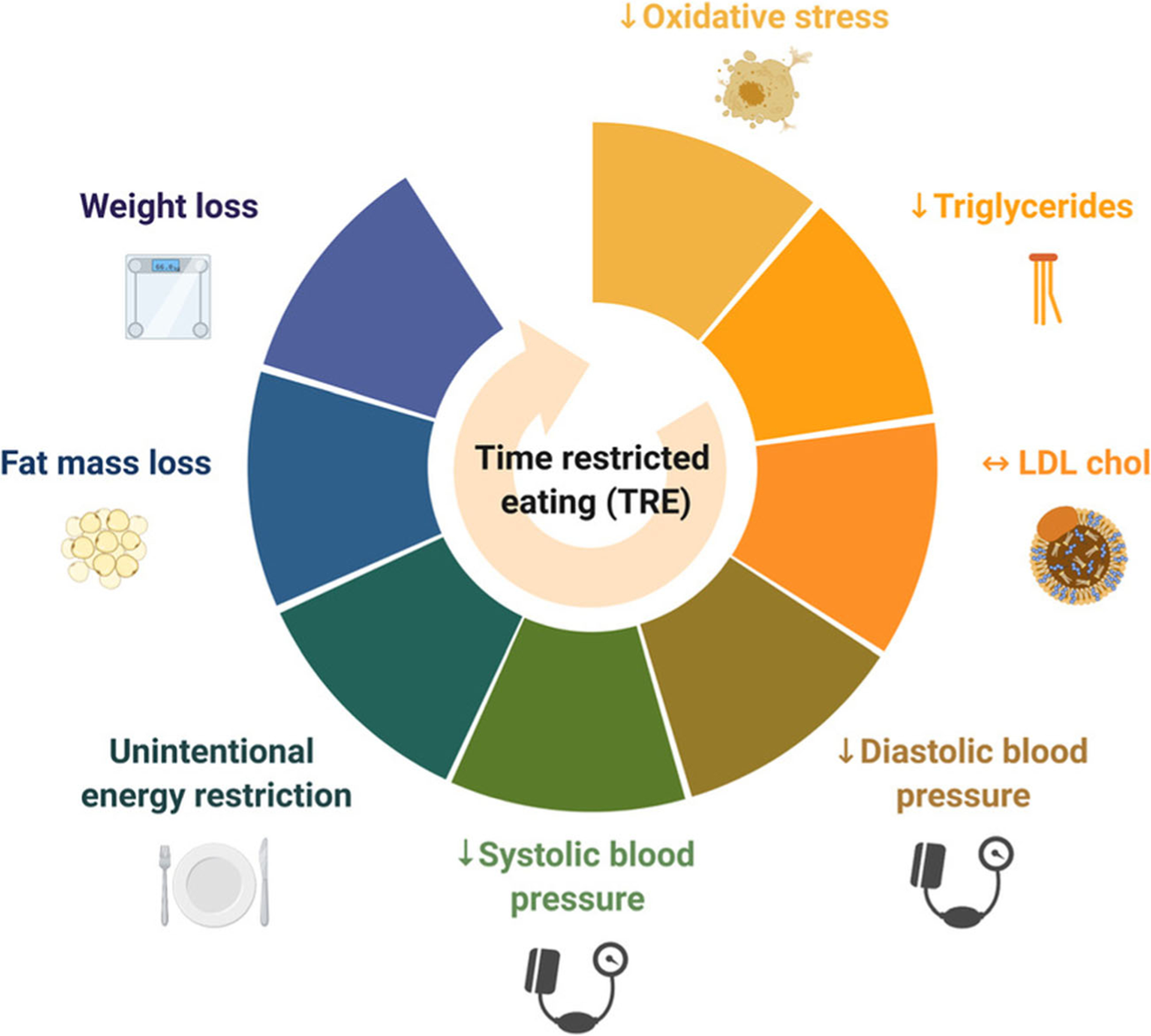
Human trial findings show that TRE reduces body weight by 1-4% after 1-16 weeks in individuals with obesity, relative to controls with no meal timing restrictions. This weight loss results from unintentional reductions in energy intake (~350-500 kcal/day) that occurs when participants confine their eating windows to 4-10 h/day. TRE is also effective in lowering fat mass, blood pressure, triglyceride levels, and markers of oxidative stress, versus controls. This fasting regimen is safe and produces few adverse events. These findings suggest that TRE is a safe diet therapy that produces mild reductions in body weight and also lowers several key indicators of cardiovascular disease in participants with obesity.
限时进食(TRE)是一种间歇性禁食,它将进食窗口限制在 4-10 小时,其余时间禁食。本综述的目的是总结有关 TRE 对体重和心血管疾病风险因素影响的现有文献。
人类试验结果表明,与没有定时限制饮食的对照组相比,TRE 可使肥胖个体在 1-16 周内体重减轻 1-4%。这种体重减轻是由于参与者将进食窗口限制在每天 4-10 小时内,无意中减少了约 350-500 千卡/天的能量摄入。与对照组相比,TRE 还能有效降低脂肪量、血压、甘油三酯水平和氧化应激标志物。这种禁食方案安全,产生的不良事件很少。这些发现表明,TRE 是一种安全的饮食疗法,可使肥胖者的体重适度减轻,还可降低心血管疾病的几个关键指标。