Department of Neurosurgery, Icahn School of Medicine at Mount Sinai, New York, NY, United States.
Department of Neurosurgery, Icahn School of Medicine at Mount Sinai, New York, NY, United States.
Am J Med Sci. 2021 May;361(5):575-584. doi: 10.1016/j.amjms.2021.01.007. Epub 2021 Jan 11.
Various non-pharmaceutical interventions (NPIs) such as stay-at-home orders and school closures have been employed to limit the spread of Coronavirus disease (COVID-19). This study measures the impact of social distancing policies on COVID-19 transmission in US states during the early outbreak phase to assess which policies were most effective.
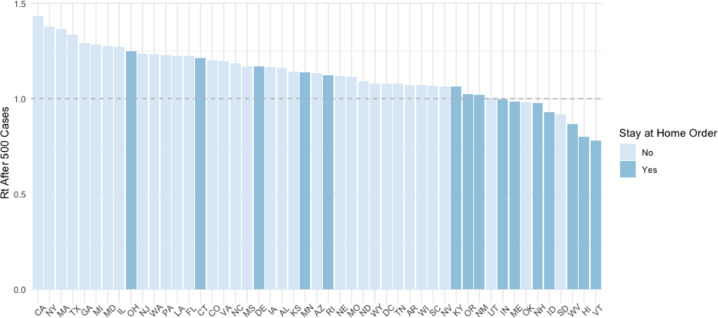
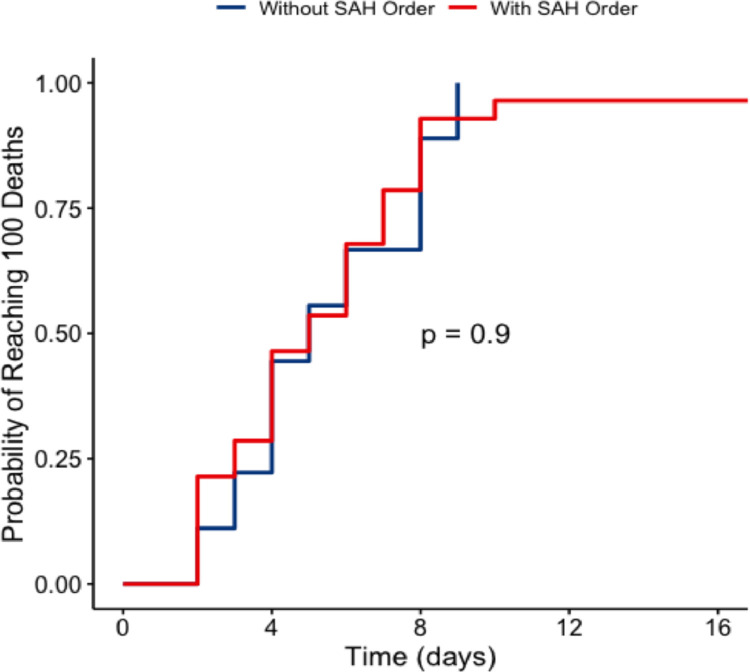
To measure transmissibility, we analyze the average effective reproductive number (R) in each state the week following its 500th case and doubling time from 500 to 1000 cases. Linear and logistic regressions were performed to assess the impact of various NPIs while controlling for population density, GDP, and certain health metrics. This analysis was repeated for deaths with doubling time to 100 deaths with several healthcare infrastructure control variables.
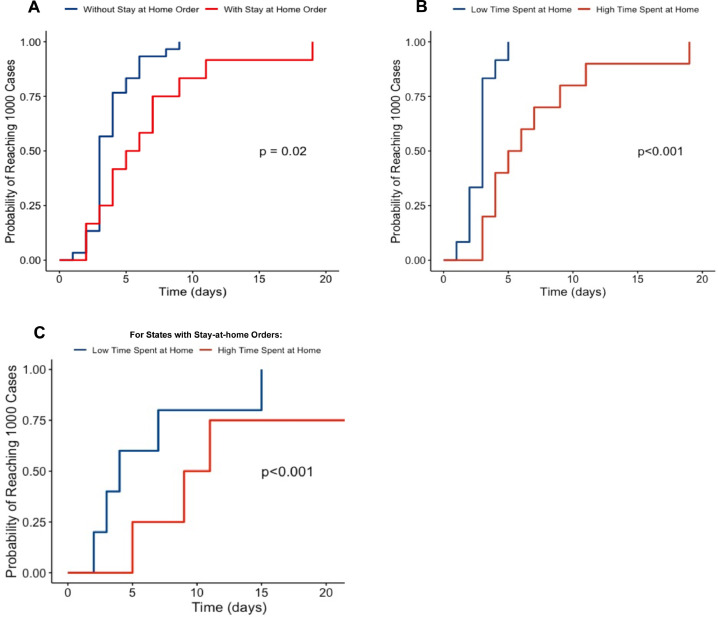
States with stay-at-home orders in place at the time of their 500th case were associated with lower average R the following week compared to states without them (p<0.001) and significantly less likely to have an R>1 (OR 0.07, 95% CI 0.01-0.37, p = 0.004). These states also experienced longer doubling time from 500 to 1000 cases (HR 0.35, 95% CI 0.17-0.72, p = 0.004). States in the highest quartile of average time spent at home were also slower to reach 1000 cases than those in the lowest quartile (HR 0.18, 95% CI 0.06-0.53, p = 0.002).
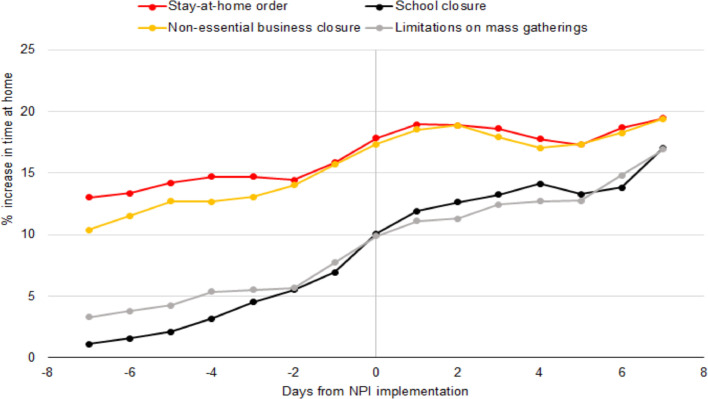
Stay-at-home orders had the largest effect of any policy analyzed. Multivariate analyses with cellphone tracking data suggest social distancing adherence drives these effects. States that plan to scale back such measures should carefully monitor transmission metrics.
为了限制新型冠状病毒疾病(COVID-19)的传播,已采取各种非药物干预措施(NPIs),如居家令和学校关闭。本研究旨在衡量社交距离政策对美国各州 COVID-19 传播的早期暴发阶段的影响,以评估哪些政策最有效。
为了衡量传染性,我们分析了各州在第 500 例病例后一周的平均有效繁殖数(R)以及从第 500 例到第 1000 例病例的倍增时间。进行线性和逻辑回归分析,以评估在控制人口密度、国内生产总值和某些健康指标的情况下,各种 NPI 的影响。对死亡病例也进行了类似的分析,在考虑到一些医疗保健基础设施控制变量的情况下,将死亡病例倍增时间延长至 100 例。
在第 500 例病例时实施居家令的州,与未实施该政策的州相比,下一周的平均 R 值较低(p<0.001),R 值大于 1 的可能性显著降低(OR 0.07,95%CI 0.01-0.37,p=0.004)。这些州从第 500 例到第 1000 例病例的倍增时间也更长(HR 0.35,95%CI 0.17-0.72,p=0.004)。平均居家时间最长的州达到 1000 例病例的速度也比居家时间最短的州慢(HR 0.18,95%CI 0.06-0.53,p=0.002)。
居家令是分析的所有政策中影响最大的政策。与手机追踪数据相关的多变量分析表明,社交距离的遵守程度推动了这些影响。计划放宽这些措施的州应仔细监测传播指标。