Silva-Jose Cristina, Sánchez-Polán Miguel, Diaz-Blanco Ángeles, Coterón Javier, Barakat Ruben, Refoyo Ignacio
Actividad Físico-Deportiva en Poblaciones Específicas (AFIPE) Research Group, Facultad de Ciencias de la Actividad Física y el Deporte, Universidad Politécnica de Madrid, Madrid, Spain.
Servicio de Obstetricia y Ginecología, Hospital Universitario Severo Ochoa, Leganés, Madrid, Spain.
Front Physiol. 2021 Mar 10;12:645136. doi: 10.3389/fphys.2021.645136. eCollection 2021.
The situation caused by COVID-19 has led to movement restrictions for the majority of the population due to the confinement established by the health authorities. This new situation has changed people's habits and significantly affected the pregnant population. Decreased exercise and increased psychophysical stress are associated with excessive weight gain, diabetes, and gestational cardiovascular complications that affect the mother, fetus, and newborn. Recent research shows that the dynamics of maternal blood pressure is one of the most important control factors during pregnancy. Thus, prevention of these type of pathologies through interventions without maternal-fetal risks is important.
To examine the influence of a virtual exercise program on maternal blood pressure during pregnancy.
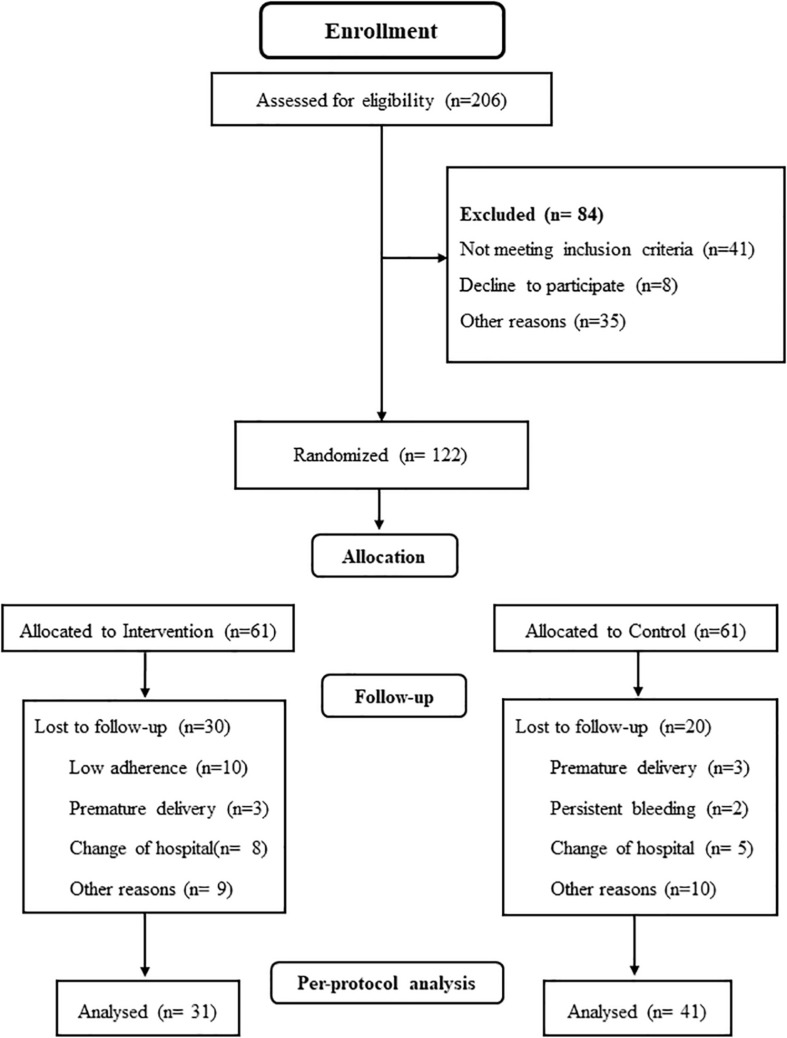
A randomized clinical trial design was used (NCT04563065). Data from 72 pregnant women without obstetric contraindications under confinement conditions in the Madrid area were collected. Women were randomly assigned to the intervention (IG) or control group (CG). They previously signed informed consent forms. A moderate exercise program was performed as an intervention from 8-10 to 38-39 weeks of pregnancy. Systolic (SBP) and diastolic (DBP) maternal blood pressure were measured during the first, second and third trimesters of pregnancy, as well as before and immediately after delivery in both study groups.
No differences in systolic and diastolic blood pressure during the first, second and third trimesters were found between groups. Significant differences in SBP were found immediately before delivery (IG = 119.83 ± 10.16 vs. CG = 125.6 ± 10.91; = 0.047) and immediately after delivery (IG = 115.00 ± 11.18 vs. CG = 122.24 ± 15.71; = 0.045).
Results show lower SBP values for the IG during delivery than CG. A virtual exercise program throughout pregnancy during COVID-19 confinement can help to control systolic blood pressure before and immediately after delivery in healthy pregnant women.
由于卫生当局实施的隔离措施,新冠疫情导致大多数人行动受限。这种新情况改变了人们的习惯,并对孕妇群体产生了重大影响。运动量减少和身心压力增加与体重过度增加、糖尿病以及影响母亲、胎儿和新生儿的妊娠期心血管并发症有关。最近的研究表明,孕期母体血压动态是最重要的控制因素之一。因此,通过无母婴风险的干预措施预防这类疾病很重要。
研究虚拟运动计划对孕期母体血压的影响。
采用随机临床试验设计(NCT04563065)。收集了马德里地区72名在隔离条件下无产科禁忌证的孕妇的数据。将女性随机分为干预组(IG)或对照组(CG)。她们事先签署了知情同意书。在怀孕8 - 10周到38 - 39周期间,实施适度运动计划作为干预措施。在两个研究组的妊娠第一、第二和第三阶段以及分娩前和分娩后立即测量母体收缩压(SBP)和舒张压(DBP)。
两组在妊娠第一、第二和第三阶段的收缩压和舒张压无差异。在分娩前即刻(IG = 119.83 ± 10.16 vs. CG = 125.6 ± 10.91;P = 0.## 047)和分娩后即刻(IG = 115.00 ± 11.18 vs. CG = 122.24 ± 15.71;P = 0.## 045)发现SBP有显著差异。
结果显示,干预组在分娩时的SBP值低于对照组。在新冠疫情隔离期间,整个孕期进行虚拟运动计划有助于控制健康孕妇分娩前和分娩后的收缩压。