Feng Lijuan, Yin Rong
Student Mental Health Education and Counseling Center, Northwest Minzu University, Lanzhou, China.
Department of Neurology, The 940th Hospital of Joint Logistics Support Force of the PLA, Lanzhou, China.
Front Psychol. 2021 Mar 10;12:623873. doi: 10.3389/fpsyg.2021.623873. eCollection 2021.
The pandemic of Coronavirus Disease 2019 (COVID-19) has burdened an unprecedented psychological stress on the front-line medical staff, who are at high risk of depression. While existing studies and theories suggest that factors such as gratitude, social support, and hope play a role in the risk of depression, few studies have combined these factors to explore the relationship between them.
This study examined the mediating roles of social support and hope in the relationship between gratitude and depression among front-line medical staff during the pandemic of COVID-19.
This study used the Gratitude Questionnaire, the Perceived Social Support Scale (PSSS), the State Hope Scale (SHS), and the Center for Epidemiologic Studies Depression Scale to examine the gratitude, social support, hope, and depression among 344 front-line medical workers in Wuhan, which was the hardest-hit area of COVID-19 in China.
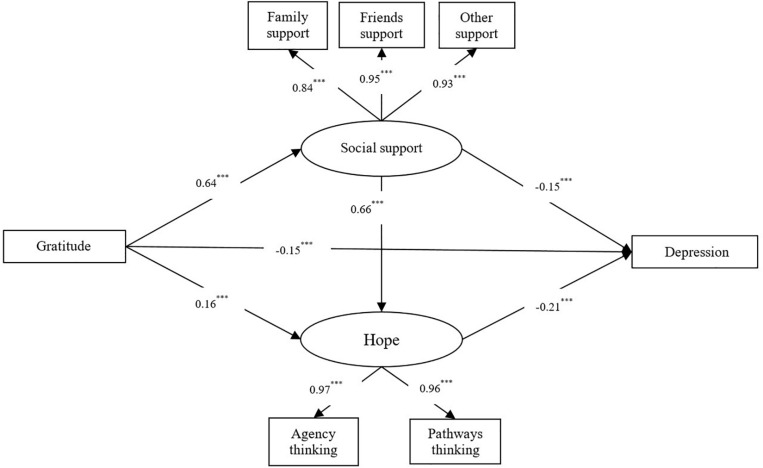
The results showed that the prevalence of mild depressive disorder was 40.12% and the prevalence of major depressive disorder was 9.59% among front-line medical staff during the pandemic of COVID-19; gratitude has a direct and negative effect on depression. Gratitude was negative predictors of depression through the mediating variables of social support and hope [β = -0.096, 95%CI(-0.129 to -0.064); β = -0.034, 95%CI(-0.055 to -0.013)], as well as via an indirect path from social support to hope [β = -0.089, 95%CI (-0.108 to -0.070)].
The study findings indicate that gratitude as a positive emotion can reduce depression in medical staff by promoting social support and hope, respectively. Gratitude also reduced depression in health care workers through a chain mediating effect of social support and hope. Overall, gratitude can directly foster social support and hope, and protect people from stress and depression, which has implications for clinical interventions among front-line medical staff during the pandemic of COVID-19.
2019年冠状病毒病(COVID-19)大流行给一线医护人员带来了前所未有的心理压力,他们患抑郁症的风险很高。虽然现有研究和理论表明,感恩、社会支持和希望等因素在抑郁症风险中起作用,但很少有研究将这些因素结合起来探讨它们之间的关系。
本研究探讨了社会支持和希望在COVID-19大流行期间一线医护人员感恩与抑郁关系中的中介作用。
本研究使用感恩问卷、领悟社会支持量表(PSSS)、状态希望量表(SHS)和流行病学研究中心抑郁量表,对中国COVID-19疫情重灾区武汉的344名一线医护人员的感恩、社会支持、希望和抑郁情况进行了调查。
结果显示,在COVID-19大流行期间,一线医护人员中轻度抑郁症的患病率为40.12%,重度抑郁症的患病率为9.59%;感恩对抑郁有直接的负面影响。感恩通过社会支持和希望的中介变量对抑郁有负向预测作用[β = -0.096,95%CI(-0.129至-0.064);β = -0.034,95%CI(-0.055至-0.013)],也通过从社会支持到希望的间接路径[β = -0.089,95%CI(-0.108至-0.070)]。
研究结果表明,感恩作为一种积极情绪,可以分别通过促进社会支持和希望来减轻医护人员的抑郁情绪。感恩还通过社会支持和希望的链式中介效应降低了医护人员的抑郁情绪。总体而言,感恩可以直接促进社会支持和希望,并保护人们免受压力和抑郁的影响,这对COVID-19大流行期间一线医护人员的临床干预具有启示意义。