Boller Benjamin, Ouellet Émilie, Belleville Sylvie
Department of Psychology, Université du Québec à Trois-Rivières, Trois-Rivières, QC, Canada.
Research Centre, Institut Universitaire de Gériatrie de Montréal, Montréal, QC, Canada.
Front Psychol. 2021 Mar 12;12:627242. doi: 10.3389/fpsyg.2021.627242. eCollection 2021.
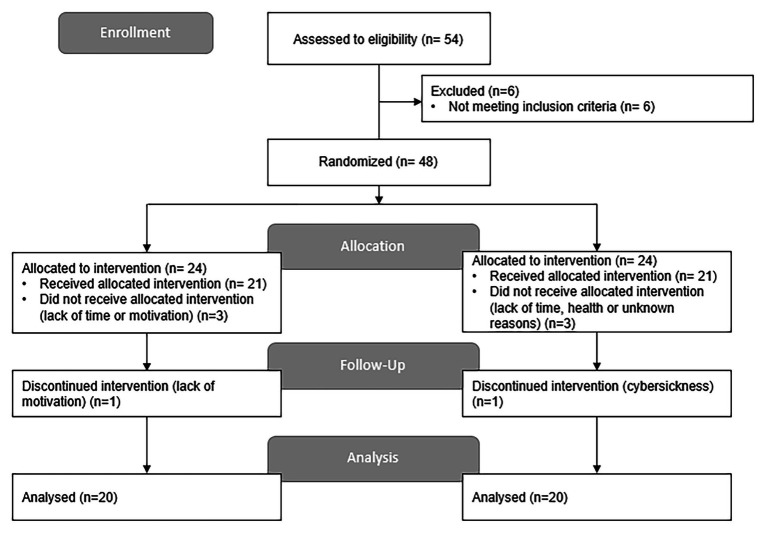
In this proof-of-concept study, we assessed the potential for immersive virtual reality (VR) to measure transfer following strategic memory training, and whether efficacy and transfer are increased when training is complemented by practice in an immersive virtual environment. Forty older adults with subjective memory complaints were trained with the method of loci. They were randomized to either a condition where they practiced the strategy in VR ( = 20) or a control condition where they were familiarized with VR using a non-memory task ( = 20). Training efficacy was measured with word recall, and transfer of the training benefit was measured with a recall task completed in two VR tasks (primary outcomes) as well as a self-report memory questionnaire (secondary outcomes). Testing was administered before (PRE), midway (POST 3), and after (POST 6) training. Participants improved their scores on word recall. Regarding transfer measures, participants improved their performance in the two VR recall tasks but not on the self-report memory questionnaire. No significant group effect was observed. Improvement was found when comparing PRE to POST 3 with no further improvement at POST 6. Thus, strategic memory training improved the memory of seniors with memory complaints on word recall and a transfer task relying on a VR scenario that resembles real-life. However, no evidence supporting an increase in transfer effects was found when enriching training with VR memory exercises.
在这项概念验证研究中,我们评估了沉浸式虚拟现实(VR)在测量策略性记忆训练后的迁移效果方面的潜力,以及当训练辅以沉浸式虚拟环境中的练习时,训练效果和迁移效果是否会增强。40名有主观记忆问题的老年人接受了位置记忆法训练。他们被随机分为两组,一组在VR中练习该策略(n = 20),另一组为对照组,通过非记忆任务熟悉VR(n = 20)。训练效果通过单词回忆进行测量,训练益处的迁移通过在两项VR任务中完成的回忆任务(主要结果)以及一份自我报告记忆问卷(次要结果)进行测量。测试在训练前(PRE)、训练中期(POST 3)和训练后(POST 6)进行。参与者在单词回忆方面提高了分数。在迁移测量方面,参与者在两项VR回忆任务中的表现有所提高,但在自我报告记忆问卷上没有提高。未观察到显著的组间效应。将PRE与POST 3进行比较时发现有改善,而在POST 6时没有进一步改善。因此,策略性记忆训练改善了有记忆问题的老年人在单词回忆以及依赖类似于现实生活的VR场景的迁移任务中的记忆。然而,当用VR记忆练习丰富训练时,没有发现支持迁移效果增强的证据。