Environmental Health Services, British Columbia Centre for Disease Control (BCCDC), Vancouver, BC, Canada.
Department of Epidemiology and Biostatistics, McGill University, Montreal, QC, Canada.
Front Public Health. 2021 Mar 12;9:499309. doi: 10.3389/fpubh.2021.499309. eCollection 2021.
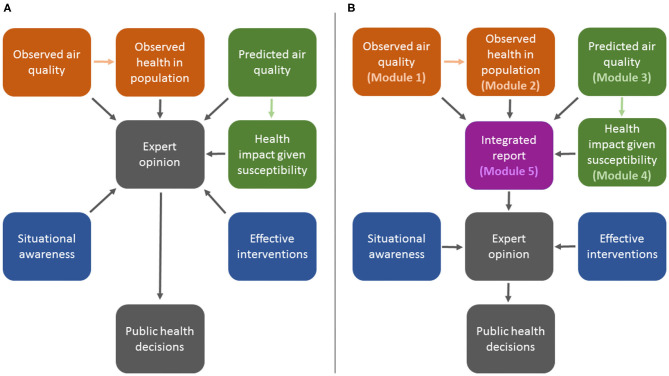
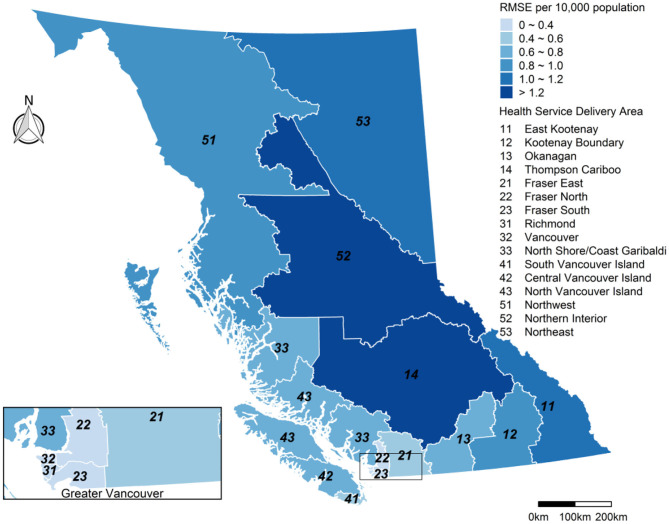
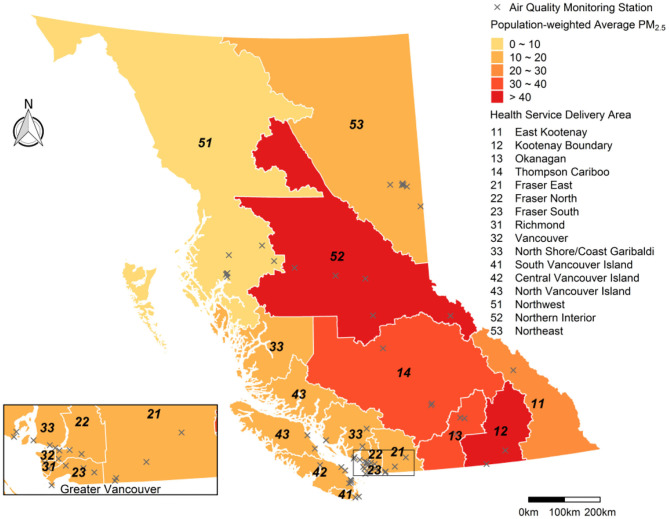
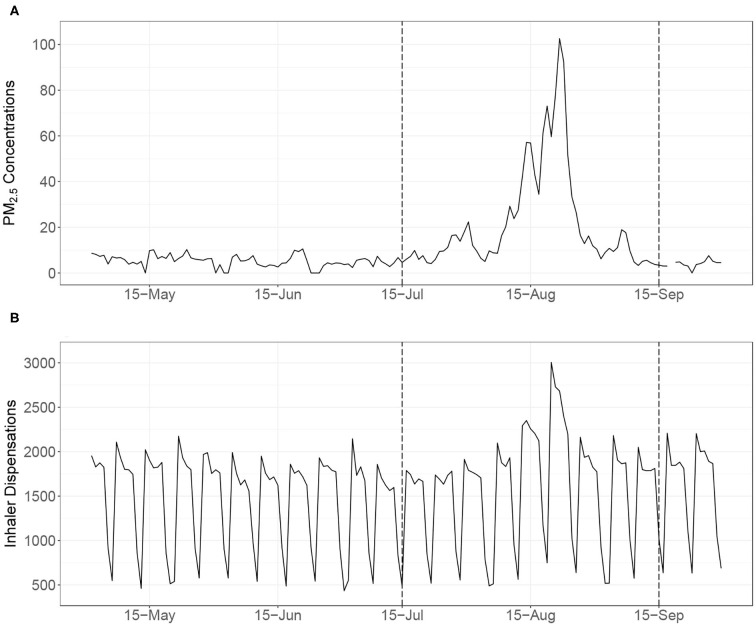
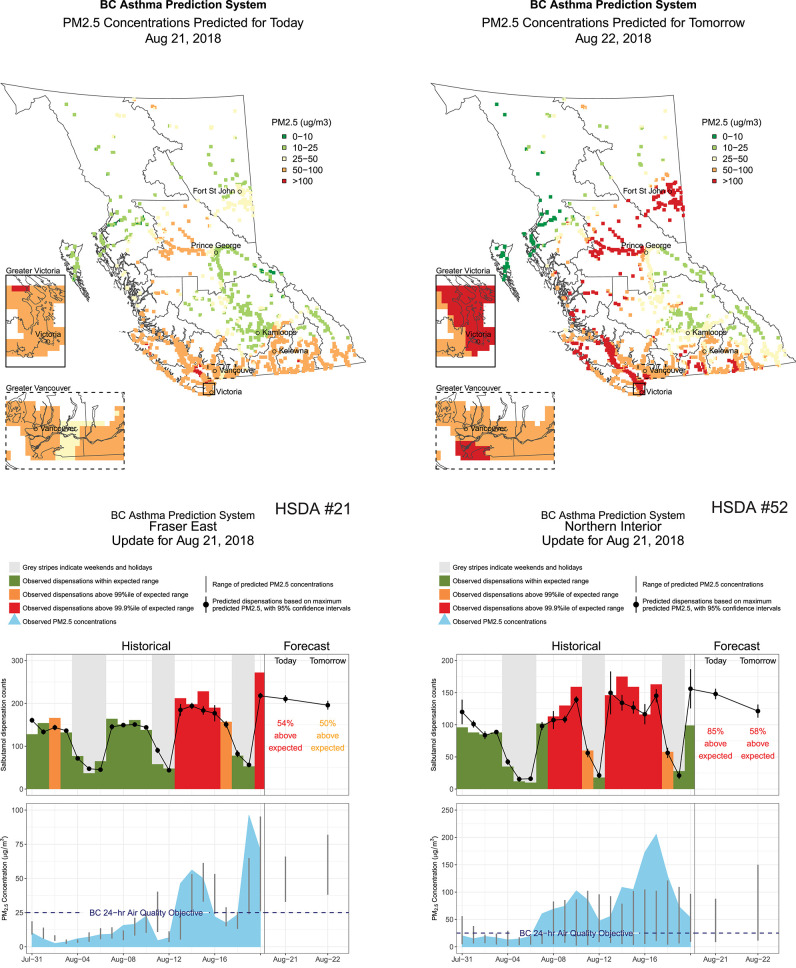
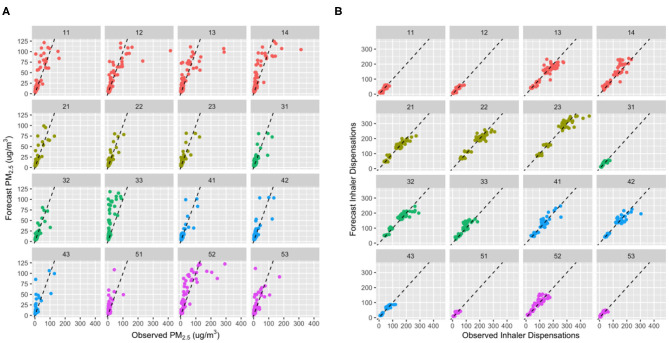
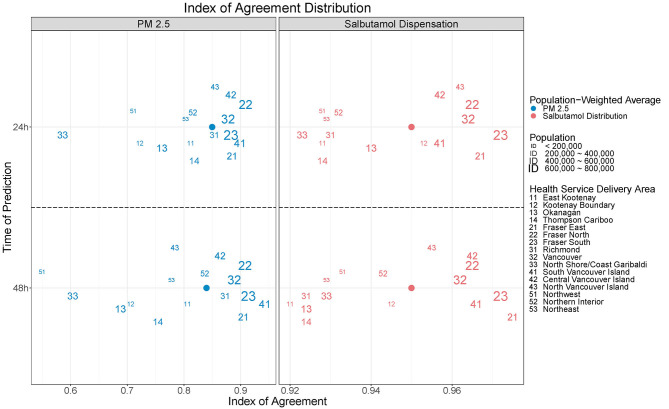
The modular British Columbia Asthma Prediction System (BCAPS) is designed to reduce information burden during wildfire smoke events by automatically gathering, integrating, generating, and visualizing data for public health users. The BCAPS framework comprises five flexible and geographically scalable modules: (1) historic data on fine particulate matter (PM) concentrations; (2) historic data on relevant health indicator counts; (3) PM forecasts for the upcoming days; (4) a health forecasting model that uses the relationship between (1) and (2) to predict the impacts of (3); and (5) a reporting mechanism. The 2018 wildfire season was the most extreme in British Columbia history. Every morning BCAPS generated forecasts of salbutamol sulfate (e.g., Ventolin) inhaler dispensations for the upcoming days in 16 Health Service Delivery Areas (HSDAs) using random forest machine learning. These forecasts were compared with observations over a 63-day study period using different methods including the index of agreement (IOA), which ranges from 0 (no agreement) to 1 (perfect agreement). Some observations were compared with the same period in the milder wildfire season of 2016 for context. The mean province-wide population-weighted PM concentration over the study period was 22.0 μg/m, compared with 4.2 μg/m during the milder wildfire season of 2016. The PM forecasts underpredicted the severe smoke impacts, but the IOA was relatively strong with a population-weighted average of 0.85, ranging from 0.65 to 0.95 among the HSDAs. Inhaler dispensations increased by 30% over 2016 values. Forecasted dispensations were within 20% of the observed value in 71% of cases, and the IOA was strong with a population-weighted average of 0.95, ranging from 0.92 to 0.98. All measures of agreement were correlated with HSDA population, where BCAPS performance was better in the larger populations with more moderate smoke impacts. The accuracy of the health forecasts was partially dependent on the accuracy of the PM forecasts, but they were robust to over- and underpredictions of PM exposure. Daily reports from the BCAPS framework provided timely and reasonable insight into the population health impacts of predicted smoke exposures, though more work is necessary to improve the PM and health indicator forecasts.
模块化不列颠哥伦比亚省哮喘预测系统(BCAPS)旨在通过自动收集、整合、生成和可视化公共卫生用户的数据来减少野火烟雾事件中的信息负担。BCAPS 框架由五个灵活且具有地理可扩展性的模块组成:(1)细颗粒物(PM)浓度的历史数据;(2)相关健康指标计数的历史数据;(3)未来几天的 PM 预测;(4)使用(1)和(2)之间的关系来预测(3)影响的健康预测模型;以及(5)报告机制。2018 年野火季节是不列颠哥伦比亚省历史上最极端的一次。每天早上,BCAPS 使用随机森林机器学习为 16 个卫生服务提供区域(HSDAs)生成未来几天硫酸沙丁胺醇(例如,Ventolin)吸入器配药的预测。在为期 63 天的研究期间,使用不同的方法(包括协议指数(IOA),范围从 0(无协议)到 1(完全协议))将这些预测与观察结果进行了比较。为了上下文比较,有些观察结果与 2016 年较温和的野火季节的同一时期进行了比较。研究期间全省加权 PM 浓度的平均值为 22.0μg/m,而 2016 年较温和的野火季节为 4.2μg/m。PM 预测低估了严重烟雾的影响,但 IOA 相对较强,加权平均值为 0.85,在 HSDAs 中范围为 0.65 至 0.95。吸入器配药比 2016 年增加了 30%。在 71%的情况下,预测的配药在观察值的 20%以内,IOA 很强,加权平均值为 0.95,范围为 0.92 至 0.98。所有协议衡量标准都与 HSDA 人口相关,其中 BCAPS 在人口较多且烟雾影响较温和的地区表现更好。健康预测的准确性部分取决于 PM 预测的准确性,但它们对 PM 暴露的过高和过低预测具有鲁棒性。BCAPS 框架的每日报告及时提供了对预测烟雾暴露对人群健康影响的合理见解,尽管需要做更多工作来改进 PM 和健康指标预测。