Cheng Yun-Jiu, Chen Zhen-Guang, Wu Su-Hua, Mei Wei-Yi, Yao Feng-Juan, Zhang Ming, Luo Dong-Ling
Department of Cardiology, the First Affiliated Hospital, Sun Yat-Sen University, Guangzhou 510700, China.
Key Laboratory on Assisted Circulation, Ministry of Health, Guangzhou, China.
EClinicalMedicine. 2021 Mar 18;33:100790. doi: 10.1016/j.eclinm.2021.100790. eCollection 2021 Mar.
Our understanding of the weight-outcome association mainly comes from single-time body mass index (BMI) measurement. However, data on long-term trajectories of within-person changes in BMI on diverse study outcomes are sparse. Therefore, his study is to determine the associations of individual BMI trajectories and cardiovascular outcomes.
The present analysis was based on data from 4 large prospective cohorts and restricted to participants aged ≥45 years with at least two BMI measurements. Hazard ratios (HR) and 95% confidence intervals(95%CI) for each outcome according to different BMI trajectories were calculated in Cox regression models.
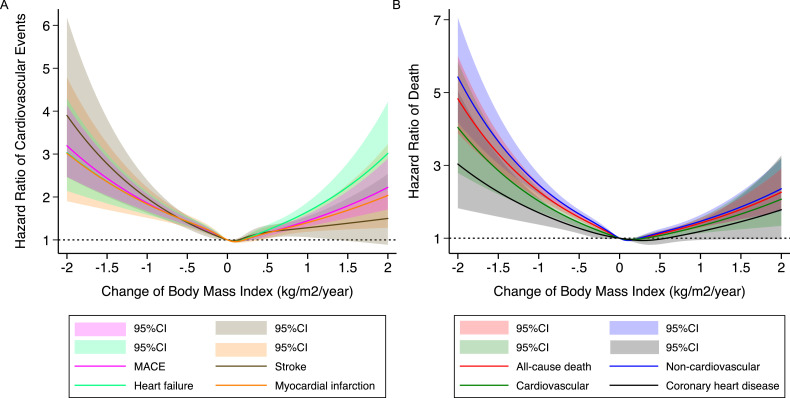
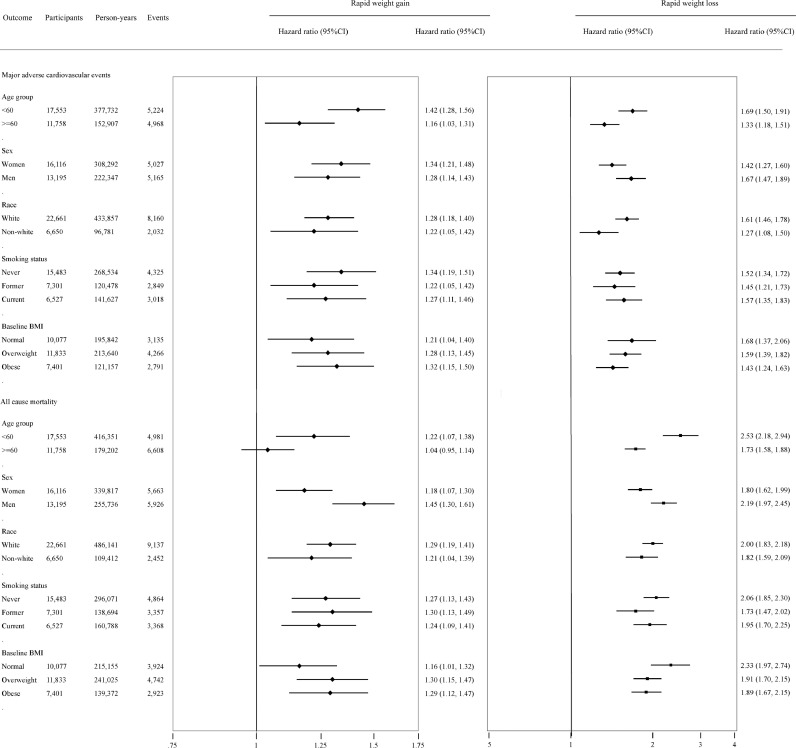
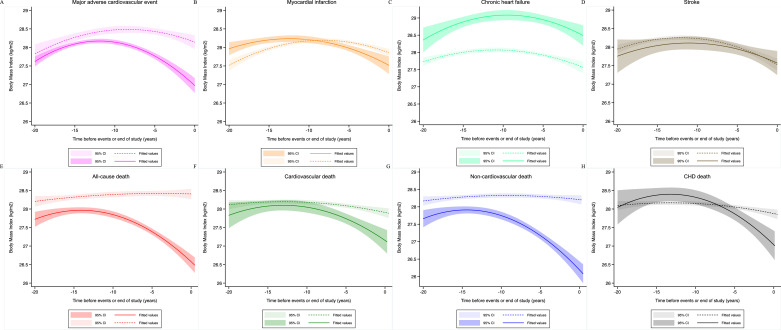
The final sample comprised 29,311 individuals (mean age 58.31 years, and 77.31% were white), with a median 4 BMI measurements used in this study. During a median follow-up of 21.16 years, there were a total of 10,192 major adverse cardiovascular events (MACE) and 11,589 deaths. A U-shaped relation was seen with all study outcomes. Compared with maintaining stable weight, the multivariate adjusted HR for MACE were 1.53 (95%CI 1.40-1.66), 1.26 (95%CI 1.16-1.37) and 1.08 (95%CI 1.02-1.15) respectively for rapid, moderate and slow weight loss; 1.01 (95%CI 0.95-1.07), 1.13 (95%CI 1.05-1.21) and 1.29 (95%CI 1.20-1.40) respectively for slow, moderate and rapid weight gain. Identical patterns of association were observed for all other outcomes. The development of BMI differed markedly between the outcome-free individuals and those who went on to experience adverse events, generally beginning to diverge 10 years before the occurrence of the events.
Our findings may signal an underlying high-risk population and inspire future studies on weight management.
National Natural Science Foundation of China, Guangdong Natural Science Foundation.
我们对体重与结果之间关联的理解主要来自单次体重指数(BMI)测量。然而,关于个体BMI随时间变化的长期轨迹与各种研究结果之间的数据却很稀少。因此,本研究旨在确定个体BMI轨迹与心血管疾病结果之间的关联。
本分析基于4个大型前瞻性队列的数据,研究对象为年龄≥45岁且至少有两次BMI测量值的参与者。在Cox回归模型中,根据不同的BMI轨迹计算每个结果的风险比(HR)和95%置信区间(95%CI)。
最终样本包括29311名个体(平均年龄58.31岁,77.31%为白人),本研究中使用的BMI测量值中位数为4次。在中位随访21.16年期间,共有10192例主要不良心血管事件(MACE)和11589例死亡。在所有研究结果中均观察到U型关系。与体重保持稳定相比,快速、中度和缓慢体重减轻者发生MACE的多因素调整HR分别为1.53(95%CI 1.40-1.66)、1.26(95%CI 1.16-1.37)和1.08(95%CI 1.02-1.15);缓慢、中度和快速体重增加者的相应HR分别为1.01(95%CI 0.95-1.07)、1.13(95%CI 1.05-1.21)和1.29(95%CI 1.20-1.40)。在所有其他结果中也观察到了相同的关联模式。无事件个体与发生不良事件个体的BMI变化情况明显不同,通常在事件发生前10年就开始出现差异。
我们的研究结果可能提示了一个潜在的高危人群,并为未来的体重管理研究提供了启示。
中国国家自然科学基金、广东省自然科学基金。