Fahim Noha Alaa Eldin
Clinical Pathology Department, Faculty of Medicine, Ain Shams University, Cairo, Egypt.
J Egypt Public Health Assoc. 2021 Mar 29;96(1):7. doi: 10.1186/s42506-020-00065-8.
The nightmare of the rising numbers of multidrug-resistant organisms (MDROs) requires the implementation of effective stewardship programs. However, this should be preceeded by making available evidence-based knowledge regarding the local antimicrobial resistance pattern, which is fundamental. The aim of the current study is to determine the prevalence of MDRO among different Ain Shams University Hospitals (ASUHs) intensive care units (ICUs) and detect the resistance profile of the common pathogens.
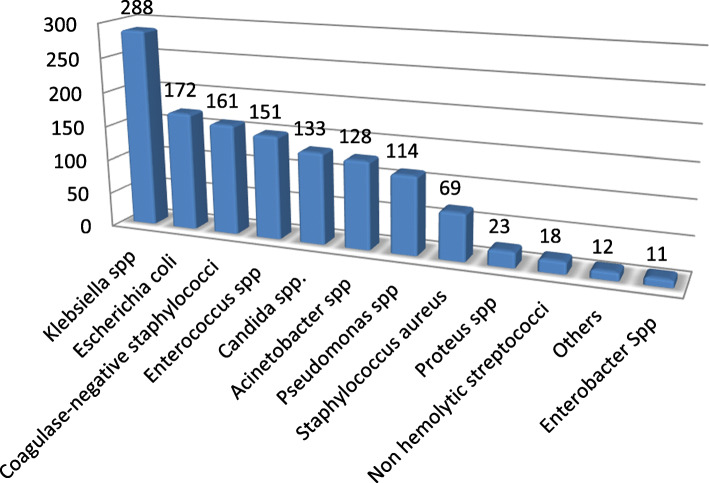
The 1-year records of a total of 1280 pathogens were studied. The highest number of pathogens were isolated from blood cultures (44.84%), followed by urine (41.41%) then wound swabs (13.75%). Gram-negative isolates (57.5%) were more prevalent than gram-positive ones (31.1%). The most frequently isolated pathogens were Klebsiella spp. (22.5%), Escherichia coli (13.4%), and Coagulase-negative Staphylococci (12.5%). The highest percentage of resistance among gram-positive organisms was exhibited by penicillin (89.5%) followed by erythromycin (83.98%) and then cefoxitin (76.52%). None of the isolates showed resistance to linezolid and resistance to vancomycin was minimal (2.62%). Gram-negative isolates exhibited high overall resistance to all used antibiotic classes. The least frequency of resistance was recorded against nitrofurantoin (52.5%), amikacin (58.01%), followed by imipenem (59.78%) and meropenem (61.82%). All isolates of Pseudomonas and Acinetobacter showed 100% susceptibility to colistin.
The prevalence of antibiotic resistance in Ain Shams University Hospitals (ASUHs) was high among both gram-negative and gram-positive organisms. This high resistance pattern foreshadows an inevitable catastrophe that requires continuous monitoring and implementation of effective antibiotic stewardship.
多重耐药菌(MDROs)数量不断增加,这一噩梦要求实施有效的管理计划。然而,在此之前应提供有关当地抗菌药物耐药模式的循证知识,这是至关重要的。本研究的目的是确定不同艾因夏姆斯大学医院(ASUHs)重症监护病房(ICUs)中MDRO的流行情况,并检测常见病原体的耐药谱。
共研究了1280种病原体的1年记录。从血培养中分离出的病原体数量最多(44.84%),其次是尿液(41.41%),然后是伤口拭子(13.75%)。革兰氏阴性菌分离株(57.5%)比革兰氏阳性菌分离株(31.1%)更普遍。最常分离出的病原体是克雷伯菌属(22.5%)、大肠杆菌(13.4%)和凝固酶阴性葡萄球菌(12.5%)。革兰氏阳性菌中耐药率最高的是青霉素(89.5%),其次是红霉素(83.98%),然后是头孢西丁(76.52%)。没有分离株对利奈唑胺耐药,对万古霉素的耐药率极低(2.62%)。革兰氏阴性菌分离株对所有使用的抗生素类别均表现出较高的总体耐药性。耐药频率最低的是呋喃妥因(52.5%)、阿米卡星(58.01%),其次是亚胺培南(59.78%)和美罗培南(61.82%)。所有铜绿假单胞菌和不动杆菌分离株对黏菌素均表现出100%的敏感性。
艾因夏姆斯大学医院(ASUHs)中革兰氏阴性菌和革兰氏阳性菌的抗生素耐药率均较高。这种高耐药模式预示着一场不可避免的灾难,需要持续监测并实施有效的抗生素管理。