South Carolina SmartState Center for Healthcare Quality, Arnold School of Public Health, University of South Carolina, Columbia, SC, United States.
Department of Health Promotion, Education, and Behavior, Arnold School of Public Health, University of South Carolina, Columbia, SC, United States.
J Med Internet Res. 2021 Apr 13;23(4):e27045. doi: 10.2196/27045.
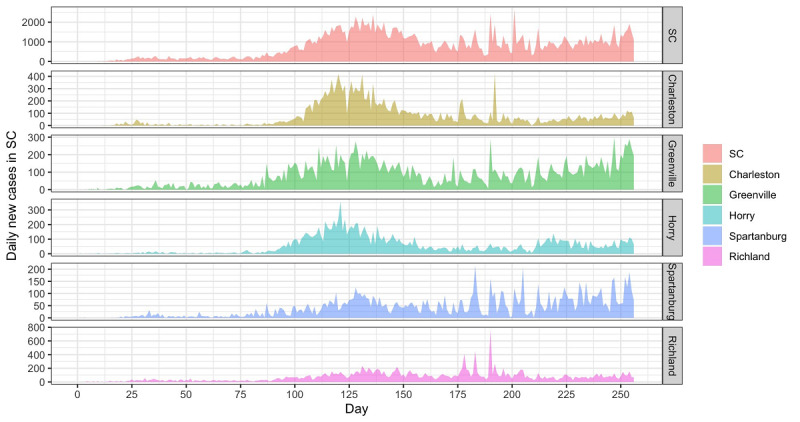
Population mobility is closely associated with COVID-19 transmission, and it could be used as a proximal indicator to predict future outbreaks, which could inform proactive nonpharmaceutical interventions for disease control. South Carolina is one of the US states that reopened early, following which it experienced a sharp increase in COVID-19 cases.
The aims of this study are to examine the spatial-temporal relationship between population mobility and COVID-19 outbreaks and use population mobility data to predict daily new cases at both the state and county level in South Carolina.
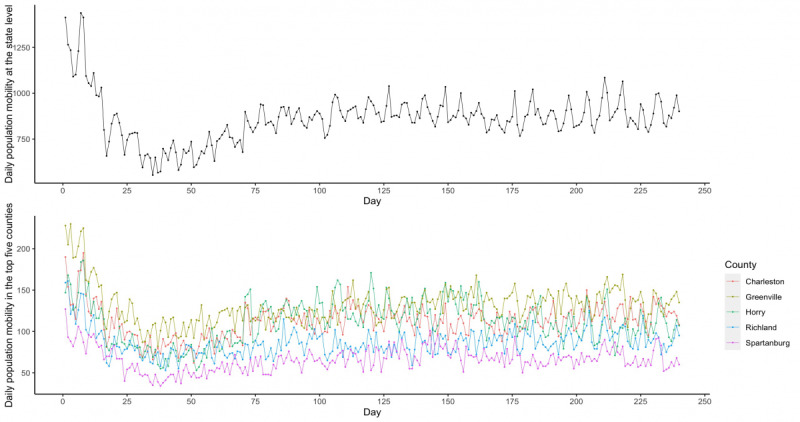
This longitudinal study used disease surveillance data and Twitter-based population mobility data from March 6 to November 11, 2020, in South Carolina and its five counties with the largest number of cumulative confirmed COVID-19 cases. Population mobility was assessed based on the number of Twitter users with a travel distance greater than 0.5 miles. A Poisson count time series model was employed for COVID-19 forecasting.
Population mobility was positively associated with state-level daily COVID-19 incidence as well as incidence in the top five counties (ie, Charleston, Greenville, Horry, Spartanburg, and Richland). At the state level, the final model with a time window within the last 7 days had the smallest prediction error, and the prediction accuracy was as high as 98.7%, 90.9%, and 81.6% for the next 3, 7, and 14 days, respectively. Among Charleston, Greenville, Horry, Spartanburg, and Richland counties, the best predictive models were established based on their observations in the last 9, 14, 28, 20, and 9 days, respectively. The 14-day prediction accuracy ranged from 60.3%-74.5%.
Using Twitter-based population mobility data could provide acceptable predictions of COVID-19 daily new cases at both the state and county level in South Carolina. Population mobility measured via social media data could inform proactive measures and resource relocations to curb disease outbreaks and their negative influences.
人口流动与 COVID-19 的传播密切相关,可作为预测未来疫情爆发的近端指标,为疾病控制提供主动的非药物干预措施信息。南卡罗来纳州是美国较早重新开放的州之一,此后 COVID-19 病例急剧增加。
本研究旨在检验人口流动与 COVID-19 疫情之间的时空关系,并利用人口流动数据预测南卡罗来纳州的州级和县级每日新增病例。
本纵向研究使用了 2020 年 3 月 6 日至 11 月 11 日期间来自南卡罗来纳州及其五个累计确诊 COVID-19 病例最多的县的疾病监测数据和基于 Twitter 的人口流动数据。人口流动通过具有大于 0.5 英里旅行距离的 Twitter 用户数量来评估。采用泊松计数时间序列模型进行 COVID-19 预测。
人口流动与州级每日 COVID-19 发病率以及前五个县(查尔斯顿、格林维尔、霍里、斯巴达堡和里奇兰)的发病率呈正相关。在州级水平,最后一个时间窗口为过去 7 天的模型具有最小的预测误差,对于未来 3、7 和 14 天,其预测准确率分别高达 98.7%、90.9%和 81.6%。在查尔斯顿、格林维尔、霍里、斯巴达堡和里奇兰县,最佳预测模型是基于过去 9、14、28、20 和 9 天的观察结果建立的,14 天预测准确率在 60.3%-74.5%之间。
利用基于 Twitter 的人口流动数据可以对南卡罗来纳州的州级和县级的 COVID-19 每日新增病例进行可接受的预测。通过社交媒体数据测量的人口流动可以为主动采取措施和资源重新配置提供信息,以遏制疾病爆发及其负面影响。