• 文献检索
  • 文档翻译
  • 深度研究
  • 学术资讯
  • Suppr Zotero 插件Zotero 插件
  • 邀请有礼
  • 套餐&价格
  • 历史记录
应用&插件
Suppr Zotero 插件Zotero 插件浏览器插件Mac 客户端Windows 客户端微信小程序
定价
高级版会员购买积分包购买API积分包
服务
文献检索文档翻译深度研究API 文档MCP 服务
关于我们
关于 Suppr公司介绍联系我们用户协议隐私条款
关注我们

Suppr 超能文献

核心技术专利:CN118964589B侵权必究
粤ICP备2023148730 号-1Suppr @ 2026

文献检索

告别复杂PubMed语法,用中文像聊天一样搜索,搜遍4000万医学文献。AI智能推荐,让科研检索更轻松。

立即免费搜索

文件翻译

保留排版,准确专业,支持PDF/Word/PPT等文件格式,支持 12+语言互译。

免费翻译文档

深度研究

AI帮你快速写综述,25分钟生成高质量综述,智能提取关键信息,辅助科研写作。

立即免费体验

新型机器学习模型的开发和性能评估,以预测肝移植后的肺炎。

Development and performance assessment of novel machine learning models to predict pneumonia after liver transplantation.

机构信息

Department of Anesthesiology, The Third Affiliated Hospital of Sun Yat-Sen University, No. 600 Tianhe Road, Guangzhou, 10630, Guangdong, People's Republic of China.

Guangzhou AID Cloud Technology Co., LTD, Guangzhou, People's Republic of China.

出版信息

Respir Res. 2021 Mar 31;22(1):94. doi: 10.1186/s12931-021-01690-3.

DOI:10.1186/s12931-021-01690-3
PMID:33789673
原文链接:https://pmc.ncbi.nlm.nih.gov/articles/PMC8011203/
Abstract

BACKGROUND

Pneumonia is the most frequently encountered postoperative pulmonary complications (PPC) after orthotopic liver transplantation (OLT), which cause high morbidity and mortality rates. We aimed to develop a model to predict postoperative pneumonia in OLT patients using machine learning (ML) methods.

METHODS

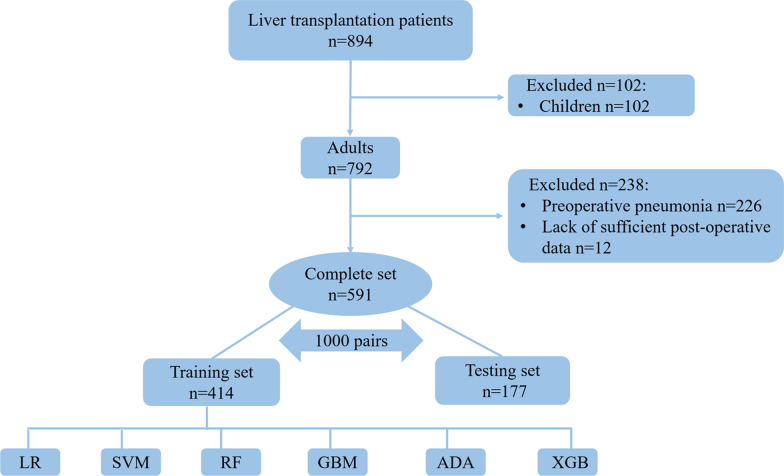
Data of 786 adult patients underwent OLT at the Third Affiliated Hospital of Sun Yat-sen University from January 2015 to September 2019 was retrospectively extracted from electronic medical records and randomly subdivided into a training set and a testing set. With the training set, six ML models including logistic regression (LR), support vector machine (SVM), random forest (RF), adaptive boosting (AdaBoost), extreme gradient boosting (XGBoost) and gradient boosting machine (GBM) were developed. These models were assessed by the area under curve (AUC) of receiver operating characteristic on the testing set. The related risk factors and outcomes of pneumonia were also probed based on the chosen model.

RESULTS

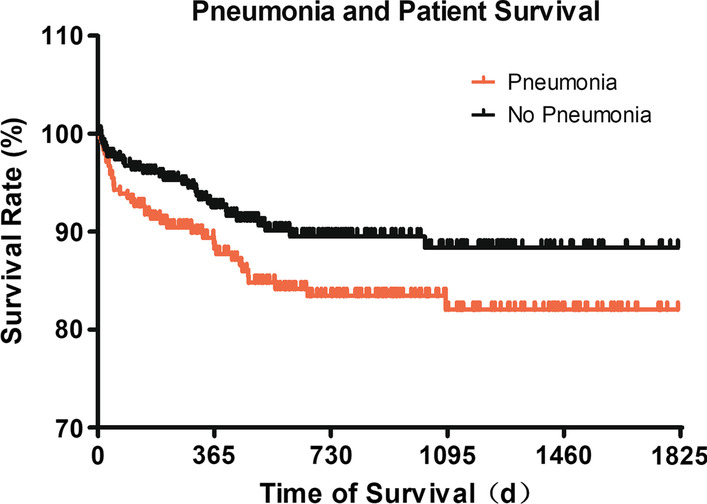
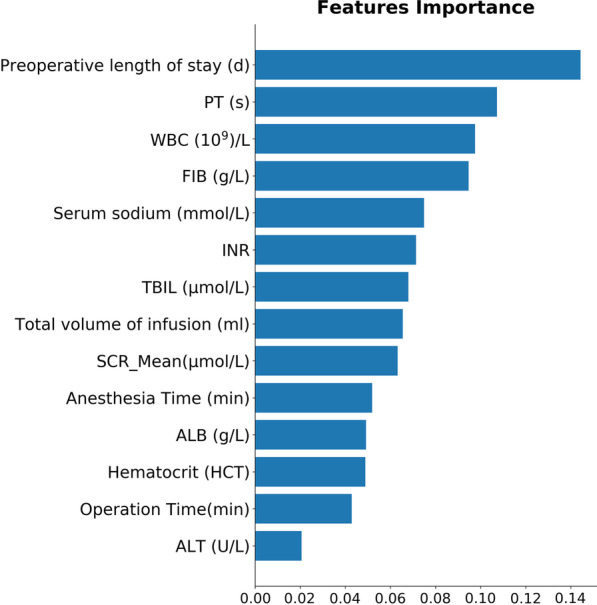
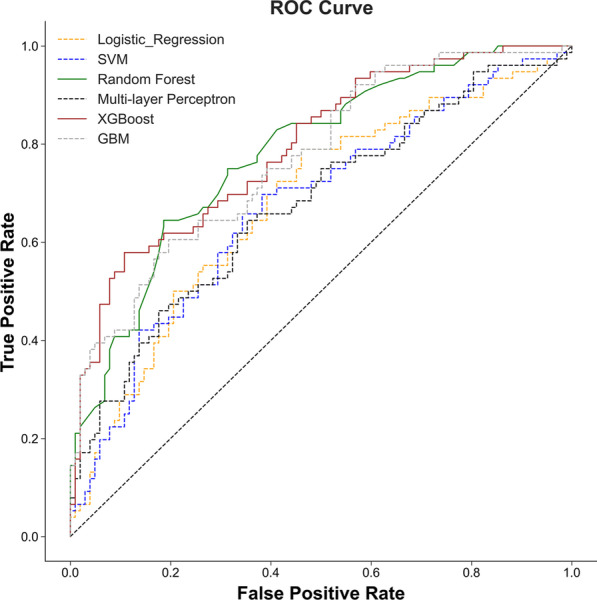
591 OLT patients were eventually included and 253 (42.81%) were diagnosed with postoperative pneumonia, which was associated with increased postoperative hospitalization and mortality (P < 0.05). Among the six ML models, XGBoost model performed best. The AUC of XGBoost model on the testing set was 0.734 (sensitivity: 52.6%; specificity: 77.5%). Pneumonia was notably associated with 14 items features: INR, HCT, PLT, ALB, ALT, FIB, WBC, PT, serum Na, TBIL, anesthesia time, preoperative length of stay, total fluid transfusion and operation time.

CONCLUSION

Our study firstly demonstrated that the XGBoost model with 14 common variables might predict postoperative pneumonia in OLT patients.

摘要

背景

肺炎是肝移植(OLT)后最常见的术后肺部并发症(PPC),导致高发病率和死亡率。我们旨在使用机器学习(ML)方法为 OLT 患者开发一种预测术后肺炎的模型。

方法

从电子病历中回顾性提取 2015 年 1 月至 2019 年 9 月在中山大学附属第三医院接受 OLT 的 786 名成年患者的数据,并将其随机分为训练集和测试集。使用训练集,开发了包括逻辑回归(LR)、支持向量机(SVM)、随机森林(RF)、自适应增强(AdaBoost)、极端梯度增强(XGBoost)和梯度提升机(GBM)在内的 6 个 ML 模型。使用测试集上的接收者操作特征曲线(AUC)评估这些模型。还根据选定的模型探究了肺炎的相关风险因素和结果。

结果

最终纳入 591 名 OLT 患者,其中 253 名(42.81%)被诊断为术后肺炎,与术后住院时间延长和死亡率增加有关(P < 0.05)。在六个 ML 模型中,XGBoost 模型表现最佳。XGBoost 模型在测试集上的 AUC 为 0.734(灵敏度:52.6%;特异性:77.5%)。肺炎与 14 项特征明显相关:INR、HCT、PLT、ALB、ALT、FIB、WBC、PT、血清 Na、TBIL、麻醉时间、术前住院时间、总液体输注量和手术时间。

结论

本研究首次表明,XGBoost 模型结合 14 个常见变量可能预测 OLT 患者术后肺炎。
https://cdn.ncbi.nlm.nih.gov/pmc/blobs/d794/8011203/49e3f20496e2/12931_2021_1690_Fig4_HTML.jpg
https://cdn.ncbi.nlm.nih.gov/pmc/blobs/d794/8011203/57b5f9a9c32e/12931_2021_1690_Fig1_HTML.jpg
https://cdn.ncbi.nlm.nih.gov/pmc/blobs/d794/8011203/f22b6dc4dc13/12931_2021_1690_Fig2_HTML.jpg
https://cdn.ncbi.nlm.nih.gov/pmc/blobs/d794/8011203/1dc80b913f1a/12931_2021_1690_Fig3_HTML.jpg
https://cdn.ncbi.nlm.nih.gov/pmc/blobs/d794/8011203/49e3f20496e2/12931_2021_1690_Fig4_HTML.jpg
https://cdn.ncbi.nlm.nih.gov/pmc/blobs/d794/8011203/57b5f9a9c32e/12931_2021_1690_Fig1_HTML.jpg
https://cdn.ncbi.nlm.nih.gov/pmc/blobs/d794/8011203/f22b6dc4dc13/12931_2021_1690_Fig2_HTML.jpg
https://cdn.ncbi.nlm.nih.gov/pmc/blobs/d794/8011203/1dc80b913f1a/12931_2021_1690_Fig3_HTML.jpg
https://cdn.ncbi.nlm.nih.gov/pmc/blobs/d794/8011203/49e3f20496e2/12931_2021_1690_Fig4_HTML.jpg

相似文献

1
Development and performance assessment of novel machine learning models to predict pneumonia after liver transplantation.新型机器学习模型的开发和性能评估,以预测肝移植后的肺炎。
Respir Res. 2021 Mar 31;22(1):94. doi: 10.1186/s12931-021-01690-3.
2
Using machine learning to predict stroke-associated pneumonia in Chinese acute ischaemic stroke patients.使用机器学习预测中国急性缺血性脑卒中患者的卒中相关性肺炎。
Eur J Neurol. 2020 Aug;27(8):1656-1663. doi: 10.1111/ene.14295. Epub 2020 May 31.
3
Predicting post-stroke pneumonia using deep neural network approaches.使用深度神经网络方法预测卒中后肺炎。
Int J Med Inform. 2019 Dec;132:103986. doi: 10.1016/j.ijmedinf.2019.103986. Epub 2019 Oct 1.
4
Application of machine learning model in predicting the likelihood of blood transfusion after hip fracture surgery.机器学习模型在预测髋部骨折手术后输血可能性中的应用。
Aging Clin Exp Res. 2023 Nov;35(11):2643-2656. doi: 10.1007/s40520-023-02550-4. Epub 2023 Sep 21.
5
Development and validation of a practical machine learning model to predict sepsis after liver transplantation.开发和验证一种实用的机器学习模型,以预测肝移植术后脓毒症。
Ann Med. 2023 Dec;55(1):624-633. doi: 10.1080/07853890.2023.2179104.
6
Prediction of postoperative infectious complications in elderly patients with colorectal cancer: a study based on improved machine learning.基于改进机器学习的老年结直肠癌患者术后感染并发症预测研究。
BMC Med Inform Decis Mak. 2024 Jan 6;24(1):11. doi: 10.1186/s12911-023-02411-0.
7
Can Predictive Modeling Tools Identify Patients at High Risk of Prolonged Opioid Use After ACL Reconstruction?预测模型工具能否识别 ACL 重建术后阿片类药物使用时间延长的高风险患者?
Clin Orthop Relat Res. 2020 Jul;478(7):0-1618. doi: 10.1097/CORR.0000000000001251.
8
Establishment and validation of a heart failure risk prediction model for elderly patients after coronary rotational atherectomy based on machine learning.基于机器学习的老年患者冠状动脉旋磨术后心力衰竭风险预测模型的建立与验证
PeerJ. 2024 Jan 31;12:e16867. doi: 10.7717/peerj.16867. eCollection 2024.
9
Prediction of poststroke independent walking using machine learning: a retrospective study.基于机器学习的脑卒中后独立行走预测:一项回顾性研究。
BMC Neurol. 2024 Sep 10;24(1):332. doi: 10.1186/s12883-024-03849-z.
10
[Application of machine learning model based on XGBoost algorithm in early prediction of patients with acute severe pancreatitis].基于XGBoost算法的机器学习模型在急性重症胰腺炎患者早期预测中的应用
Zhonghua Wei Zhong Bing Ji Jiu Yi Xue. 2023 Apr;35(4):421-426. doi: 10.3760/cma.j.cn121430-20221019-00930.

引用本文的文献

1
Development and validation of an explainable machine learning model for predicting the risk of sleep disorders in older adults with multimorbidity: a cross-sectional study.一种用于预测患有多种疾病的老年人睡眠障碍风险的可解释机器学习模型的开发与验证:一项横断面研究。
Front Public Health. 2025 Aug 11;13:1619406. doi: 10.3389/fpubh.2025.1619406. eCollection 2025.
2
Prediction model for postoperative pulmonary complications after thoracoscopic surgery with machine learning algorithms and SHapley Additive exPlanations.基于机器学习算法和SHapley加性解释法的胸腔镜手术后肺部并发症预测模型
J Thorac Dis. 2025 Jun 30;17(6):3603-3618. doi: 10.21037/jtd-24-1853. Epub 2025 Jun 23.
3

本文引用的文献

1
Development of a Web-Based System for Exploring Cancer Risk With Long-term Use of Drugs: Logistic Regression Approach.基于网络的长期用药癌症风险探索系统的开发:逻辑回归方法
JMIR Public Health Surveill. 2021 Feb 15;7(2):e21401. doi: 10.2196/21401.
2
[Clinical and laboratory characteristics of 215 cases of coronavirus disease 2019 with different prognosis].215例不同预后的2019冠状病毒病患者的临床和实验室特征
Zhonghua Wei Zhong Bing Ji Jiu Yi Xue. 2020 Dec;32(12):1428-1433. doi: 10.3760/cma.j.cn121430-20200824-00590.
3
Application of machine learning in the diagnosis of gastric cancer based on noninvasive characteristics.
An In-depth overview of artificial intelligence (AI) tool utilization across diverse phases of organ transplantation.
人工智能(AI)工具在器官移植不同阶段的应用深度概述。
J Transl Med. 2025 Jun 18;23(1):678. doi: 10.1186/s12967-025-06488-1.
4
Exploring the assessment of post-cardiac valve surgery pulmonary complication risks through the integration of wearable continuous physiological and clinical data.通过整合可穿戴式连续生理和临床数据探索心脏瓣膜置换术后肺部并发症风险评估
BMC Med Inform Decis Mak. 2025 Jan 31;25(1):47. doi: 10.1186/s12911-025-02875-2.
5
A Supervised Explainable Machine Learning Model for Perioperative Neurocognitive Disorder in Liver-Transplantation Patients and External Validation on the Medical Information Mart for Intensive Care IV Database: Retrospective Study.一种用于肝移植患者围手术期神经认知障碍的监督式可解释机器学习模型及在重症监护医学信息数据库IV上的外部验证:一项回顾性研究
J Med Internet Res. 2025 Jan 15;27:e55046. doi: 10.2196/55046.
6
Development and validation of interpretable machine learning models for postoperative pneumonia prediction.用于术后肺炎预测的可解释机器学习模型的开发与验证
Front Public Health. 2024 Dec 11;12:1468504. doi: 10.3389/fpubh.2024.1468504. eCollection 2024.
7
TELEPROM Psoriasis: Enhancing patient-centered care and health-related quality of life (HRQoL) in moderate-to-severe plaque psoriasis.远程促进银屑病治疗:改善中重度斑块状银屑病以患者为中心的护理及健康相关生活质量(HRQoL)
Front Med (Lausanne). 2024 Dec 10;11:1465725. doi: 10.3389/fmed.2024.1465725. eCollection 2024.
8
Enhancing Thoracic Surgery with AI: A Review of Current Practices and Emerging Trends.人工智能在胸外科中的应用:现状与新兴趋势综述。
Curr Oncol. 2024 Oct 17;31(10):6232-6244. doi: 10.3390/curroncol31100464.
9
Development and performance assessment of novel machine learning models for predicting postoperative pneumonia in aneurysmal subarachnoid hemorrhage patients: external validation in MIMIC-IV.用于预测动脉瘤性蛛网膜下腔出血患者术后肺炎的新型机器学习模型的开发与性能评估:在MIMIC-IV中的外部验证
Front Neurol. 2024 Apr 15;15:1341252. doi: 10.3389/fneur.2024.1341252. eCollection 2024.
10
Use of machine learning models for the prognostication of liver transplantation: A systematic review.机器学习模型在肝移植预后评估中的应用:一项系统综述。
World J Transplant. 2024 Mar 18;14(1):88891. doi: 10.5500/wjt.v14.i1.88891.
基于无创特征的机器学习在胃癌诊断中的应用。
PLoS One. 2020 Dec 31;15(12):e0244869. doi: 10.1371/journal.pone.0244869. eCollection 2020.
4
Analysis of Risk Factors for 24 Patients With COVID-19 Developing From Moderate to Severe Condition.分析 24 例 COVID-19 患者由轻症转为重症的危险因素。
Front Cell Infect Microbiol. 2020 Sep 15;10:548582. doi: 10.3389/fcimb.2020.548582. eCollection 2020.
5
Predicting Phenotypic Polymyxin Resistance in Klebsiella pneumoniae through Machine Learning Analysis of Genomic Data.通过对基因组数据进行机器学习分析预测肺炎克雷伯菌的表型多粘菌素耐药性
mSystems. 2020 May 26;5(3):e00656-19. doi: 10.1128/mSystems.00656-19.
6
Using machine learning to predict stroke-associated pneumonia in Chinese acute ischaemic stroke patients.使用机器学习预测中国急性缺血性脑卒中患者的卒中相关性肺炎。
Eur J Neurol. 2020 Aug;27(8):1656-1663. doi: 10.1111/ene.14295. Epub 2020 May 31.
7
Systemic Inflammation Score as a Predictor of Pneumonia after Radical Resection of Gastric Cancer: Analysis of a Multi-Institutional Dataset.系统炎症评分作为胃癌根治术后肺炎的预测因子:多机构数据集分析。
Dig Surg. 2020;37(5):401-410. doi: 10.1159/000506940. Epub 2020 Apr 28.
8
Machine learning for the prediction of severe pneumonia during posttransplant hospitalization in recipients of a deceased-donor kidney transplant.机器学习用于预测已故供体肾移植受者移植后住院期间的重症肺炎。
Ann Transl Med. 2020 Feb;8(4):82. doi: 10.21037/atm.2020.01.09.
9
Diagnosis of ventilator-associated pneumonia using electronic nose sensor array signals: solutions to improve the application of machine learning in respiratory research.使用电子鼻传感器阵列信号诊断呼吸机相关性肺炎:解决机器学习在呼吸研究中应用的问题。
Respir Res. 2020 Feb 7;21(1):45. doi: 10.1186/s12931-020-1285-6.
10
Correction to Extreme Gradient Boosting as a Method for Quantitative Structure-Activity Relationships.对极端梯度提升作为定量构效关系方法的修正。
J Chem Inf Model. 2020 Mar 23;60(3):1910. doi: 10.1021/acs.jcim.0c00029. Epub 2020 Jan 24.