Wang Wenjun, Ding Manyu, Gardner Jacob D, Wang Yongqiang, Miao Bo, Guo Wu, Wu Xinhua, Ruan Qiurong, Yu Jianjun, Hu Xingjun, Wang Bo, Wu Xiaohong, Tang Zihua, Niyazi Alipujiang, Zhang Jie, Chang Xien, Tang Yunpeng, Ren Meng, Cao Peng, Liu Feng, Dai Qingyan, Feng Xiaotian, Yang Ruowei, Zhang Ming, Wang Tianyi, Ping Wanjing, Hou Weihong, Li Wenying, Ma Jian, Kumar Vikas, Fu Qiaomei
College of Life Sciences, Northwest University, Xi'an 710069, China.
Key Laboratory of Vertebrate Evolution and Human Origins, Institute of Vertebrate Paleontology and Paleoanthropology, Chinese Academy of Sciences, Beijing 100044, China.
Sci Adv. 2021 Mar 31;7(14). doi: 10.1126/sciadv.abd6690. Print 2021 Mar.
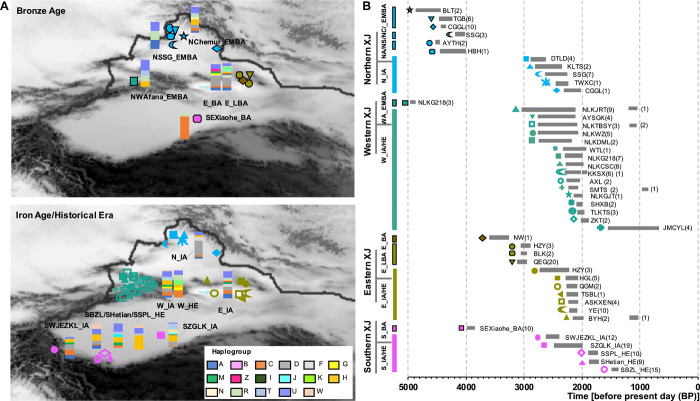
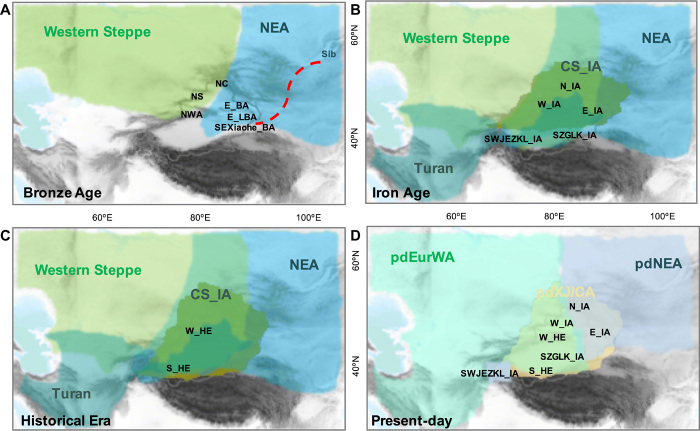
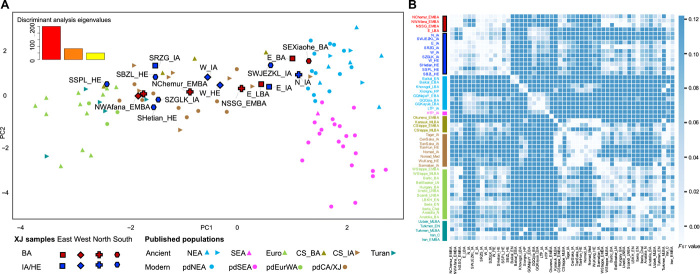
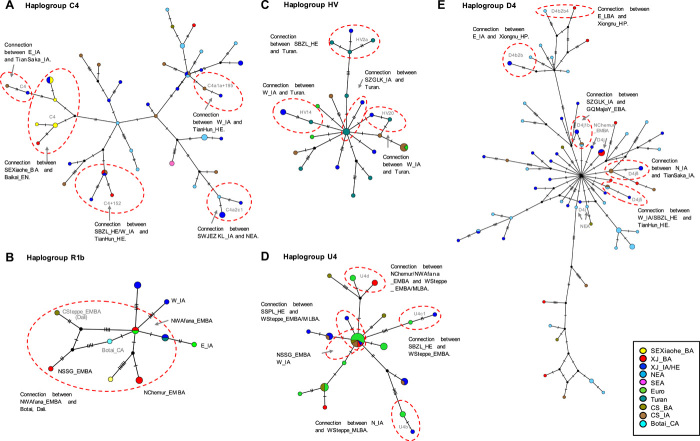
Xinjiang is a key region in northwestern China, connecting East and West Eurasian populations and cultures for thousands of years. To understand the genetic history of Xinjiang, we sequenced 237 complete ancient human mitochondrial genomes from the Bronze Age through Historical Era (41 archaeological sites). Overall, the Bronze Age Xinjiang populations show high diversity and regional genetic affinities with Steppe and northeastern Asian populations along with a deep ancient Siberian connection for the Tarim Basin Xiaohe individuals. In the Iron Age, in general, Steppe-related and northeastern Asian admixture intensified, with North and East Xinjiang populations showing more affinity with northeastern Asians and South Xinjiang populations showing more affinity with Central Asians. The genetic structure observed in the Historical Era of Xinjiang is similar to that in the Iron Age, demonstrating genetic continuity since the Iron Age with some additional genetic admixture with populations surrounding the Xinjiang region.
新疆是中国西北部的一个关键地区,数千年来一直连接着东西方的欧亚人口和文化。为了解新疆的遗传历史,我们对来自青铜时代至历史时期(41个考古遗址)的237个完整的古代人类线粒体基因组进行了测序。总体而言,青铜时代的新疆人群表现出高度的多样性,与草原和东北亚人群有区域遗传亲缘关系,塔里木盆地小河遗址的个体与古代西伯利亚有着深厚的联系。在铁器时代,一般来说,与草原相关的和东北亚的混合加剧,新疆北部和东部人群与东北亚人表现出更多的亲缘关系,而新疆南部人群与中亚人表现出更多的亲缘关系。在新疆历史时期观察到的遗传结构与铁器时代相似,表明自铁器时代以来遗传连续性,同时与新疆周边人群有一些额外的遗传混合。