Department of Pathology, New York University Grossman School of Medicine, New York, NY, USA.
Divison of Gastroenterology and Hepatology, Department of Medicine, Perelman School of Medicine at the University of Pennsylvania, Philadelphia, PA, USA.
Commun Biol. 2021 Mar 31;4(1):436. doi: 10.1038/s42003-021-01962-0.
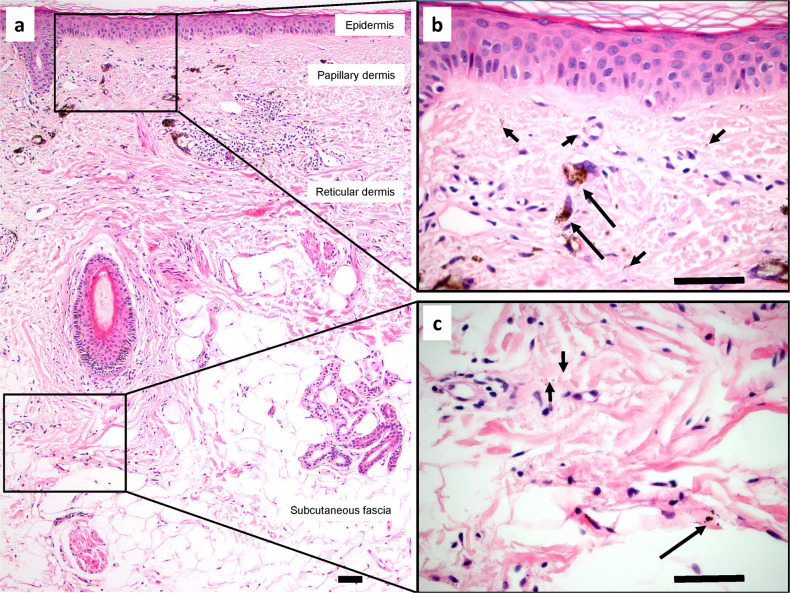
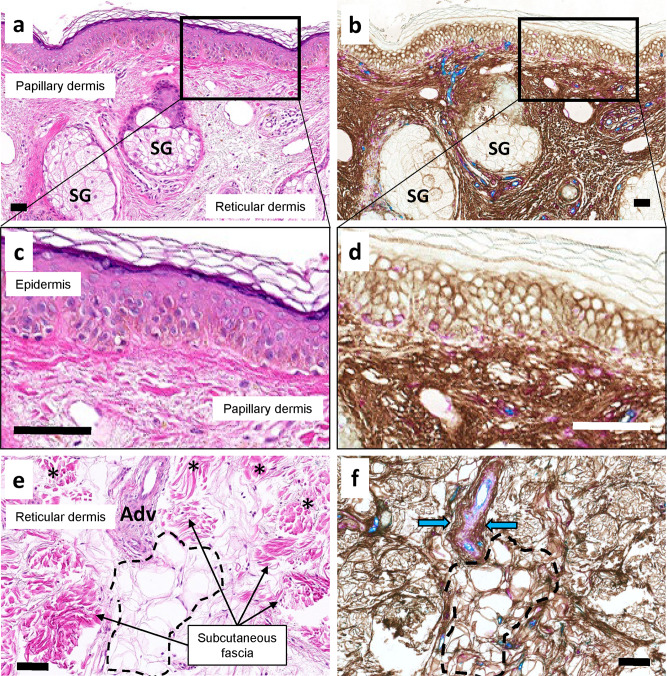
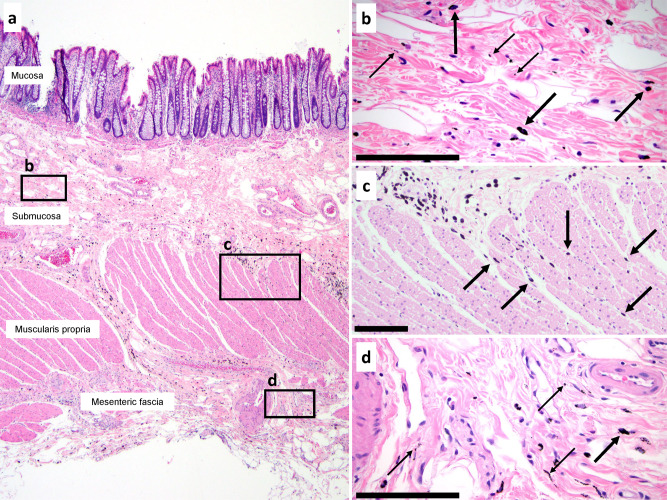
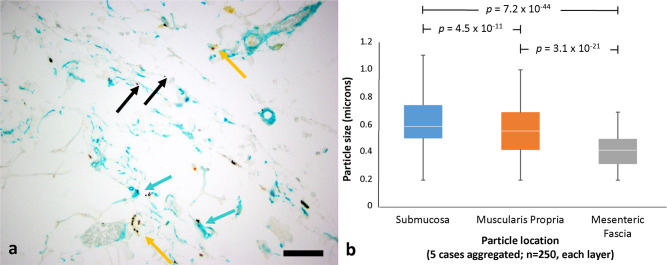
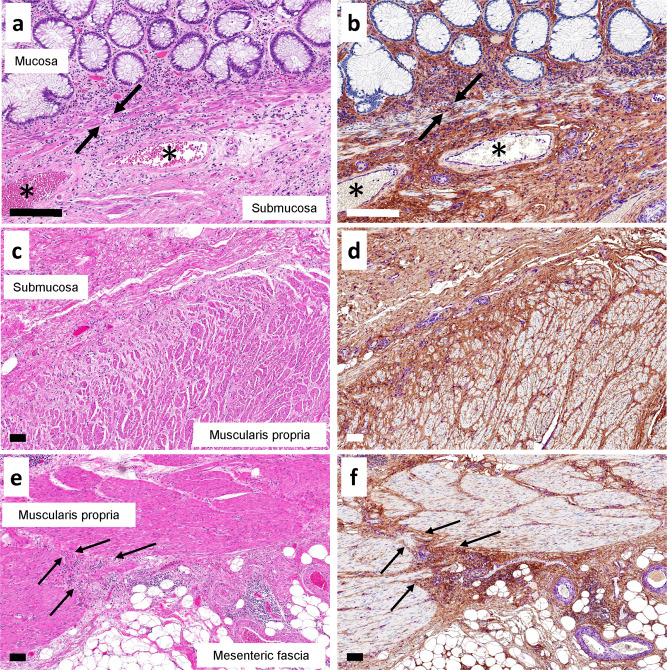
Bodies have continuous reticular networks, comprising collagens, elastin, glycosaminoglycans, and other extracellular matrix components, through all tissues and organs. Fibrous coverings of nerves and blood vessels create structural continuity beyond organ boundaries. We recently validated fluid flow through human fibrous tissues, though whether these interstitial spaces are continuous through the body or discontinuous, confined within individual organs, remains unclear. Here we show evidence for continuity of interstitial spaces using two approaches. Non-biological particles (tattoo pigment, colloidal silver) were tracked within colon and skin interstitial spaces and into adjacent fascia. Hyaluronic acid, a macromolecular component of interstitial spaces, was also visualized. Both techniques demonstrate interstitial continuity within and between organs including within perineurium and vascular adventitia traversing organs and the spaces between them. We suggest that there is a body-wide network of fluid-filled interstitial spaces that has significant implications for molecular signaling, cell trafficking, and the spread of malignant and infectious disease.
人体组织具有连续的网状结构,包括胶原蛋白、弹性蛋白、糖胺聚糖和其他细胞外基质成分,贯穿所有组织和器官。神经和血管的纤维外皮在器官边界之外创造了结构连续性。我们最近验证了人体纤维组织中的流体流动,但这些细胞间空间是否在整个身体中是连续的,还是不连续的、局限于单个器官内,目前尚不清楚。在这里,我们通过两种方法证明了细胞间空间的连续性。非生物颗粒(纹身颜料、胶体银)在结肠和皮肤细胞间空间以及相邻的筋膜中被追踪。细胞间空间的高分子成分透明质酸也被可视化。这两种技术都证明了细胞间空间在器官内和器官之间的连续性,包括神经外膜和血管外膜穿过器官及其之间的空间。我们认为,存在一个遍布全身的充满液体的细胞间空间网络,这对分子信号传递、细胞迁移以及恶性和传染性疾病的传播具有重要意义。