Matos Queirós Alcina, von Gunten Armin, Martins Manuela, Wellens Nathalie I H, Verloo Henk
Department of Health and Social Welfare, Lausanne, Switzerland.
Escola Superior de Enfermagem do Porto/Institute of Biomedical Sciences Abel Salazar, University of Porto, Porto, Portugal.
Dement Geriatr Cogn Dis Extra. 2021 Feb 18;11(1):38-44. doi: 10.1159/000514118. eCollection 2021 Jan-Apr.
As Earth's population is rapidly aging, the question of how best to care for its older adults suffering from psychiatric disorders is becoming a constant and growing preoccupation. Depression is one of the most common psychiatric disorders among older adults, and depressed nursing home residents are at a particularly high risk of a decreased quality of life. The complex requirements of supporting and caring for depressed older adults in nursing homes demand the development and implementation of innovative clinical and organizational models that can ensure early identification of the disorder and high-quality multidisciplinary services for dealing with it. This perspective article aims to provide an overview of the literature and the state of the art of and the urgent need for research on the epidemiology and clinical treatment of depression among older adults.
In collaboration with a medical librarian, we conducted literature and bibliometric reviews of published articles in Medline Ovid SP from inception until September 30, 2020, to identify studies related to depression, depressive symptoms, mood disorders, dementia, cognitive disorders, and health complications in long-term care facilities and nursing homes.
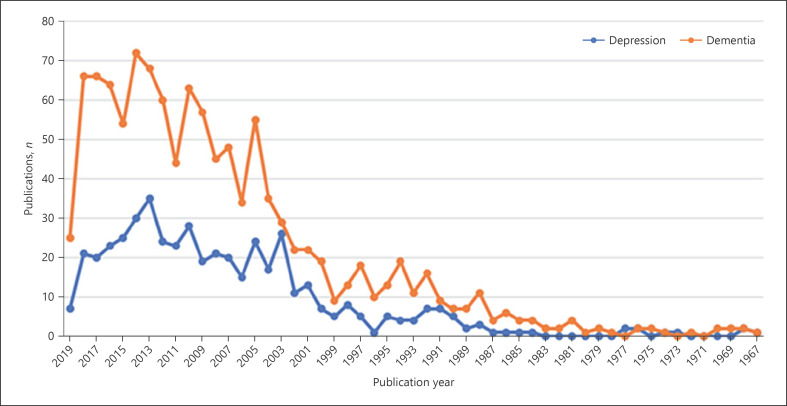
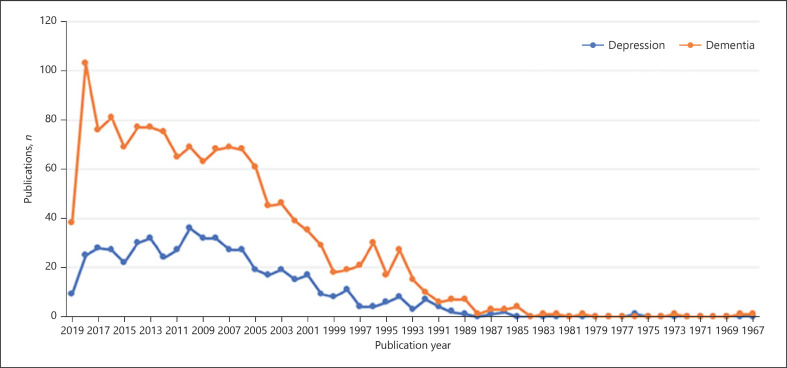
We had 38,777 and 40,277 hits for depression and dementia, respectively, in long-term care facilities or nursing homes. The search equation found 536 and 1,447 studies exploring depression and dementia, respectively, and their related health complications in long-term care facilities or nursing homes.
Depression's relationships with other health complications have been poorly studied in long-term care facilities and nursing homes. More research is needed to understand them better.
随着地球人口迅速老龄化,如何最好地照料患有精神疾病的老年人这一问题正日益成为人们持续且不断增加的关注焦点。抑郁症是老年人中最常见的精神疾病之一,而抑郁的养老院居民生活质量下降的风险尤其高。在养老院为抑郁的老年人提供支持和护理的复杂需求,要求开发并实施创新的临床和组织模式,以确保早期识别该疾病并提供高质量的多学科服务来应对它。这篇观点文章旨在概述关于老年人抑郁症流行病学和临床治疗的文献、当前水平以及研究的迫切需求。
我们与一名医学图书馆员合作,对Medline Ovid SP数据库中从建库至2020年9月30日发表的文章进行了文献和文献计量学综述,以识别与长期护理机构和养老院中的抑郁症、抑郁症状、情绪障碍、痴呆、认知障碍及健康并发症相关的研究。
在长期护理机构或养老院中,我们分别检索到38,777条和40,277条与抑郁症和痴呆症相关的记录。搜索式分别找到536项和1,447项探索长期护理机构或养老院中抑郁症和痴呆症及其相关健康并发症的研究。
在长期护理机构和养老院中,抑郁症与其他健康并发症之间的关系研究较少。需要更多研究来更好地理解它们。