Rando Halie M, Bennett Tellen D, Byrd James Brian, Bramante Carolyn, Callahan Tiffany J, Chute Christopher G, Davis Hannah E, Deer Rachel, Gagnier Joel, Koraishy Farrukh M, Liu Feifan, McMurry Julie A, Moffitt Richard A, Pfaff Emily R, Reese Justin T, Relevo Rose, Robinson Peter N, Saltz Joel H, Solomonides Anthony, Sule Anupam, Topaloglu Umit, Haendel Melissa A
Center for Health AI, University of Colorado Anschutz Medical Campus, Aurora, CO, USA.
Department of Biochemistry and Molecular Genetics, University of Colorado School of Medicine, Aurora, CO, USA.
medRxiv. 2021 Mar 26:2021.03.20.21253896. doi: 10.1101/2021.03.20.21253896.
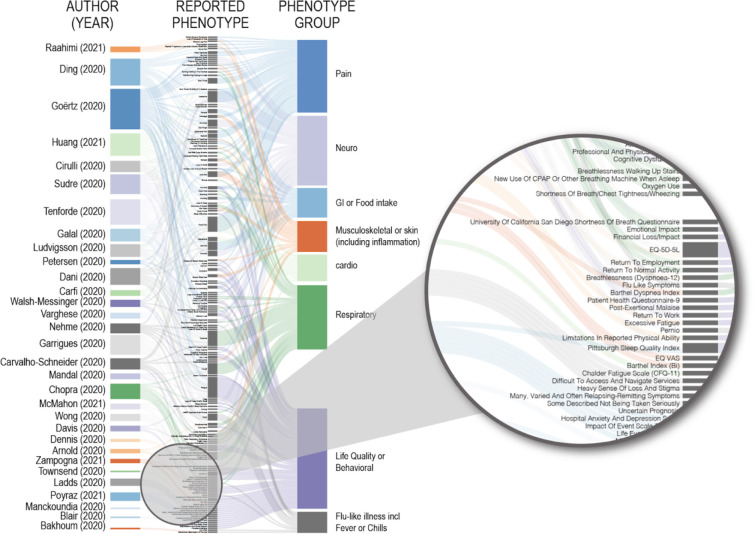
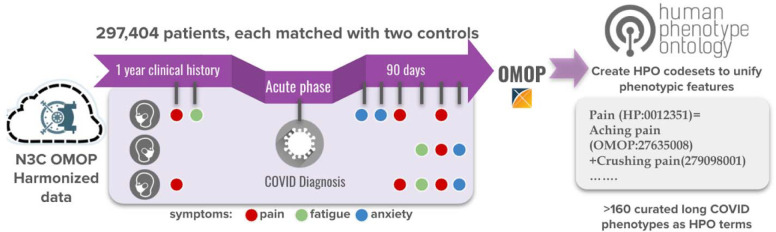
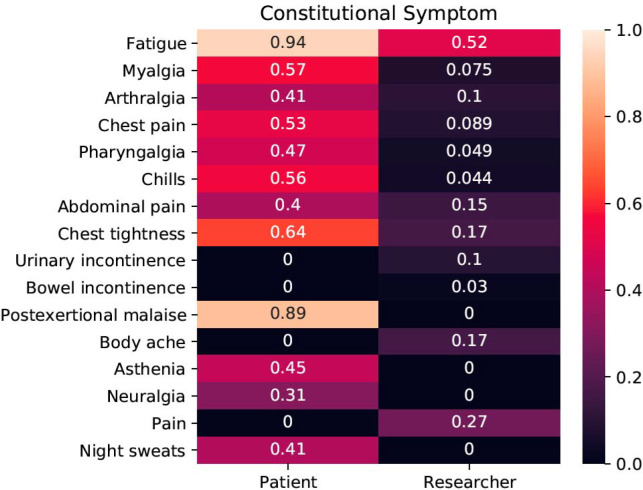
Since late 2019, the novel coronavirus SARS-CoV-2 has introduced a wide array of health challenges globally. In addition to a complex acute presentation that can affect multiple organ systems, increasing evidence points to long-term sequelae being common and impactful. The worldwide scientific community is forging ahead to characterize a wide range of outcomes associated with SARS-CoV-2 infection; however the underlying assumptions in these studies have varied so widely that the resulting data are difficult to compareFormal definitions are needed in order to design robust and consistent studies of Long COVID that consistently capture variation in long-term outcomes. Even the condition itself goes by three terms, most widely "Long COVID", but also "COVID-19 syndrome (PACS)" or, "post-acute sequelae of SARS-CoV-2 infection (PASC)". In the present study, we investigate the definitions used in the literature published to date and compare them against data available from electronic health records and patient-reported information collected via surveys. Long COVID holds the potential to produce a second public health crisis on the heels of the pandemic itself. Proactive efforts to identify the characteristics of this heterogeneous condition are imperative for a rigorous scientific effort to investigate and mitigate this threat.
自2019年末以来,新型冠状病毒SARS-CoV-2在全球引发了一系列广泛的健康挑战。除了可能影响多个器官系统的复杂急性症状外,越来越多的证据表明长期后遗症很常见且影响重大。全球科学界正在努力描述与SARS-CoV-2感染相关的广泛结果;然而,这些研究中的潜在假设差异很大,因此所得数据难以比较。为了设计强大且一致的长期新冠研究,持续捕捉长期结果的变化,需要正式的定义。甚至这种病症本身就有三个名称,最常用的是“长期新冠”,但也有“新冠后综合征(PACS)”或“SARS-CoV-2感染的急性后遗症(PASC)”。在本研究中,我们调查了迄今为止发表的文献中使用的定义,并将其与电子健康记录中的可用数据以及通过调查收集的患者报告信息进行比较。长期新冠有可能在大流行本身之后引发第二次公共卫生危机。积极努力确定这种异质性病症的特征,对于开展严谨的科学研究以调查和减轻这一威胁至关重要。