McMaster University, Hamilton, Ontario, Canada.
Western University, London, Ontario, Canada.
PLoS One. 2021 Apr 1;16(4):e0239244. doi: 10.1371/journal.pone.0239244. eCollection 2021.
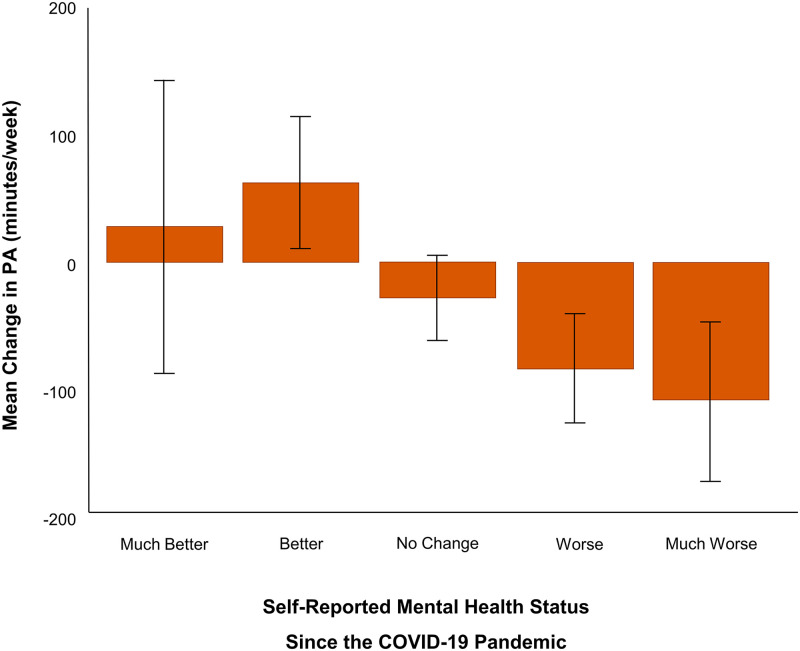
The COVID-19 pandemic has impacted the mental health, physical activity, and sedentary behavior of people worldwide. According to the Health Belief Model (HBM), health-related behavior is determined by perceived barriers and motivators. Using an online survey with 1669 respondents, we sought to understand why and how physical activity and sedentary behavior has changed by querying about perceived barriers and motivators to physical activity that changed because of the pandemic, and how those changes impacted mental health. The following results were statistically significant at p < .05. Consistent with prior reports, our respondents were less physically active (aerobic activity, -11%; strength-based activity, -30%) and more sedentary (+11%) during the pandemic as compared to 6-months before. The pandemic also increased psychological stress (+22%) and brought on moderate symptoms of anxiety and depression. Respondents' whose mental health deteriorated the most were also the ones who were least active (depression r = -.21, anxiety r = -.12). The majority of respondents were unmotivated to exercise because they were too anxious (+8%,), lacked social support (+6%), or had limited access to equipment (+23%) or space (+41%). The respondents who were able to stay active reported feeling less motivated by physical health outcomes such as weight loss (-7%) or strength (-14%) and instead more motivated by mental health outcomes such as anxiety relief (+14%). Coupled with previous work demonstrating a direct relationship between mental health and physical activity, these results highlight the potential protective effect of physical activity on mental health and point to the need for psychological support to overcome perceived barriers so that people can continue to be physically active during stressful times like the pandemic.
新冠疫情对全球范围内人们的心理健康、身体活动和久坐行为产生了影响。根据健康信念模型(HBM),健康相关行为取决于感知到的障碍和动机。我们通过一项针对 1669 名受访者的在线调查,旨在了解人们的身体活动和久坐行为发生变化的原因和方式,这些变化是由疫情引起的,以及这些变化如何影响心理健康。以下结果在 p<0.05 时具有统计学意义。与之前的报告一致,与疫情前 6 个月相比,我们的受访者在疫情期间的身体活动量减少(有氧运动减少 11%,力量训练减少 30%),久坐时间增加(增加 11%)。疫情还增加了心理压力(增加 22%),并导致中度焦虑和抑郁症状。心理健康恶化最严重的受访者也是最不活跃的受访者(抑郁 r = -.21,焦虑 r = -.12)。大多数受访者因为焦虑(增加 8%)、缺乏社会支持(增加 6%)、或设备受限(增加 23%)或空间受限(增加 41%)而缺乏锻炼的动力。能够保持活跃的受访者报告说,他们对身体健康结果(如减肥(减少 7%)或力量(减少 14%))的动力降低,而对心理健康结果(如缓解焦虑(增加 14%))的动力增加。结合之前的研究表明心理健康和身体活动之间存在直接关系,这些结果强调了身体活动对心理健康的潜在保护作用,并指出需要提供心理支持以克服感知障碍,以便人们在像疫情这样的压力时期继续保持身体活跃。