Unit of Epidemiology and Medical Statistics, Dept of Diagnostics and Public Health, University of Verona, Verona, Italy
Equal contribution as first authors.
Eur Respir J. 2021 Oct 21;58(4). doi: 10.1183/13993003.02791-2020. Print 2021 Oct.
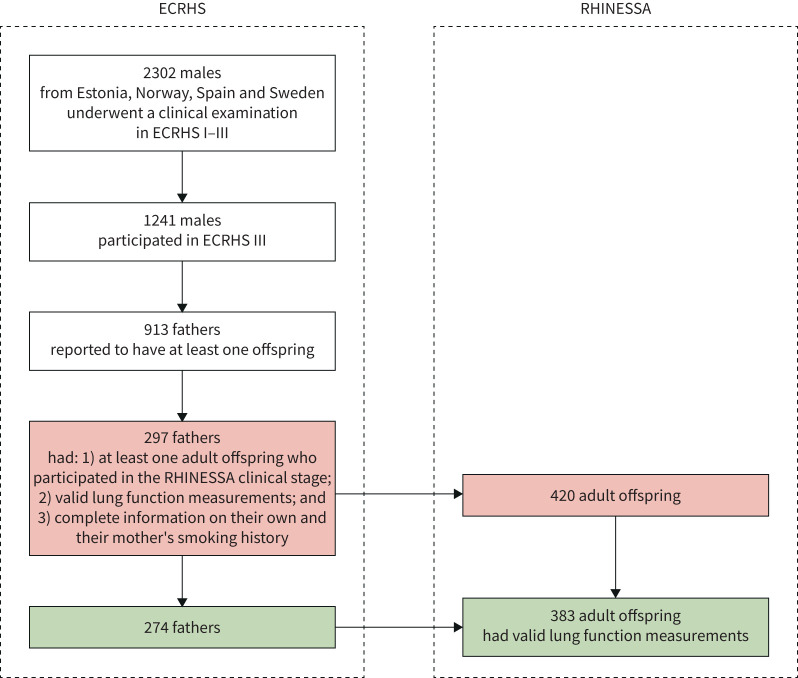
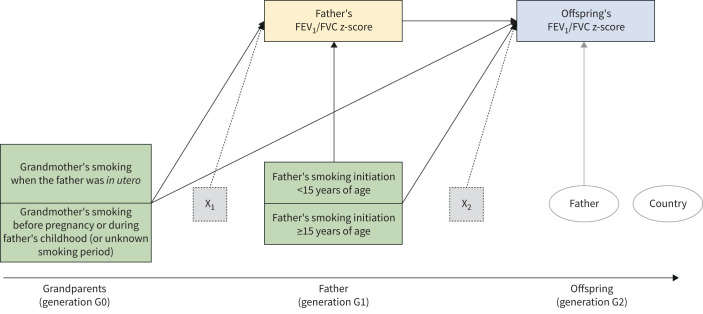
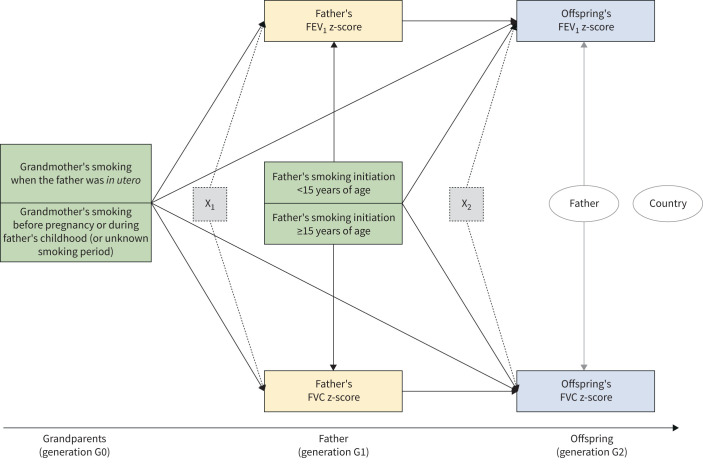
Mechanistic research suggests that lifestyle and environmental factors impact respiratory health across generations by epigenetic changes transmitted through male germ cells. Evidence from studies on humans is very limited.We investigated multigeneration causal associations to estimate the causal effects of tobacco smoking on lung function within the paternal line. We analysed data from 383 adult offspring (age 18-47 years; 52.0% female) and their 274 fathers, who had participated in the European Community Respiratory Health Survey (ECRHS)/Respiratory Health in Northern Europe, Spain and Australia (RHINESSA) generation study and had provided valid measures of pre-bronchodilator lung function. Two counterfactual-based, multilevel mediation models were developed with: paternal grandmothers' smoking in pregnancy and fathers' smoking initiation in prepuberty as exposures; fathers' forced expiratory volume in 1 s (FEV) and forced vital capacity (FVC), or FEV/FVC z-scores as potential mediators (proxies of unobserved biological mechanisms that are true mediators); and offspring's FEV and FVC, or FEV/FVC z-scores as outcomes. All effects were summarised as differences (Δ) in expected z-scores related to fathers' and grandmothers' smoking history.Fathers' smoking initiation in prepuberty had a negative direct effect on both offspring's FEV (Δz-score -0.36, 95% CI -0.63- -0.10) and FVC (-0.50, 95% CI -0.80- -0.20) compared with fathers' never smoking. Paternal grandmothers' smoking in pregnancy had a negative direct effect on fathers' FEV/FVC (-0.57, 95% CI -1.09- -0.05) and a negative indirect effect on offspring's FEV/FVC (-0.12, 95% CI -0.21- -0.03) compared with grandmothers' not smoking before fathers' birth nor during fathers' childhood.Fathers' smoking in prepuberty and paternal grandmothers' smoking in pregnancy may cause lower lung function in offspring. Our results support the concept that lifestyle-related exposures during these susceptibility periods influence the health of future generations.
机制研究表明,生活方式和环境因素通过雄性生殖细胞传递的表观遗传变化,影响跨代的呼吸道健康。人类研究的证据非常有限。我们调查了多代因果关系,以估计父系中吸烟对肺功能的因果影响。我们分析了来自欧洲社区呼吸健康调查(ECRHS)/北欧、西班牙和澳大利亚呼吸健康(RHINESSA)世代研究中 383 名成年后代(年龄 18-47 岁;52.0%为女性)及其 274 名父亲的数据,这些人提供了有效的预支气管扩张剂肺功能测量值。使用:祖母在怀孕期间吸烟和父亲在青春期前开始吸烟作为暴露因素;父亲的 1 秒用力呼气量(FEV)和用力肺活量(FVC)或 FEV/FVC z 分数作为潜在的中介(未观察到的生物机制的代表,这些机制是真正的中介);以及后代的 FEV 和 FVC,或 FEV/FVC z 分数作为结果。所有效应均总结为与父亲和祖母吸烟史相关的预期 z 分数差异(Δ)。与父亲从不吸烟相比,父亲在青春期前开始吸烟对后代的 FEV(Δz 分数-0.36,95%CI-0.63-0.10)和 FVC(-0.50,95%CI-0.80-0.20)均有负直接影响。与祖母在父亲出生前或在父亲童年时不吸烟相比,祖母在怀孕期间吸烟对父亲的 FEV/FVC(-0.57,95%CI-1.09-0.05)有负直接影响,对后代的 FEV/FVC(-0.12,95%CI-0.21-0.03)有负间接影响。父亲在青春期前吸烟和父亲的祖母在怀孕期间吸烟可能导致后代的肺功能降低。我们的结果支持这样一种概念,即在这些易感期与生活方式相关的暴露会影响后代的健康。