Centro Tecnológico de la Carne de Galicia, rúa Galicia n° 4, Parque Tecnológico de Galicia, 32900 San Cibrao das Viñas, Ourense, Spain.
Department of Preventive Medicine and Public Health, Food Science, Toxicology and Forensic Medicine, Faculty of Pharmacy, Universitat de València, Avda. Vicent Andrés Estellés, 46100 Burjassot, València, Spain.
Molecules. 2021 Mar 11;26(6):1547. doi: 10.3390/molecules26061547.
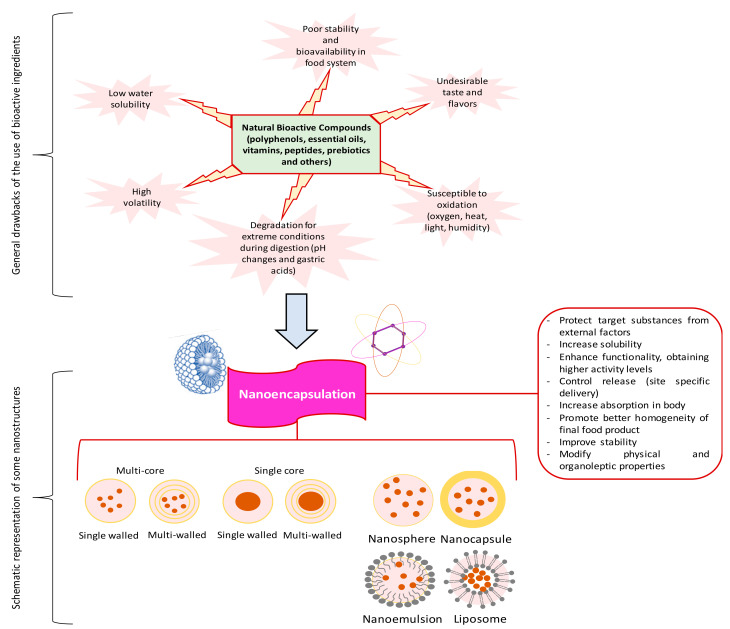
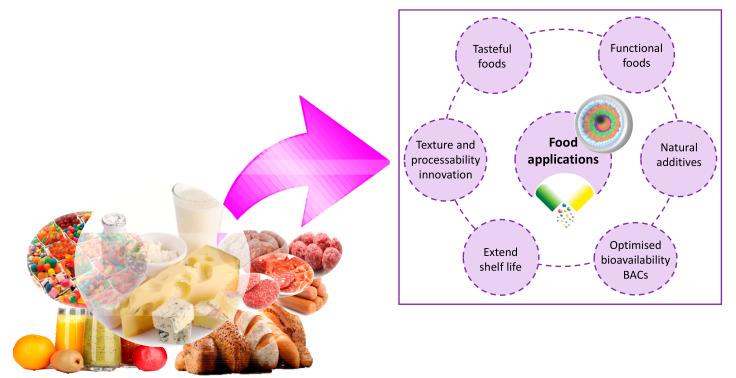
The design of functional foods has grown recently as an answer to rising consumers' concerns and demands for natural, nutritional and healthy food products. Nanoencapsulation is a technique based on enclosing a bioactive compound (BAC) in liquid, solid or gaseous states within a matrix or inert material for preserving the coated substance (food or flavor molecules/ingredients). Nanoencapsulation can improve stability of BACs, improving the regulation of their release at physiologically active sites. Regarding materials for food and nutraceutical applications, the most used are carbohydrate-, protein- or lipid-based alternatives such as chitosan, peptide-chitosan and β-lactoglobulin nanoparticles (NPs) or emulsion biopolymer complexes. On the other hand, the main BACs used in foods for health promoting, including antioxidants, antimicrobials, vitamins, probiotics and prebiotics and others (minerals, enzymes and flavoring compounds). Nanotechnology can also play notable role in the development of programmable food, an original futuristic concept promising the consumers to obtain high quality food of desired nutritive and sensory characteristics.
功能性食品的设计最近有所发展,以满足消费者对天然、营养和健康食品日益增长的关注和需求。纳米封装技术是一种将生物活性化合物(BAC)封装在基质或惰性材料内的液体、固体或气体状态的技术,用于保护被包裹物质(食品或风味分子/成分)。纳米封装可以提高 BAC 的稳定性,改善其在生理活性部位的释放调节。关于食品和营养应用的材料,最常用的是基于碳水化合物、蛋白质或脂质的替代品,如壳聚糖、肽壳聚糖和β-乳球蛋白纳米颗粒(NPs)或乳液生物聚合物复合物。另一方面,用于促进健康的食品中主要使用的 BAC 包括抗氧化剂、抗菌剂、维生素、益生菌和益生元等(矿物质、酶和调味化合物)。纳米技术在可编程食品的开发中也可以发挥重要作用,这是一个原始的未来主义概念,承诺为消费者提供具有所需营养和感官特性的高质量食品。