Istituto Nazionale di Geofisica e Vulcanologia, Via di Vigna Murata 605, 00143 Rome, Italy.
Istituto per le Applicazioni del Calcolo Mauro Picone, Consiglio Nazionale delle Ricerche, Via dei Taurini 19, 00185 Rome, Italy.
Viruses. 2021 Mar 11;13(3):463. doi: 10.3390/v13030463.
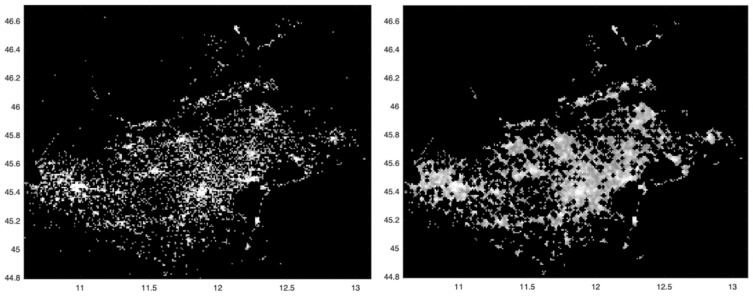
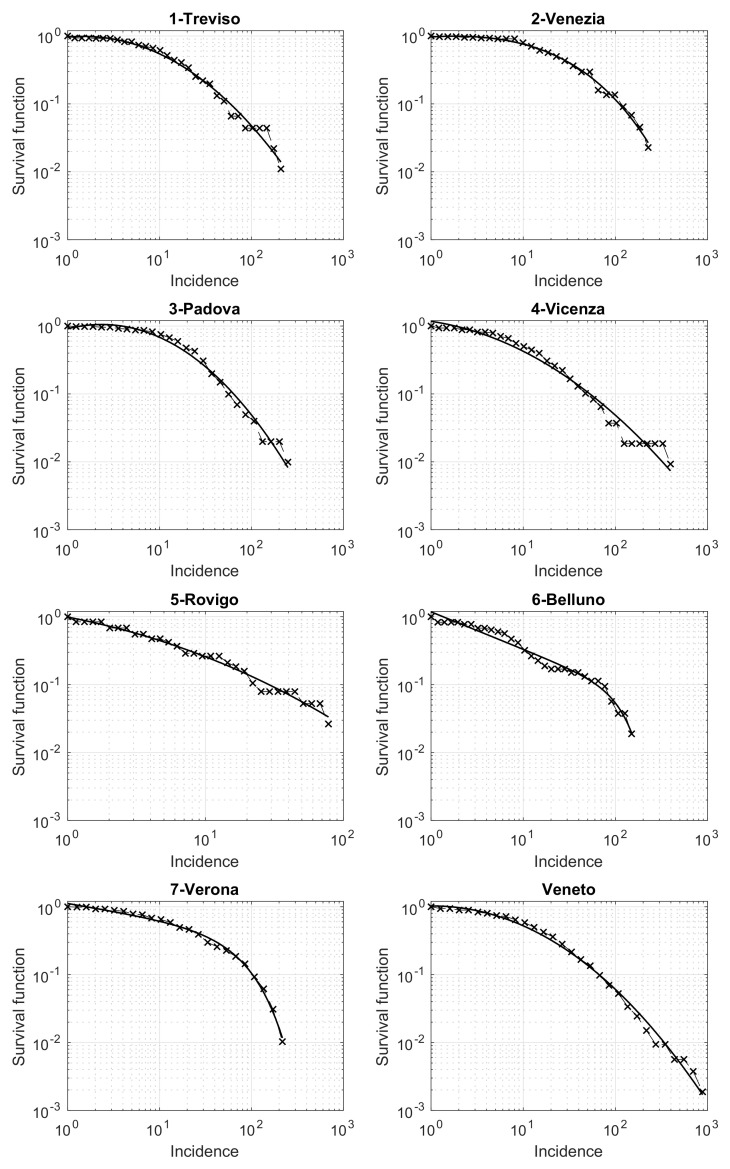
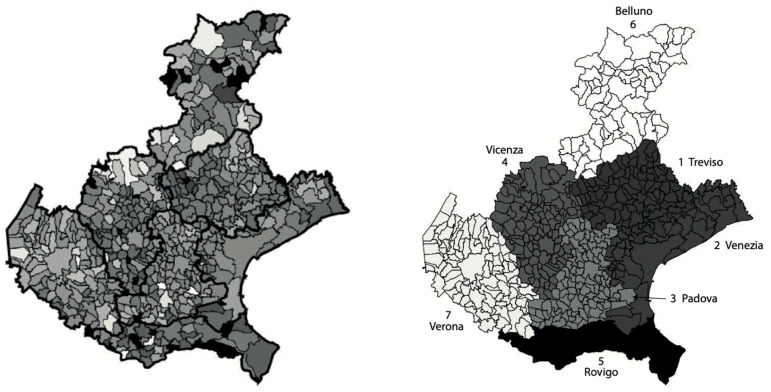
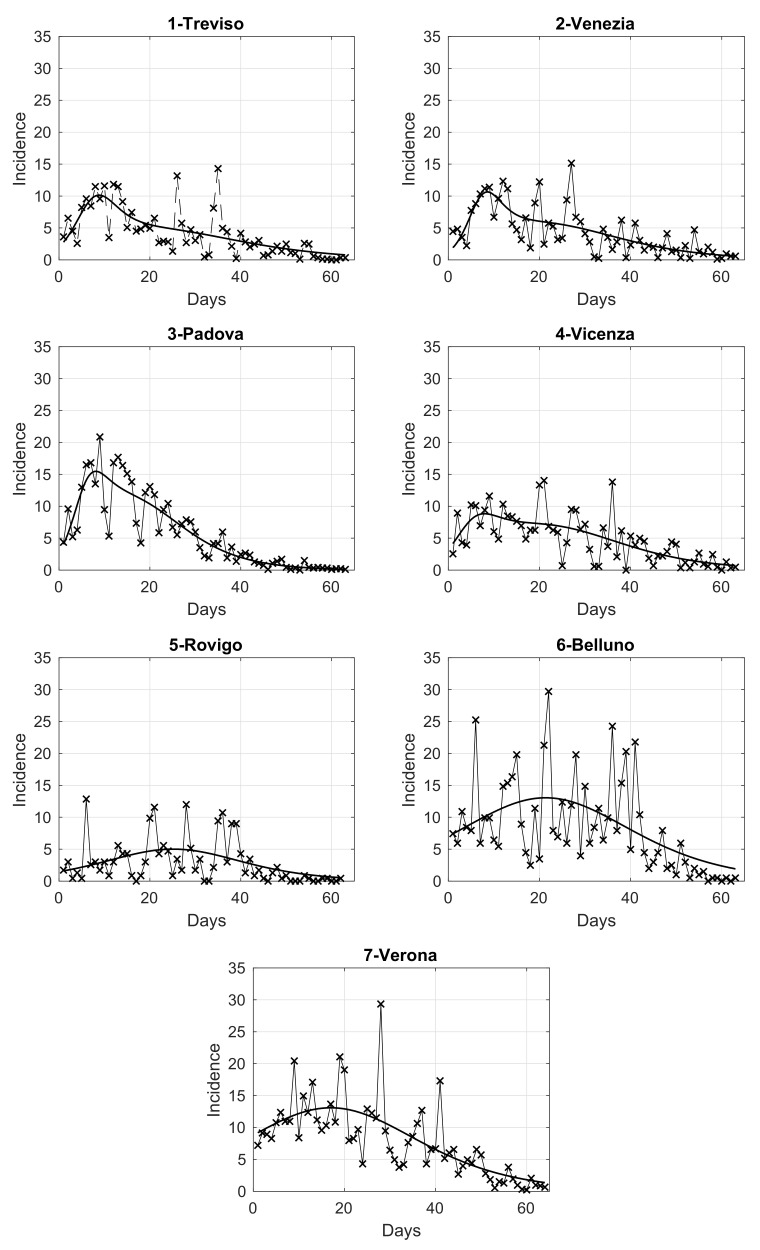
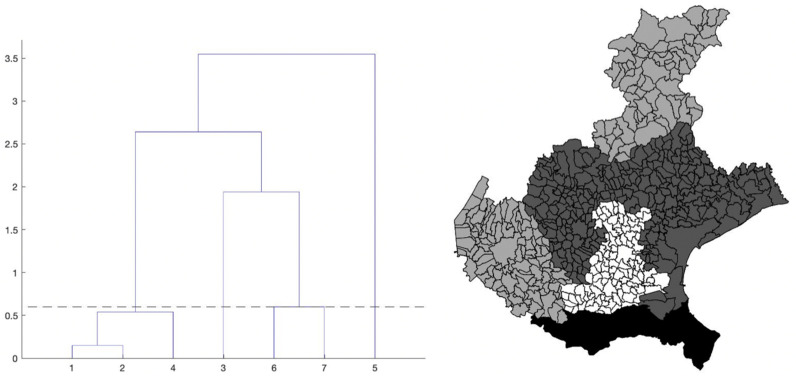
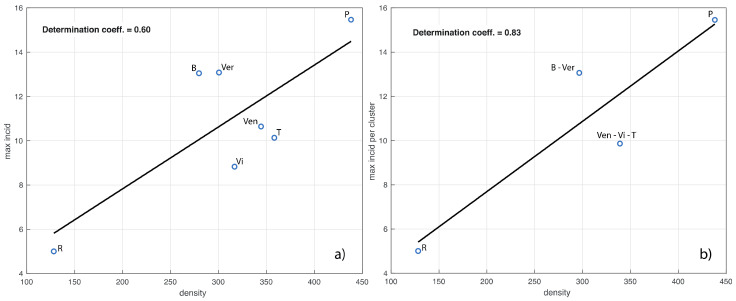
(1) Background: A better understanding of COVID-19 dynamics in terms of interactions among individuals would be of paramount importance to increase the effectiveness of containment measures. Despite this, the research lacks spatiotemporal statistical and mathematical analysis based on large datasets. We describe a novel methodology to extract useful spatiotemporal information from COVID-19 pandemic data. (2) Methods: We perform specific analyses based on mathematical and statistical tools, like mathematical morphology, hierarchical clustering, parametric data modeling and non-parametric statistics. These analyses are here applied to the large dataset consisting of about 19,000 COVID-19 patients in the Veneto region (Italy) during the entire Italian national lockdown. (3) Results: We estimate the COVID-19 cumulative incidence spatial distribution, significantly reducing image noise. We identify four clusters of connected provinces based on the temporal evolution of the incidence. Surprisingly, while one cluster consists of three neighboring provinces, another one contains two provinces more than 210 km apart by highway. The survival function of the local spatial incidence values is modeled here by a tapered Pareto model, also used in other applied fields like seismology and economy in connection to networks. Model's parameters could be relevant to describe quantitatively the epidemic. (4) Conclusion: The proposed methodology can be applied to a general situation, potentially helping to adopt strategic decisions such as the restriction of mobility and gatherings.
(1) 背景:更好地理解 COVID-19 在个体之间的相互作用的动态,对于提高控制措施的有效性至关重要。尽管如此,这项研究仍缺乏基于大型数据集的时空统计和数学分析。我们描述了一种从 COVID-19 大流行数据中提取有用时空信息的新方法。(2) 方法:我们使用数学和统计工具,如数学形态学、层次聚类、参数数据建模和非参数统计,进行特定的分析。这些分析应用于包含约 19000 名 COVID-19 患者的大型数据集,这些患者在意大利全国封锁期间分布在威尼托地区(意大利)。(3) 结果:我们估计了 COVID-19 的累积发病率的空间分布,显著降低了图像噪声。我们根据发病率的时间演变确定了四个连接的省份集群。令人惊讶的是,虽然一个集群由三个相邻的省份组成,但另一个集群却包含了两个相隔 210 公里以上的高速公路省份。本地空间发病率值的生存函数由锥形帕累托模型建模,该模型也用于其他应用领域,如地震学和与网络相关的经济学。模型的参数可以用来定量描述疫情。(4) 结论:所提出的方法可以应用于一般情况,可能有助于做出战略决策,如限制流动性和集会。