Nawrotek Katarzyna, Grams Jacek
Department of Environmental Engineering, Faculty of Process and Environmental Engineering, Lodz University of Technology, Wolczanska 213 Street, 90-924 Lodz, Poland.
Institute of General and Ecological Chemistry, Faculty of Chemistry, Lodz University of Technology, Zeromskiego 116, 90-924 Lodz, Poland.
Materials (Basel). 2021 Mar 8;14(5):1288. doi: 10.3390/ma14051288.
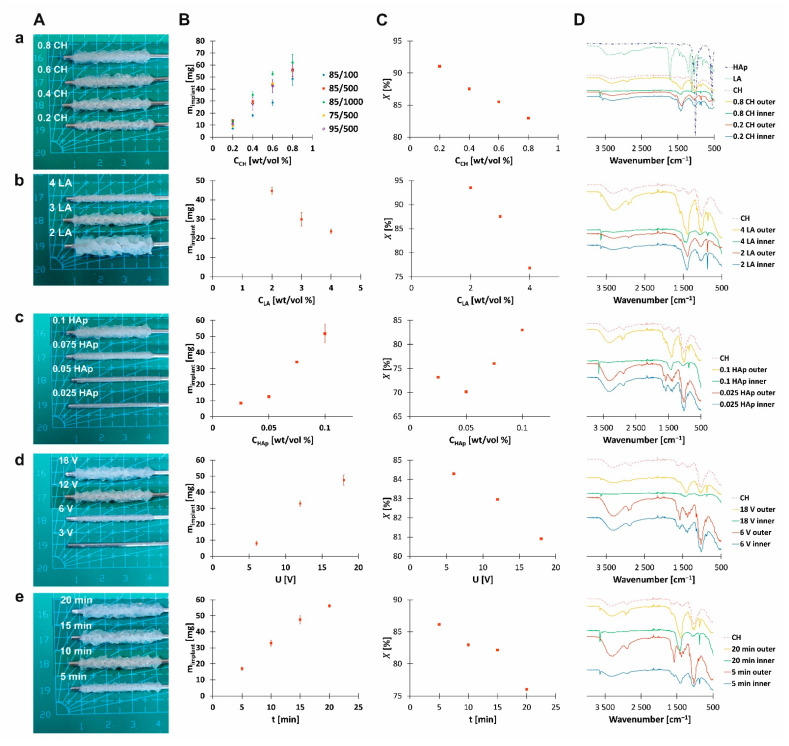
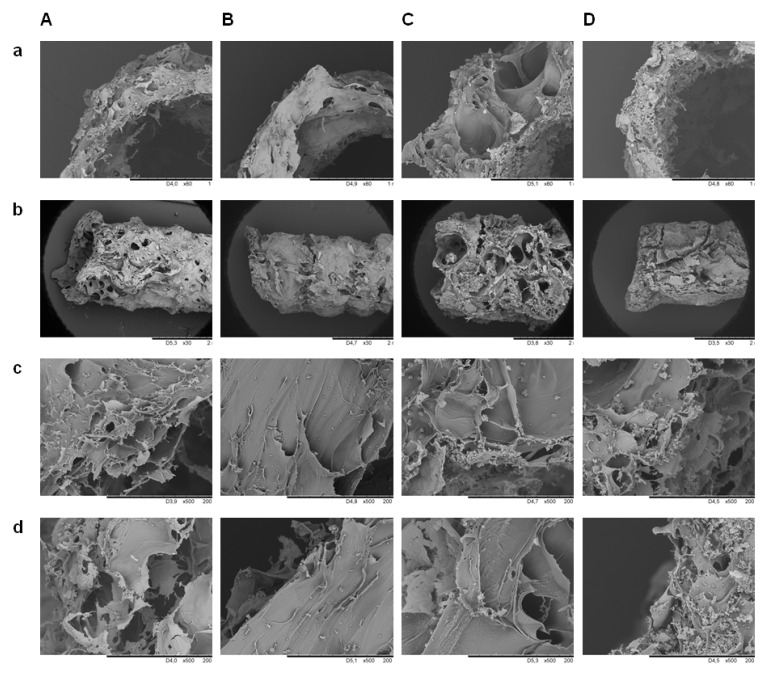
Tubular-shaped hydrogel structures were obtained in the process of cathodic electrodeposition from a chitosan-hydroxyapatite solution carried out in a cylindrical geometry. The impact of the initial concentration of solution components (i.e., chitosan, hydroxyapatite, and lactic acid) and process parameters (i.e., time and voltage) on the mass and structural properties of deposit was examined. Commercially available chitosan differs in average molecular weight and deacetylation degree; therefore, these parameters were also studied. The application of Fourier-transform infrared spectroscopy, scanning electron microscopy, and time-of-flight secondary ion mass spectrometry allowed obtaining fundamental information about the type of bonds and interactions created in electrodeposited structures. Biocompatible tubular implants are highly desired in the field of regeneration or replacement of tubular-shaped tissues and organs; therefore, the possibility of obtaining deposits with the desired structural properties is highly anticipated.
通过在圆柱形装置中进行的壳聚糖 - 羟基磷灰石溶液的阴极电沉积过程,获得了管状水凝胶结构。研究了溶液成分(即壳聚糖、羟基磷灰石和乳酸)的初始浓度以及工艺参数(即时间和电压)对沉积物质量和结构性质的影响。市售壳聚糖的平均分子量和脱乙酰度不同;因此,也对这些参数进行了研究。傅里叶变换红外光谱、扫描电子显微镜和飞行时间二次离子质谱的应用使得能够获得有关电沉积结构中形成的键和相互作用类型的基本信息。在管状组织和器官的再生或替换领域,非常需要生物相容性管状植入物;因此,人们高度期待获得具有所需结构性质的沉积物的可能性。