Department of Informatics and Telecommunications, University of Ioannina, GR47100 Arta, Greece.
Q Base R&D, Science & Technology Park of Epirus, University of Ioannina Campus, GR45110 Ioannina, Greece.
Sensors (Basel). 2021 Mar 27;21(7):2339. doi: 10.3390/s21072339.
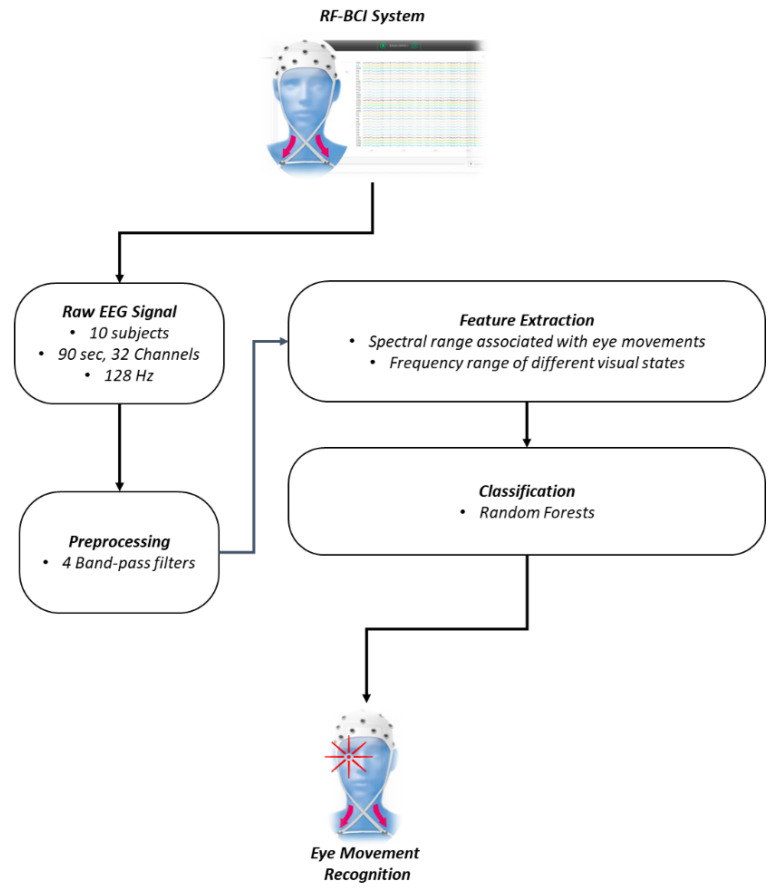
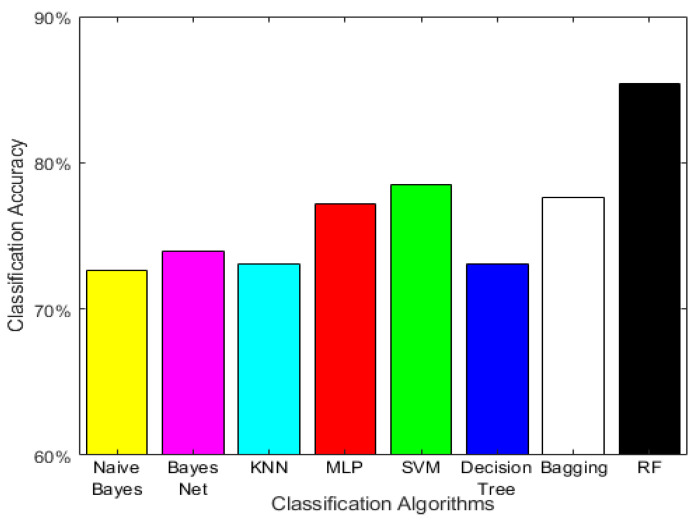
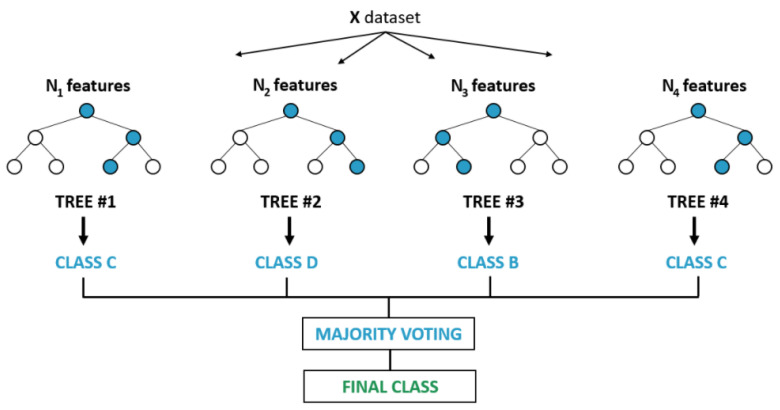
Discrimination of eye movements and visual states is a flourishing field of research and there is an urgent need for non-manual EEG-based wheelchair control and navigation systems. This paper presents a novel system that utilizes a brain-computer interface (BCI) to capture electroencephalographic (EEG) signals from human subjects while eye movement and subsequently classify them into six categories by applying a random forests (RF) classification algorithm. RF is an ensemble learning method that constructs a series of decision trees where each tree gives a class prediction, and the class with the highest number of class predictions becomes the model's prediction. The categories of the proposed random forests brain-computer interface (RF-BCI) are defined according to the position of the subject's eyes: open, closed, left, right, up, and down. The purpose of RF-BCI is to be utilized as an EEG-based control system for driving an electromechanical wheelchair (rehabilitation device). The proposed approach has been tested using a dataset containing 219 records taken from 10 different patients. The BCI implemented the EPOC Flex head cap system, which includes 32 saline felt sensors for capturing the subjects' EEG signals. Each sensor caught four different brain waves (delta, theta, alpha, and beta) per second. Then, these signals were split in 4-second windows resulting in 512 samples per record and the band energy was extracted for each EEG rhythm. The proposed system was compared with naïve Bayes, Bayes Network, k-nearest neighbors (K-NN), multilayer perceptron (MLP), support vector machine (SVM), J48-C4.5 decision tree, and Bagging classification algorithms. The experimental results showed that the RF algorithm outperformed compared to the other approaches and high levels of accuracy (85.39%) for a 6-class classification are obtained. This method exploits high spatial information acquired from the Emotiv EPOC Flex wearable EEG recording device and examines successfully the potential of this device to be used for BCI wheelchair technology.
眼球运动和视觉状态的判别是研究的热门领域,因此迫切需要基于非手动 EEG 的轮椅控制和导航系统。本文提出了一种新的系统,该系统利用脑机接口 (BCI) 从人类受试者采集脑电图 (EEG) 信号,然后通过应用随机森林 (RF) 分类算法将其分类为六个类别。RF 是一种集成学习方法,它构建了一系列决策树,每棵树给出一个类别预测,具有最高类别预测数的类别成为模型的预测。所提出的随机森林脑机接口 (RF-BCI) 的类别是根据受试者眼睛的位置定义的:开、闭、左、右、上和下。RF-BCI 的目的是用作基于 EEG 的控制系统,以驱动机电轮椅 (康复设备)。该方法已使用包含 10 位不同患者的 219 条记录的数据集进行了测试。BCI 实现了 EPOC Flex 头戴帽系统,该系统包括 32 个盐水毛毡传感器,用于捕获受试者的 EEG 信号。每个传感器每秒捕获四个不同的脑波(德尔塔、θ、α 和β)。然后,这些信号被分为 4 秒的窗口,每个记录产生 512 个样本,并且每个 EEG 节律提取带宽能量。所提出的系统与朴素贝叶斯、贝叶斯网络、k-最近邻 (K-NN)、多层感知机 (MLP)、支持向量机 (SVM)、J48-C4.5 决策树和 Bagging 分类算法进行了比较。实验结果表明,RF 算法的性能优于其他方法,并且可以获得 85.39%的 6 类分类准确率。该方法利用从 Emotiv EPOC Flex 可穿戴 EEG 记录设备获取的高空间信息,并成功检验了该设备用于 BCI 轮椅技术的潜力。