PhD Program in Public and Community Health, Institute for Health and Equity, Medical College of Wisconsin, 8701 Watertown Plank Rd., Milwaukee, WI 53226, USA.
Department of Emergency Medicine, Medical College of Wisconsin, 8701 Watertown Plank Rd., Milwaukee, WI 53226, USA.
Int J Environ Res Public Health. 2021 Mar 3;18(5):2481. doi: 10.3390/ijerph18052481.
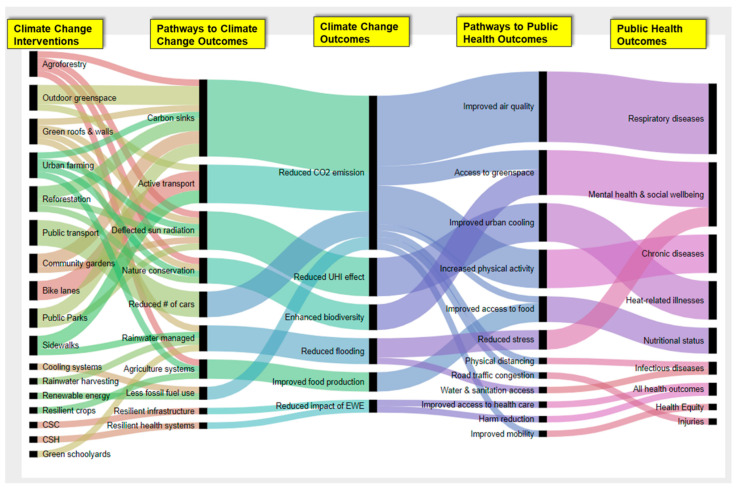
Anthropogenic climate change is adversely impacting people and contributing to suffering and increased costs from climate-related diseases and injuries. In responding to this urgent and growing public health crisis, mitigation strategies are in place to reduce future greenhouse gas emissions (GHGE) while adaptation strategies exist to reduce and/or alleviate the adverse effects of climate change by increasing systems' resilience to future impacts. While these strategies have numerous positive benefits on climate change itself, they also often have other positive externalities or health co-benefits. This knowledge can be harnessed to promote and improve global public health, particularly for the most vulnerable populations. Previous conceptual models in mitigation and adaptation studies such as the shared socioeconomic pathways (SSPs) considered health in the thinking, but health outcomes were not their primary intention. Additionally, existing guidance documents such as the World Health Organization (WHO) Guidance for Climate Resilient and Environmentally Sustainable Health Care Facilities is designed primarily for public health professionals or healthcare managers in hospital settings with a primary focus on resilience. However, a detailed cross sectoral and multidisciplinary conceptual framework, which links mitigation and adaptation strategies with health outcomes as a primary end point, has not yet been developed to guide research in this area. In this paper, we briefly summarize the burden of climate change on global public health, describe important mitigation and adaptation strategies, and present key health benefits by giving context specific examples from high, middle, and low-income settings. We then provide a conceptual framework to inform future global public health research and preparedness across sectors and disciplines and outline key stakeholders recommendations in promoting climate resilient systems and advancing health equity.
人为气候变化正在对人类造成负面影响,并导致与气候相关的疾病和伤害造成更多的痛苦和成本增加。在应对这一紧迫和日益严重的公共卫生危机时,已经采取了缓解策略来减少未来的温室气体排放(GHGE),同时还存在适应策略,通过提高系统对未来影响的弹性来减少和/或减轻气候变化的不利影响。虽然这些策略对气候变化本身有许多积极的好处,但它们通常也具有其他积极的外部性或健康共同效益。可以利用这些知识来促进和改善全球公共卫生,特别是对最脆弱的人群。先前在缓解和适应研究中的概念模型,如共享社会经济途径(SSPs),在考虑中考虑了健康因素,但健康结果并不是其主要目的。此外,现有的指导文件,如世界卫生组织(WHO)关于气候适应和环境可持续性卫生保健设施的指南,主要是为医院环境中的公共卫生专业人员或卫生保健管理人员设计的,主要侧重于弹性。然而,尚未制定一个详细的跨部门和多学科的概念框架,将缓解和适应策略与健康结果作为主要终点联系起来,以指导该领域的研究。在本文中,我们简要总结了气候变化对全球公共卫生的负担,描述了重要的缓解和适应策略,并通过高、中、低收入环境中的具体示例提供了关键的健康效益。然后,我们提供了一个概念框架,以告知未来跨部门和学科的全球公共卫生研究和准备工作,并概述了促进气候适应系统和推进健康公平的主要利益相关者建议。