Kalyan Srivathsan, Torabi Corinna, Khoo Harrison, Sung Hyun Woo, Choi Sung-Eun, Wang Wenzhao, Treutler Benjamin, Kim Dohyun, Hur Soojung Claire
Department of Mechanical Engineering, Johns Hopkins University, 3400 N Charles Street, Baltimore, MD 21218, USA.
Department of Chemical and Biomolecular Engineering, Johns Hopkins University, 3400 N Charles Street, Baltimore, MD 21218, USA.
Micromachines (Basel). 2021 Mar 3;12(3):257. doi: 10.3390/mi12030257.
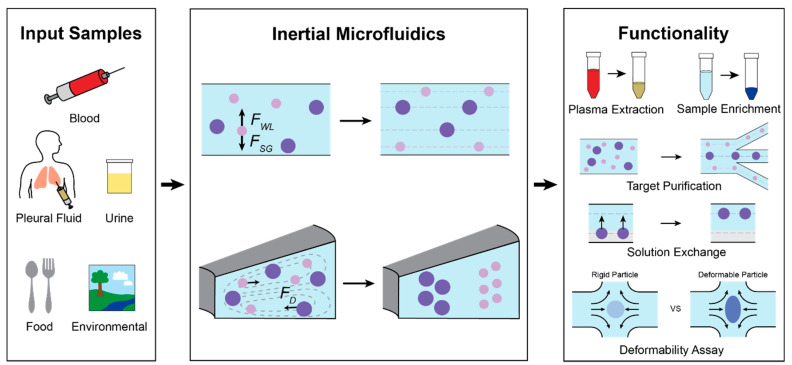
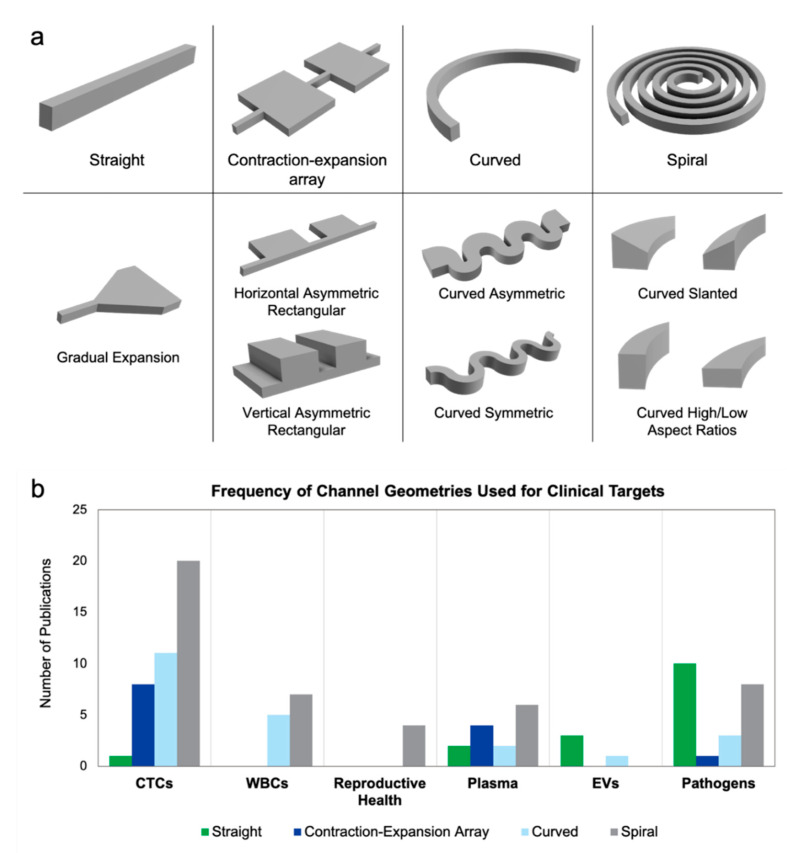
Fast and accurate interrogation of complex samples containing diseased cells or pathogens is important to make informed decisions on clinical and public health issues. Inertial microfluidics has been increasingly employed for such investigations to isolate target bioparticles from liquid samples with size and/or deformability-based manipulation. This phenomenon is especially useful for the clinic, owing to its rapid, label-free nature of target enrichment that enables further downstream assays. Inertial microfluidics leverages the principle of inertial focusing, which relies on the balance of inertial and viscous forces on particles to align them into size-dependent laminar streamlines. Several distinct microfluidic channel geometries (e.g., straight, curved, spiral, contraction-expansion array) have been optimized to achieve inertial focusing for a variety of purposes, including particle purification and enrichment, solution exchange, and particle alignment for on-chip assays. In this review, we will discuss how inertial microfluidics technology has contributed to improving accuracy of various assays to provide clinically relevant information. This comprehensive review expands upon studies examining both endogenous and exogenous targets from real-world samples, highlights notable hybrid devices with dual functions, and comments on the evolving outlook of the field.
快速准确地检测含有病变细胞或病原体的复杂样本,对于就临床和公共卫生问题做出明智决策至关重要。惯性微流控技术已越来越多地用于此类研究,通过基于尺寸和/或可变形性的操作从液体样本中分离目标生物颗粒。由于其具有快速、无标记的目标富集特性,能够进行进一步的下游分析,这种现象在临床上特别有用。惯性微流控技术利用惯性聚焦原理,该原理依靠颗粒上惯性力和粘性力的平衡,将它们排列成与尺寸相关的层流流线。为了实现各种目的的惯性聚焦,包括颗粒纯化和富集、溶液交换以及用于芯片检测的颗粒排列,几种不同的微流控通道几何形状(例如,直的、弯曲的、螺旋的、收缩-扩张阵列)已得到优化。在这篇综述中,我们将讨论惯性微流控技术如何有助于提高各种检测的准确性,以提供临床相关信息。这篇全面的综述扩展了对来自实际样本的内源性和外源性目标的研究,突出了具有双重功能的显著混合设备,并对该领域不断发展的前景进行了评论。