Department of Medical Physiology, University of Nairobi, P.O. Box 30197, 00100 Nairobi, Kenya.
Clinic and Policlinic for Psychiatry, Psychosomatics and Psychotherapy Margarete-Hoeppel-Platz 1, University Hospital Wuerzburg, 97080 Wuerzburg, Germany.
Cells. 2021 Mar 9;10(3):598. doi: 10.3390/cells10030598.
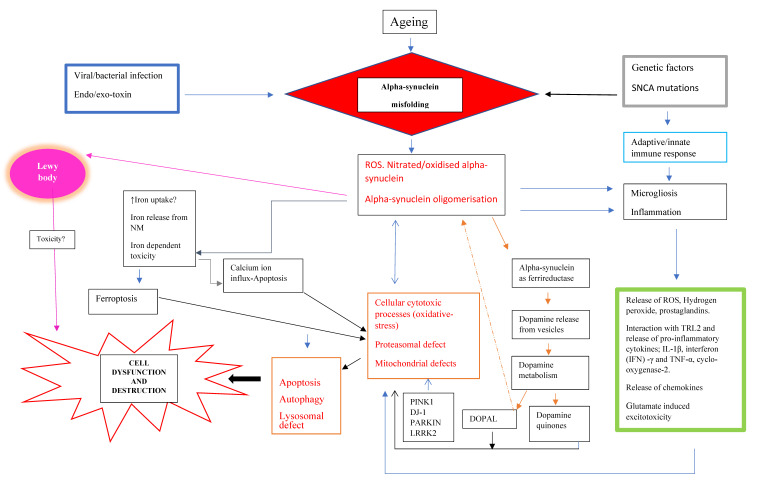
The risk of Parkinson's disease increases with age. However, the etiology of the illness remains obscure. It appears highly likely that the neurodegenerative processes involve an array of elements that influence each other. In addition, genetic, endogenous, or exogenous toxins need to be considered as viable partners to the cellular degeneration. There is compelling evidence that indicate the key involvement of modified α-synuclein (Lewy bodies) at the very core of the pathogenesis of the disease. The accumulation of misfolded α-synuclein may be a consequence of some genetic defect or/and a failure of the protein clearance system. Importantly, α-synuclein pathology appears to be a common denominator for many cellular deleterious events such as oxidative stress, mitochondrial dysfunction, dopamine synaptic dysregulation, iron dyshomeostasis, and neuroinflammation. These factors probably employ a common apoptotic/or autophagic route in the final stages to execute cell death. The misfolded α-synuclein inclusions skillfully trigger or navigate these processes and thus amplify the dopamine neuron fatalities. Although the process of neuroinflammation may represent a secondary event, nevertheless, it executes a fundamental role in neurodegeneration. Some viral infections produce parkinsonism and exhibit similar characteristic neuropathological changes such as a modest brain dopamine deficit and α-synuclein pathology. Thus, viral infections may heighten the risk of developing PD. Alternatively, α-synuclein pathology may induce a dysfunctional immune system. Thus, sporadic Parkinson's disease is caused by multifactorial trigger factors and metabolic disturbances, which need to be considered for the development of potential drugs in the disorder.
帕金森病的风险随着年龄的增长而增加。然而,这种疾病的病因仍然不清楚。很可能神经退行性过程涉及一系列相互影响的因素。此外,还需要考虑遗传、内源性或外源性毒素,它们可能是细胞退化的可行伙伴。有强有力的证据表明,经过修饰的α-突触核蛋白(路易体)在疾病发病机制的核心中起着关键作用。错误折叠的α-突触核蛋白的积累可能是由于某些遗传缺陷或/和蛋白质清除系统失效的结果。重要的是,α-突触核蛋白病理学似乎是许多细胞有害事件(如氧化应激、线粒体功能障碍、多巴胺突触失调、铁动态失衡和神经炎症)的共同因素。这些因素可能在最后阶段采用共同的凋亡/自噬途径来执行细胞死亡。错误折叠的α-突触核蛋白包含物巧妙地触发或引导这些过程,从而放大多巴胺神经元的死亡率。尽管神经炎症过程可能代表继发事件,但它在神经变性中起着基本作用。一些病毒感染会引起帕金森病,并表现出类似的特征性神经病理学变化,如大脑多巴胺轻度缺乏和α-突触核蛋白病理学。因此,病毒感染可能会增加患帕金森病的风险。或者,α-突触核蛋白病理学可能会导致免疫系统功能失调。因此,散发性帕金森病是由多种触发因素和代谢紊乱引起的,这需要在该疾病的潜在药物开发中加以考虑。