Department of Nursing and Health Promotion, Faculty of Health Science, Oslo Metropolitan University, Kunnskapsveien 55, 2007 Kjeller, Norway.
Department of Nutrition and Public Health, Faculty of Health and Sport Sciences, University of Agder, Universitetsveien 25, 4630 Kristiansand, Norway.
Biomolecules. 2021 Mar 18;11(3):454. doi: 10.3390/biom11030454.
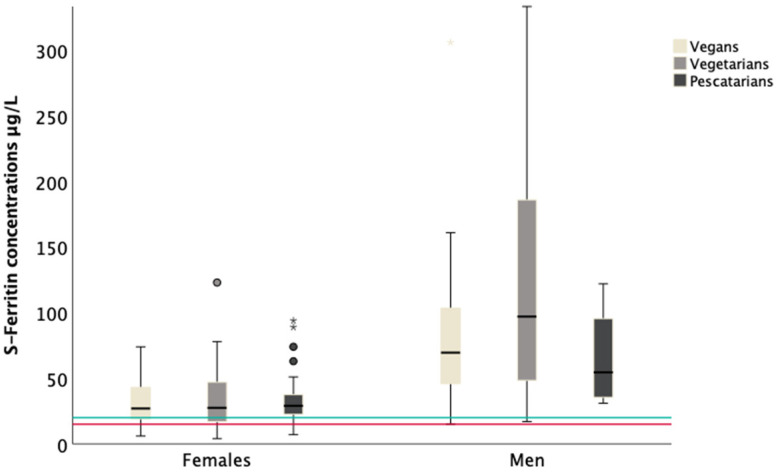
Although plant-based diets provide well-established physical and environmental health benefits, omitting meat or meat products has also been associated with a risk of being deficient in specific nutrients, such as iron. As data on the iron status among Norwegian vegans, vegetarians and pescatarians are lacking, the present study aimed to assess iron status in these groups of healthy adults. Blood markers for iron status were measured in 191 participants (18-60 years old) comprising 106 vegans, 54 vegetarians and 31 pescatarians: serum-ferritin (S-Fe), serum-iron (S-Iron) and serum-total iron binding capacity (S-TIBC). Serum-transferrin-saturation (S-TSAT) was estimated (S-Iron/S-TIBC × 100). The median concentration of blood markers for iron status were within the normal range with no difference between the different dietary practices. In total, 9% reported iron supplement use the last 24 h. S-Fe concentrations below reference (<15 μg/L) were found in 8% of the participating women, of which one participant reported iron supplement use. In multiple regression analysis, duration of adherence to dietary practices and the female gender were found to be the strongest predictors for decreased S-Fe concentration. In conclusion, although the participants were eating a plant-based diet, the majority had sufficient iron status. Female vegans and vegetarians of reproductive age are at risk of low iron status and should have their iron status monitored.
虽然植物性饮食对身体健康和环境有益,但完全不吃肉或肉类产品也可能导致某些特定营养素(如铁)缺乏。由于缺乏挪威纯素食者、素食者和食鱼素食者的铁营养状况数据,本研究旨在评估这些健康成年人的铁营养状况。本研究共纳入了 191 名参与者(18-60 岁),其中包括 106 名纯素食者、54 名素食者和 31 名食鱼素食者,检测了血液中铁营养状况的标志物:血清铁蛋白(S-Ferritin,S-Fe)、血清铁(S-Iron)和血清总铁结合力(S-Total Iron Binding Capacity,S-TIBC)。通过 S-Iron/S-TIBC×100 计算血清转铁蛋白饱和度(S-Transferrin Saturation,S-TSAT)。血液标志物浓度处于正常范围内,不同饮食模式之间无差异。共有 9%的参与者报告在过去 24 小时内服用过铁补充剂。8%的女性参与者 S-Fe 浓度低于参考值(<15μg/L),其中一名参与者报告正在服用铁补充剂。多元回归分析显示,坚持饮食实践的时间长短和女性性别是 S-Fe 浓度降低的最强预测因素。总之,尽管参与者的饮食以植物性食物为主,但大多数人的铁营养状况良好。处于生育年龄的女性纯素食者和素食者存在缺铁的风险,应该监测其铁营养状况。